Make a simple google search using the terms “Email Marketing Mistakes to Avoid” and you’ll be met with approximately 1.6 million results. Oh, so you don’t have a few years to set aside for some light reading? Good, let me sum it up for you. There are do’s and don’ts and best practices and recommendations for every intricacy of email marketing. These range from clear, distinct guidelines, to ambiguous ideas. Most are helpful, most are lengthy. So, how do you know if you’re making one of these common mistakes? You might be if….
1. Your content is irrelevant
In an age where we can make a simple search for a pair of black snow boots, and have said snowboots show up in our targeted ads on all social media platforms for a week, you better believe subscribers are expecting mail that makes sense for them. If someone lives in Anchorage, Alaska, chances are they aren’t regularly looking to buy those cute flamingo pool floats. So do you ensure that you’re sending your subscribers content that is relevant to them? Start at the beginning! Does your sign-up process include a chance for subscribers to give their geographical location and preferences about what they would like to receive? If not, this is probably a great place to start in order to make sure that your mail is relevant and targeted to your subscriber’s needs.
2. Your creative needs a refresh
So often, email marketers focus on the subject and preheader of a message that the actual creative content falls to the wayside. The reality is that people are more likely to engage with your mail if something in the body of your message catches their eye. Be sure to include a call to action! Let your users actually engage with your mail by adding in easily found links to your website, a sale, or a special offer. You CAN have fun with your email! For example, below we see Apple is sending a campaign that is relevant to the quickly approaching Valentine’s Day. In their message, they keep the user invested with bold colors, holiday specific emojis, and links to shop the featured products in a subtle, yet easily identifiable way throughout the entire message.
3. You haven’t optimized for your mobile subscribers
Studies show that 43 percent of subscribers are checking their emails on a mobile device, and that number will only grow since mobile devices aren’t going anywhere anytime soon. Make sure that your images, links, and text are rendering in a coherent, eye-catching way to ensure that your mobile users are having a positive experience with your mail. An easy way to do this is to test in our Inbox Preview tool. This tool gives you exact renderings of your mail across multiple platforms and shows you the issues you need to fix before you hit send. Another useful tool is Email Client Monitor. This tool allows you to gain insight into how long subscribers spend reading your email and geographically where they are opening it to help in targeting and segmentation. It also gives you data about which platforms, browsers, and email clients your subscribers use most often to optimize your email for the most used platforms.
4. You aren’t asking for permission
Permission-based email is vital for an email program to be successful and maintain a healthy reputation with mailbox providers and subscribers. How do you know if you’re deploying these types of emails? I’m glad you asked. First, make sure that users are fully aware of the type of mail they’ll be receiving from you at the point of sign up. Do you only send a monthly newsletter? Let them know! Be straightforward about your relationship going forward and I promise, it will be a long and fruitful one. Also, make sure you’re allowing your subscribers to opt-out of your email whenever they may decide. Meaning, don’t bury the unsubscribe button! Doing so will only increase complaints. Much like it is better to have loved and lost than never loved at all, same goes for your email program. An unsubscribe is better than a complaint any day of the week. Next, make sure you’re keeping subscriber’s contact information up to date. Give your subscribers an easy way to update any changes in their email addresses, so that you always stay in their most relevant inbox. Lastly, don’t buy or rent a list. It is difficult to obtain consent from these types of lists, not to mention some of those addresses may be spam traps, landing you on a blacklist.
5. Signing up for your emails is hard
People like convenience, no one likes to jump through hoops, especially when it comes to getting on an email list. More often than not, I see sign up processes that look more like the format a doctor’s office than a mailing list to hear about sales on my favorite sweaters. Keep your sign up process on one page, make the information you need from them an easy click, not a long form in which they need to write in a great deal of personal information.
We may be in the midst of a social media boom, but email marketing is holding strong. Not only has email continued to be one of the most cost-effective ways to reach customers, but 72 percent of consumers say that they prefer to hear from businesses via email. The channel’s longevity can be ascribed to innovation: Every year, marketers develop new ways to make email even more powerful. Wondering what 2018 has in store for your email marketing program? Here are five trends that we have our eye on:
Improved personalization and segmentation
We’ve explored the power of personalization and segmentation here before. Together the two tactics increase engagement by providing readers with messages that are relevant and timely. Now marketers are collecting more data about their audiences to improve their targeting capabilities. In a recent Econsultancy report, 80 percent of respondents said they were segmenting their contact lists into customer groups. Where personalization once meant addressing email readers by their first name, marketers now divide their contact lists based on everything from birthdays to time zones, enabling themselves to create messages that resonate with specific segments on a deeper level.
Interactivity
Fifty-three percent of marketers now integrate interactive content into the buyer’s journey. Running the gamut from embedded surveys to quizzes to GIFs, interactive content brings emails to life. It also encourages readers to engage with a brand, generating twice as many conversions as passive content. Not only is a quiz or slideshow attention-grabbing, but businesses have discovered that elements like these can be easier for subscribers to consume. In some cases (such as product releases), an image carousel or three-second GIF may convey a message more effectively than a block of text.
Creative typography
Want to make sure readers hone in on a specific offer? Decorative typefaces make the most important information in marketing emails stand out. And, when used judiciously, creative typography makes emails vibrant, adds a compelling element and can showcase a brand’s personality.
Spread of automation
The emergence of accessible automation tools is enabling small business owners to reach their audiences at the right time with the right messages. Not only is automation a time-saver — making it possible to create and schedule messages when it’s most convenient — but it also improves email performance. According to Epsilon research, automated emails boost click-through rates by 119 percent.
Making the most of transactional emails
Transactional emails can be more than just receipts. Since they deliver eight times as many opens and clicks than any other type of email, they also can provide businesses with a great opportunity to market to customers. Savvy business owners use the emails that are automatically triggered after a purchase or other customer action has taken place to present special, relevant offers to customers.
Email marketing is constantly evolving. To achieve your best results in 2018, start integrating these latest trends into your email strategy today. Source
You probably know by now that segmentation improves email marketing performance significantly, so if you’re still operating primarily in “batch and blast” mode it’s time to start slicing and dicing your subscriber file.
Marketers who practice list segmentation see better open and click-through rates, fewer unsubscribes and better deliverability. The reasons are obvious: segmentation creates discreet audiences we can laser-target with offers, creative, and information crafted specifically for them, at just the right time. This in turn improves relevancy and response, while decreasing complaints or blocking. Who among us doesn’t want to see more of this kind of email in our inbox: messages that speak to us as if we’re the center of attention, and show up at the perfect moment (or not at all?)
Too Little? Let me begin by addressing the easy part of the question: how much email list segmentation is not enough?
Zero segmentation for one – so get on with it already! I’d also suggest if you’re not segmenting by at least these key attributes, you’re leaving opportunity on the table:
Customer Life Cycle Stage (new, existing, loyal, inactive) – new customers have different needs – and response propensity – than existing or inactive customers, so recognize these distinct stages with message appropriate to each
Geography – Simple geographic segmentation is necessary and relevant to national and certainly global companies. Accounting for seasonal, weather, cultural and current events differences reflect an understanding of where your customers live and how geography affects their habits, lifestyle and needs. It also allows you to hyper-target distinct populations with super-relevant messaging when a specific event – like a natural disaster, sporting or political event – takes place.
Product/Brand Interests – You’re likely not selling one product at one price point, so recognize your customers by product type, brand interests, or your different lines of business.
Purchase History – Not all buyers spend alike, which is why analyzing them by the tried-and-true RFM (recency, frequency, and monetary amount of purchase) formula can yield insights as to who your most valuable customers are, who needs nurturing, and who deserves your most lucrative offers.
Of course there are infinite additional ways to segment (age, gender, education level, content preferences, lead scores, sales funnel stage, customer personae and more), many of which depend on your business type and marketing goals. Still, if you’re newer to segmentation starting with the four types above will at least get you moving in the right direction.
Too Much? With segmentation so powerful, 1:1, dynamically customized email is on the rise and easier than ever to implement in most ESP and marketing automation platforms. Sophisticated marketers have embraced email automation to the point where so many of their campaigns are sent based solely on individual behavior or conditions, that they’re facing a new challenge: how much segmentation is too much?
I’m all for email marketing automation – in fact automated campaigns produce somewhere along the lines of 5x the revenue and ROI of broadcast email – so much so that these highly-targeted “triggered” emails (like cart abandonment, welcome and onboarding campaigns, up-sell offers, etc.) should be part of most if not all programs. The downside? You’re often sending to an audience of one or very few people, which can leave most of your email subscriber base untouched if you haven’t built a diverse and multi-layered messaging mix.
Consider that you might be over-segmenting if:
You have no broadcast email campaign in your program such as a newsletter, monthly bulletin, weekly special, featured news item, monthly webinar or content, etc. Yes, broadcast campaigns have their place in your overall mix: they provide continuity, credibility and a predictably recurring touch-point for your entire list. You want this because not every subscriber will be equally engaged nor engaged to the point of qualifying for automated email.
You’re not conducting segmentation or engagement analysis to mine for high-value customer segments and buyer correlations. Which subscribers open and click on your email the most? Who are your frequent buyers? Have you searched for correlations between product purchases and/or content interests across categories?Mine your data for the propensity and interest of customers who purchase one thing to also need a related product or service. Do women who buy a dress almost always return to purchase an accessory like jewelry or a handbag to go with it? Do guests in your resort hotel usually need to book local excursions and activities – or ground transportation to and from the airport? Do first-time diners come back within the next 30 days to eat in your restaurant again – or recommend it to friends? Searching for behavioral correlations like these can yield opportunities not only for automated 1:1 cross-sell, up-sell and follow-on offers, but also for campaigns segmented to a group of like customers based on purchase history.
All of your email campaigns are automated based on individual behavior. Yes, you want as many 1:1 automated campaigns as possible relevant to your business, but these are by far not the only email campaigns you should be sending.
You’re seeing declining open and click-through rates across your list. Again, likely an indication that you’re not engaging often enough with large swaths of subscribers to keep them interested.
Optimize Targeting with a Diverse Messaging Strategy
Optimal segmentation is both art and science and is achieved by creating a multi-layered email campaign strategy that ranges from broad to specific and includes a mix of general, promotional, categorical, segment-specific, and individually-triggered messages. True, the most sophisticated (and successful) email programs can become complex due to the risk of high frequency and/or overlapping campaigns for certain subscribers, which is where suppression and campaign prioritization rules can help. But once we accept that balance – neither too general nor too specific a level of segmentation – is key, and that subscriber engagement is our priority, we’re fully harnessing the power of email.
Check out our Email Marketing courses to learn more about how you optimize your targeting and strategy.
You’ve put time and effort into creating an email you’re sure will interest and intrigue your audience. Now you just need to get them to open it.
The subject line is the gateway to your email content. If your subject line doesn’t quickly grab your reader’s attention and tell them exactly what they’ll find inside your email, you’ll lose out on valuable opens. Here are eight tips for keeping your email subject lines clear and concise.
1. Keep it short and sweet.
A good rule of thumb to follow is to keep your subject lines to 50 characters or fewer. The key is to use as few characters as possible to get your message across. An analysis of more than 40 million emails found that three to four words is the ideal length for a subject line.
2. Avoid spam triggers.
Avoid obvious spam trigger words like “Free offer,” “Order now,” and “Incredible deal!” Even if these words don’t automatically trigger spam filters, they may decrease your open rates.
These words tend to set off readers’ radars and distract from the more substantive message you want to get across.
3. Stand out.
A picture is worth a thousand words. Used sparingly and cleverly, emojis can stick out from a cluttered inbox and draw attention to your email, while saving on characters. Don’t rely on them to convey your entire message, though, since not all email clients support them.
On the flip side, NO ONE LIKES BEING YELLED AT!!!! so cool it with the caps and exclamation points.
4. Follow rules for clear, concise writing.
Subject lines are like any form of writing, and the same rules for writing clear, concise essays or articles still apply.
Avoid adverbs. Stick to the active voice. Don’t use two words where one will do.
5. Use groups and segmentation.
You can improve your email open rates by segmenting your lists and sending tailored emails only to groups to whom they are most relevant.
This allows you to be smarter and more targeted with your email content and avoid inundating your subscribers’ inboxes with too many messages or cramming too much content into a single email. It also allows you to keep your subject lines concise because you can focus on conveying a single message, rather than many.
6. Personalize.
If you’re keeping with the curve, you’re already using machine learning to personalize email content. (If not, check out Salesforce Einstein to see what you’re missing.) Take personalization a step further and use your data to personalize your subject lines.
Using your recipient’s name can cut through the clutter and make your message more direct and relevant.
7. Keep your email concise.
If the body of your email is concise and direct, it will be simpler to write a concise and direct subject line. Instead of trying to fit multiple, disconnected messages into one email, choose the most important to focus on for both the email and subject line.
If your email strategy calls for multiple messages — a newsletter, for example — make your most important message more prominent in the email body, and draw from that single message or theme to inspire your subject line.
8. Conduct A/B testing.
What works for one brand’s audience won’t necessarily work for another. Whenever you try something new, test it against your status quo to make sure it’s a tactic that will work with your audience.
Want to know how to increase the click-through rate of your emails? To increase email click-through, you need to nurture your list. Email nurturing is essential because no one wants to engage with an email sent by a stranger. On average, 13+ promotional emails are hitting the inbox of your subscribers daily from various brands. It goes without saying that if you don’t build a relationship with your subscribers, it is hard to get your emails noticed, let alone receive clicks and engagement. Let’s take a look at a few tricks that could help you boost your email click-through rate.
1. Create a scarcity effect
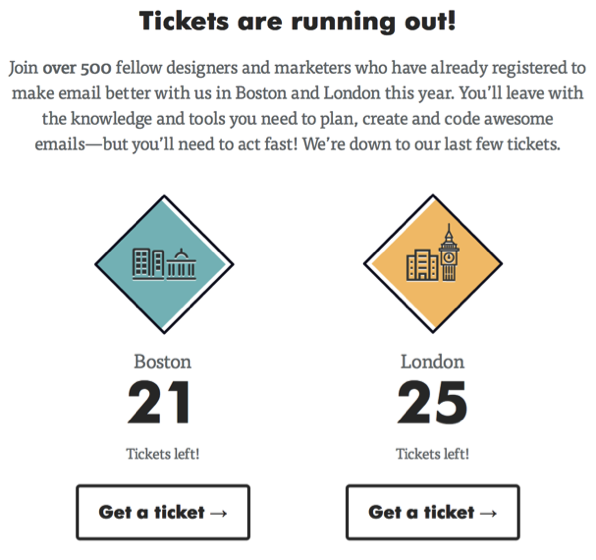
Creating a sense of urgency (the scarcity principle) is the best way to persuade your leads to engage with your emails. Urgency works because when you put a deadline on a specific action like the purchase of a product before an offer ends, people automatically lean towards taking that action by engaging with your email. Litmus’ email campaign is a perfect example of using urgency to drive people to complete an action based on urgency. It persuades users to purchase tickets before they get sold out by showing the exact number of tickets that are left for the event.
There are two types of urgency you can make use of in your email marketing campaigns: time-based urgency and scarcity-based urgency. Time-based urgency entices prospects to engage with a campaign by providing only a limited timeframe. Whereas scarcity-based urgency capitalizes on scarcity to make it work just like the Litmus example mentioned above.
2. Send personalized emails
The best way to improve email click-through rates is to send more personalized emails to your leads. When emails are personalized on the basis of your individual subscriber’s unique behavior and interests, they are more likely to engage with your emails. Now, it’s next to impossible to manually personalize emails. This is where segmentation comes in. Email segmentation allows you to classify your leads on the basis of common interests and behaviors. This way you can send targeted emails to each individual group addressing the needs of their concerns and behaviors. Some ways to segment your email list are:
Ask your subscribers’ email preference
Know their locations
Pay attention to purchasing behavior
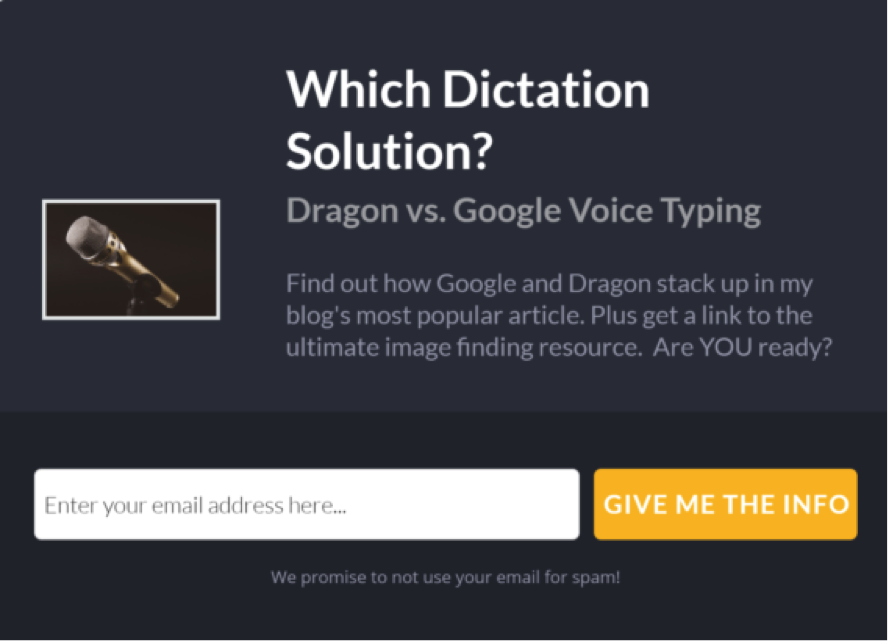
Email segmentation isn’t scary as it seems to be. With a tool like OptinMonster, one of Constant Contact’s integration partners, you can easily build a hyper targeted and segmented email list based on visitors’ location and user activity. Combining with its exit intent technology, you can rapidly grow a hyper segmented email list by prompting a targeted popup form to abandoning visitors at the precise moment they’re about to leave.
After building a segmented email list, you can start sending personalized emails to your subscribers. Here are a few ideas for email personalization:
Educate your leads: Let’s say you recently launched a mobile app. Based on users’ activity, create a segment of leads who probably didn’t know it existed. The idea is to teach a subscriber what they mightn’t know about your product or services.
Notify your customer about an activity: For example, if a customer recently added a product to the cart but didn’t complete the purchase, you can notify them to complete the purchase.
Send product recommendations: Send a personalized email promoting products that you know your leads are more likely to buy.
3. Ask email preferences
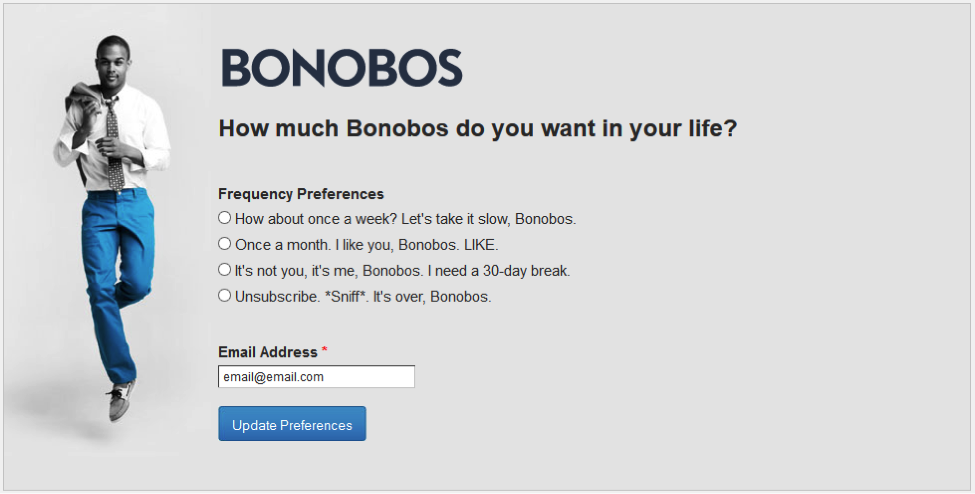
Sending too many emails can be annoying to your potential customers, which makes them unsubscribe from the list. To make your list active and to boost click-through rate, it is essential to know your subscribers’ email preferences. You can ask your subscribers how often they wish to receive your emails and the types of email they want to receive from you. This way, you can ensure that you’re not annoying your leads, keep them longer on your email list and more importantly, keep them engaged with your emails.
By asking email preferences of subscribers, Bonobos maintained strong user engagement ratios, sent 2-3X more emails to highly engaged contacts and also increased engagement with lower-engaged contacts due to reduced frequency.
4. Create a win-back email campaign
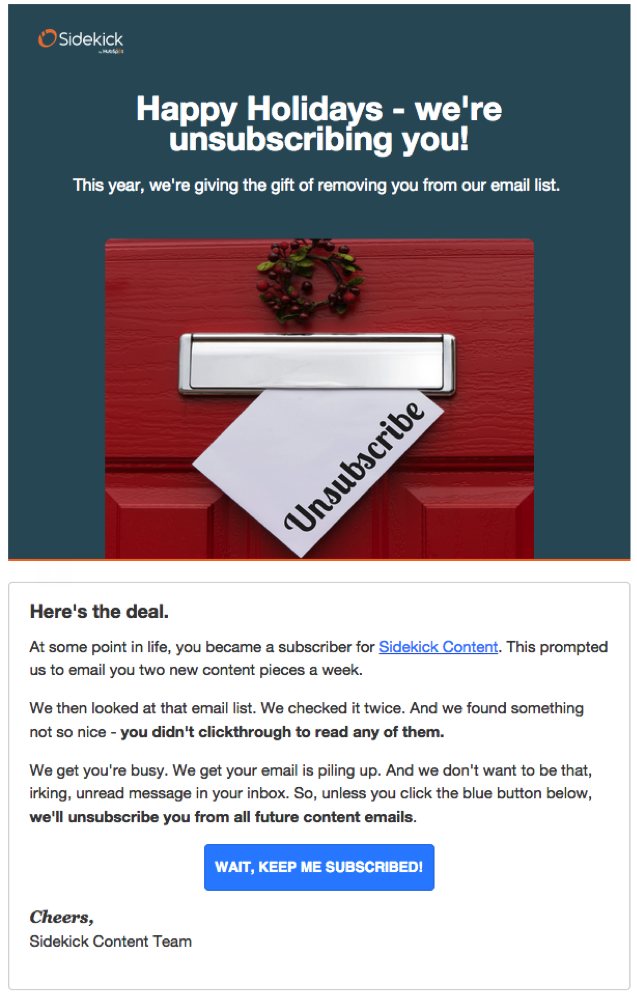
The harsh reality of email marketing is that an average of 60% of email lists are full of dead email subscribers. Since every subscriber is costing you, you need to make your list active by regularly cleaning up your inactive emails from the list. Additionally, having a high number of inactive leads can even adversely affect your email deliverability and cause your emails to be delivered to spam. Before you clean up your list, you need to take the last step to make your leads re-engaged with your emails by creating a win-back email campaign. According to a study, an average open rate of win back emails is 12%. This rate is respectable since all leads were identified as inactive before. One of the best ways to persuade your inactive leads to engage with your emails is to make an offer they can’t refuse. Another strategy to make a list engaged is to send an unsubscription notice to your leads who haven’t engaged with your list for a while.
In addition to unsubscription notice, Sidekick also provides an option to users to remain in the list by clicking the ‘Keep me subscribed’ button.
Evaluate your email click-through rates
If you feel that you could do better, you can follow these recommendations to boost your click-through rates. What is your favorite trick to boost email CTRs? Let us know by commenting below!
What happened? Much like the plumber with leaky pipes…. I didn’t send out an email to my list for a very long time.
It was bad. No… it was terrible. and I feel like the worst marketer that ever lived because of it. (maybe not the absolute worst, but it felt too close to call.)
Honestly, I am *quite* embarrassed about it.
Everyone subscribing to my newsletter either knows me personally or loves email marketing / making a lot of money. And I am supposed to give advice on how to combine the two (being an email marketing consultant and all). Then I turn around and display the absolute worst example. So bring out the pitchforks, townspeople!
Trying to redeem myself.. I sat down and wrote a down all ideas I had to start sending again after being away for a long time. It is called re-engagement and it’s a thing. Here are my best, and I think you will like #3 most (because it gives the most value).
1. Ignore that it was a long time ago and just start sending again
That might be a valid option for a company – especially if there is enough other things to highlight. Might get a few strange looks though, as people wouldn’t remember signing up. And get a bunch of unsubscribes. For me, though that would be missing an opportunity to address a common problem amongst email marketers – getting out of touch or on a very low frequency. What is a good email frequency anyway? (It won’t be 6.21 emails per week for me).
2. Start building anticipation for next emails
This is actually quite good. Step over the past and look at the future, there is a lot coming up. Because if someone is opening the email they are already “re-engaged”, in part. As X (still have to look up who said that, who was that again?) says “Your goal for your newsletter is to make them open the next one”.
So what is there to look forward to? There are plans for: * Offering more email marketing whitepapers through this site (!) * Some very cool start-up tactics you can use for your email marketing. * Send an invitation to take a trip around the world with me. * Online email testing and optimisation Masterclass. * How I gathered more than 500 new opt-ins in 3 minutes. (yes, that is more than 2 per second) * New, unique research and stats on consumer email behavior. * An article on Augmented reality and email * Next to helping you select email and automation software, also giving some pretty hefty discounts on them. At the same time, you want a “teaser” to be more than a flat announcement of what is coming up. And there is more than enough to share from the last months…. so
3. Give the Best of what you got, a reverse we missed you.
This is the reverse of a “We missed you” type reactivation email. Create an email with the articles they have missed. Sort of like a “best of” album. Of course, you have to have a few best of articles up your sleeve. Not like the best of would actually be just one song (called Ice Ice baby). I like the idea of overloading subscribers with value.
This pretty awesome collection of 60+ full-length articles with the answers to Marketing Automation Questions you never knew you had. How to grow a resilient email list
There wasn’t actually any good reason to not send any mailings for me (and most people), to be honest. It is not like sending a newsletter takes a lot of time to create. Pam can write a newsletter in 90 minutes. The problem wasn’t content either. I have been publishing content, blogs and articles. But most importantly – I think Nobody is actually going to care about the reasons and fake rationalization, next to a “I-feel-so-bad-for-you-shared-emotion” so that is a terrible idea.
5. Set low expectations – retroactively
Setting lower expectations will allow you to wow your audience. But does that work with frequency as well? Something like: The new normal is one email per year, haven’t you heard? Chris Penn does this with his “Almost timely newsletter” – I think that is quite a great name. But shouldn’t you set expectations beforehand? Turns out you don’t. But my intention is not to lower expectations, that would just be an excuse for lagging.
6. A reference to fact that I was thinking of sending my newsletter, personalised
Something like (a photo of) a ridiculous long to-do list or even an email marketing bucket list. Another idea would be a dynamic image with their own name on it, inside the email, post-it on the wall next to my desk.
7. Make the whole email with articles about re-engagement
That would be pretty meta, and I kind of like the idea. There are quite some good articles about re-engagement, mostly showing examples.
You can check out: the Monks the GetVero the Myemma the PostUp the SendLane that plays to the point, you are able to create a very good newsletter through curated content.
8. Segment and conquer
To make the message better, more impactful, we could look at how to best make use of email marketing segmentation . So if I am talking about the lack of sending newsletters/reactivation the power-play would be to only select the people that didn’t interact with for a while. So, for instance, they just signed up the other day, there wouldn’t be any “noticeable problem” and could send a different email.
But also engagement on social or website would count. So that can be seen as an eRFM. Engagement, Recency, and Frequency, Monetary value and interactions on other sites with articles or meeting them at a conference. If it was for a company, interaction like purchases (the monetary) would work. The other side of the coin: Just be inclusive and make the content of the email interesting for a bigger group
9. Offer a bribe
This seems to be a trend in marketing, bribing people into liking you (again) or at least try to. I don’t know. What would it take to make you happy?
10. Ask for a re-opt in
That would just be silly. All the addresses are double opt-in and the moment someone is actually opening the email, they are already – partially – engaging with your email. The re-optin would be a consideration if you were planning to say goodbye to a part of your email list. Like a Hail Mary message and/or if it needed to be vetted because quality is a concern. Nope. Definitely on my list of email marketing no-no’s.
11. Write down all the ideas I had and make it into a blog post, then mail that to my list
When it comes to your email marketing, you already have a lot working against you in a subscriber’s inbox. Family news, party invites, and every other online business owner vying for some attention are your competition, and you’ve got to find a way to rise above the chatter. The best way to do that? Email segmentation.
The name itself might not initially sound like a strategy for increased open and click rates, but once I start to unpack it a little more, you’ll quickly see why email segmentation is going to be your new best friend. In fact, according to DMA, 77% of email marketing ROI came from segmented, targeted, and triggered campaigns in 2015. So I’m not just talking about deliverability anymore – I’m talking about product sales and money in your pocket.
Stated simply, email segmentation is the process of putting your email subscribers into different buckets and speaking to each of those groups directly. Think of it as meeting your subscribers where they’re at on their customer journey so you can send them targeted content that speaks specifically to their needs and goals at that point in time. To do that, you’re going to need to do some recon on your subscribers, but we’ll talk about that later. First let me tell you a bit more about the benefits of email segmentation.
Why you need email segmenting in your email marketing
Email segmentation is one of the key distinctions between a list that converts and one that makes it hard to reach your goals. Knowing your subscriber's backstory and how they interact with your content is key to understanding how to communicate with them and pitch your products.
For example, if you know that your subscriber is a newbie on your topic, you can specifically send them your intro level eBooks for free and put them into a sequence where you teach them the basics of your topic to gain their trust and build authority.
But if you find that another of your subscribers is more knowledgeable on your topic, you can send them one of your more complex eBooks and put them into a sequence that eventually pitches them one of your more expensive and advanced products. See how that works?
Now you know that email segmentation helps you meet your subscribers where they’re at, but here’s what segmentation actually means for your email deliverability:
Increased Open Rates
An email in an inbox is only as good as the person reading it. Having a segmented list allows you to send the same email but with custom subject lines to specific subscriber groups that appeal to their needs.
Your customers aren’t all the same person and segmentation can help you get more specific with smaller groups of your list.
Better Click-Through Rates
Once you have those custom subject lines set up for your different subscriber groups and you’ve sent your emails off, it’s up to your subscribers for the next step– click-throughs.
Setting up targeted emails alone won’t put money in the bank. You need your email subscribers to interact with your content by clicking through on links to your articles, videos, and, ultimately, your products.
ConvertKit customers with targeted segmentation often see click-through rates of as high as 10-14%. Considering the industry average across all email marketing platforms is roughly 6%, that’s at least a 66% increase. Your subscribers are also much happier as they’re now getting emails they actually want to open and click on. It’s definitely a win-win.
Maximized Conversions
When you’ve reached that trust point and are ready to send your sales email to your list, the last thing you want to see is zero conversions. If you’re emailing your entire list of subscribers who may or may not be interested in that particular offering, you risk losing them as a subscriber and you certainly risk losing the sale. You’ve got to narrow your audience based on your subject.
With good segmentation you can track who clicks on your links and then send targeted emails just to those people with a reminder about any details, some FAQs, or anything else they need to know to seal the deal. Emailing just the people who have shown direct interest is not just a smart business move, it makes you look like a real human on the other side of the computer screen too.
Using segmentation to your advantage will keep the number of unsubscribes to your account at a minimum. You’ll still have people who clean up their inboxes for time to time, but the more targeted you can get with the emails you send, the more likely your subscribers are to hang out.
Avoid The Dreaded SPAM Filter
The whole point of email marketing is to have the emails you send actually delivered and read, right? Spam folders are notorious for making that hard on marketers, but there are actions you can take to make it better.
Email service providers (ESPs) want to see that your subscribers are opening emails, clicking on links, sharing emails, replying to emails, marking them as important, and not immediately hitting delete. Sending targeted email content through segmentation helps you avoid being flagged by those ESPs.
Want to know more about how to increase the quality of your list and avoid the SPAM filter? Read up right here.
Hopefully now you see that email segmentation is the best way to create targeted content for your email subscribers to help with your click rates, revenue, and so much more. Now let me tell you how easy it is to create segmentation in ConvertKit.
How to segment email subscribers with tags in ConvertKit
In ConvertKit, we create segmentation by tagging subscribers and then grouping those tags together. So basically tags organize people and segments organize tags.
Tags allow you to organize and group your subscribers based on actions, interest, and more. Because we are subscriber-centric and not list-centric, you only have one list of subscribers, and tags help you keep that one list organized.
Ways you can add tags to your customers are:
With Link Triggers, you can add a tag when a subscriber clicks a link.
With certain integrations, you can add a tag based on a purchase.
You can import into a tag, so you know when you brought over certain subscribers
Within the ConvertKit app:
Tags can be created on the Subscriber page or within an Automation.
Tags can be added to existing subscribers on the Subscriber page via Bulk Actions, or within an individual Subscriber profile.
Here's a quick video that explains how to use forms, tags and segments effectively.
Figuring out the best way to segment your email marketing lists can be a huge undertaking. But the more you tag, the better you can target your emails with content that feels tailor made for each subscriber.
Types of subscriber data to collect for email segmentation
You could also think of tags in terms of data you collect about your subscribers. This data will help you get to know your subscribers better– what they’re interested in, where they’re from, what they want to learn from you– so that you can send them more targeted content and in turn pitch them products they actually want. Here are some tags that we suggest our customers use for collecting data for their subscribers:
Where the subscriber is at on their customer journey
Other than the basic information, this is one of the first pieces of data email marketers use to start segmenting their list. Knowing this initial starting point will help you know what level of skill, knowledge, and engagement your subscriber has with your topic. This can give you insight on everything from what kind of product to pitch to how much teaching content you need to prepare.
How to use this tag– In your introductory email, ask your subscribers what their main struggle is by offering five different options to choose from. The reader will respond by clicking on the link they identify with which will trigger a sequence that ends by pitching a product geared toward that struggle.
Products they’ve bought/downloaded from you
The next thing you'll want to track is when subscribers purchase your product. It helps to create a tag called “Purchase: Product Name” for each product. Then Gumroad, Shopify, Teachable, or whatever other e-commerce provider you are using can add customers to that tag once they make a purchase through an automation. And don't forget to include these purchase tags in your newsletter or all subscribers segments
How to use this tag– Knowing what a subscriber has already purchased helps you in a couple different ways.
You can exclude that person (through their tag of Purchase: Product Name) from any further communication about that product. They don’t need your sequences that pitch that product any more since they’ve already bought it, right?
You can make an assumption on what other products they might enjoy based on their first purchase. You can set up a link trigger that sets them into a new sequence that pitches your subscriber that similar product.
Webinar attendee
People who join webinars are generally people who are excited to learn. A webinar attendee has already given you their email address so they could attend your webinar, so make sure to make the most of this list growth by adding a webinar tag to their name.
How to use this tag- You’ve most likely given away a free product or pitched something on a webinar, so you know that anyone with that tag already has a basic knowledge of who you are and what you do. You can parlay that knowledge by putting people with that tag through a sequence that teaches them more in depth on your webinar topic and ends with a hard pitch for one of your products for sale.
Event attendee
Don't miss the opportunity to reach out to leads and potential customers you've already made a positive connection with at a live event.
How to use this tag- Segment your email list depending on the type, topic, or theme of event or even to RSVPs who didn't make it out. You'll be able to keep inviting them to events while sharing relevant content offers based on what you learned about them from past events.
Where the subscriber’s sign up form came from
Did your new subscriber sign up because of your podcast or video show? Did they read your guest blog post you wrote or find you through a contest you contributed a product to? Knowing the type of content your subscriber originally found you on can tell you a lot about what kind of content they like and how they like to consume it.
How to use this tag- If a subscriber found you through your podcast, you know that you can push any products you have related to creating and hosting podcasts. If a subscriber found you through a guest post, you can create content and products that relate to the core topic of the blog that hosted your guest post (or at least reach out to more blogs in that industry to expand your audience).
If they refer your products/services often
If you have customers who constantly refer you to new clients or other businesses, it’s a good idea to create a tag for them. These customers are your biggest advocates and you should give them extras from time to time.
How to use this tag- You can use these advocates as beta-testers when you have a new product coming out. And to give them extra incentive to keep referring you, you could send them extras like discounts, free trials, or even set up some kind of affiliate system.
What affiliate the subscriber came from
If you already have an affiliate program setup, it’s smart to keep the sign ups for each affiliate separate. Every affiliate will cover their own niche topic so knowing which affiliate a new subscriber comes from helps you craft content specifically for them.
How to use this tag- If you blog about baking cakes and you have an affiliate that blogs about wedding inspiration, you could create an eBook or another small free giveaway about popular wedding cake flavor combinations or color schemes that you can send to subscribers who came specifically from that affiliate.
Interests
If you blog on different topics, it’s very important to keep all your readers grouped into their correct interest so you’re not talking to them about the stuff they don’t need.
How to use this tag-You could run a survey asking your readers to click one of five topics you blog about. The link they click will tag them by their favorite interest, and now you know more specifically who to send content to when you deal with multiple topics.
Interested in, but hasn’t bought
A subscriber can go through a whole teaching sequence of yours and still not end up purchasing anything. You can create a link in the final email of that sequence that tags those subscribers as “interest in: product name”
How to use this tag- When that subscriber goes through your sequences and ends up not purchasing and being tagged as “interested”, you can send them a follow up sequence with a downsell of that product they are interested in. It could be a smaller version at a lower price or just a lower priced product that you think compliments the original product you were pitching. Doing this shows that subscriber that you care about them getting a product that truly helps them reach their goals and can go a long way in building trust and authority.
Customer tag
Whenever a subscriber buys anything from you, give them a ‘customer’ tag. Knowing what subscribers have made a purchase from you lets you know that they might be willing to buy other products from you. The difference between the “interested in” tag and the “customer” tag here is big. It’s the difference between sending a subscriber through another teaching sequence and offering free incentives or sending them through a sequence with a hard pitch that doesn’t involve as much trust building.
How to use this tag- If a subscriber purchases your course on “How to use gluten-free flours in baking”, you can assume that since they bought a course on this subject from you, they might also purchase another course from you in a similar topic. You could send them into a sequence with a hard pitch on your more targeted course “Gluten-free bread baking”.
Time to get tagging
It’s a Type A’s dream, right? Gathering all the information and putting your subscribers in their designated places will not only help you understand your audience more, it’s also going to help your audience feel understood. The more you send them content that feels like you wrote it just for them, the more they’ll trust you and your work– that means increased revenue numbers.
Do these data points we talked about work for your audience? What other tags would add to this list? Let’s talk about it in the comments.





 Where the subscriber is at on their customer journey
 Products they’ve bought/downloaded from you
 Webinar attendee
 Event attendee
 Where the subscriber’s sign up form came from
 If they refer your products/services often
 What affiliate the subscriber came from
 Interests
 Interested in, but hasn’t bought
 Customer tag