Make a simple google search using the terms “Email Marketing Mistakes to Avoid” and you’ll be met with approximately 1.6 million results. Oh, so you don’t have a few years to set aside for some light reading? Good, let me sum it up for you. There are do’s and don’ts and best practices and recommendations for every intricacy of email marketing. These range from clear, distinct guidelines, to ambiguous ideas. Most are helpful, most are lengthy. So, how do you know if you’re making one of these common mistakes? You might be if….
1. Your content is irrelevant
In an age where we can make a simple search for a pair of black snow boots, and have said snowboots show up in our targeted ads on all social media platforms for a week, you better believe subscribers are expecting mail that makes sense for them. If someone lives in Anchorage, Alaska, chances are they aren’t regularly looking to buy those cute flamingo pool floats. So do you ensure that you’re sending your subscribers content that is relevant to them? Start at the beginning! Does your sign-up process include a chance for subscribers to give their geographical location and preferences about what they would like to receive? If not, this is probably a great place to start in order to make sure that your mail is relevant and targeted to your subscriber’s needs.
2. Your creative needs a refresh
So often, email marketers focus on the subject and preheader of a message that the actual creative content falls to the wayside. The reality is that people are more likely to engage with your mail if something in the body of your message catches their eye. Be sure to include a call to action! Let your users actually engage with your mail by adding in easily found links to your website, a sale, or a special offer. You CAN have fun with your email! For example, below we see Apple is sending a campaign that is relevant to the quickly approaching Valentine’s Day. In their message, they keep the user invested with bold colors, holiday specific emojis, and links to shop the featured products in a subtle, yet easily identifiable way throughout the entire message.
3. You haven’t optimized for your mobile subscribers
Studies show that 43 percent of subscribers are checking their emails on a mobile device, and that number will only grow since mobile devices aren’t going anywhere anytime soon. Make sure that your images, links, and text are rendering in a coherent, eye-catching way to ensure that your mobile users are having a positive experience with your mail. An easy way to do this is to test in our Inbox Preview tool. This tool gives you exact renderings of your mail across multiple platforms and shows you the issues you need to fix before you hit send. Another useful tool is Email Client Monitor. This tool allows you to gain insight into how long subscribers spend reading your email and geographically where they are opening it to help in targeting and segmentation. It also gives you data about which platforms, browsers, and email clients your subscribers use most often to optimize your email for the most used platforms.
4. You aren’t asking for permission
Permission-based email is vital for an email program to be successful and maintain a healthy reputation with mailbox providers and subscribers. How do you know if you’re deploying these types of emails? I’m glad you asked. First, make sure that users are fully aware of the type of mail they’ll be receiving from you at the point of sign up. Do you only send a monthly newsletter? Let them know! Be straightforward about your relationship going forward and I promise, it will be a long and fruitful one. Also, make sure you’re allowing your subscribers to opt-out of your email whenever they may decide. Meaning, don’t bury the unsubscribe button! Doing so will only increase complaints. Much like it is better to have loved and lost than never loved at all, same goes for your email program. An unsubscribe is better than a complaint any day of the week. Next, make sure you’re keeping subscriber’s contact information up to date. Give your subscribers an easy way to update any changes in their email addresses, so that you always stay in their most relevant inbox. Lastly, don’t buy or rent a list. It is difficult to obtain consent from these types of lists, not to mention some of those addresses may be spam traps, landing you on a blacklist.
5. Signing up for your emails is hard
People like convenience, no one likes to jump through hoops, especially when it comes to getting on an email list. More often than not, I see sign up processes that look more like the format a doctor’s office than a mailing list to hear about sales on my favorite sweaters. Keep your sign up process on one page, make the information you need from them an easy click, not a long form in which they need to write in a great deal of personal information.
Before the rise of the Internet and everything mobile (now up to 56% of opens in September), the news used to take time. We’d have our coffee and read the paper page by page. And we knew exactly what to focus on: what was above the fold. That’s where the biggest stories broke each day. If you weren’t sure you wanted to buy the paper, what was above the fold would also serve to entice you to buy, since most newsstands displayed them like so:
Source: New York Times
Now, the news is instant and 24/7, sometimes in as few as 140 characters. Even though the sight of an actual newspaper may be foreign to many cellphone-happy millennials, the term “the fold” has stuck around. For email and web design alike, “above the fold,” is still used to indicate relative importance—and also acknowledges the shrinking attention spans of readers today.
For email marketers, the fold has been a longstanding concern, whether that’s trying to optimize emails to render correctly in Outlook’s preview pane or for newer preview functionality like that in Inbox by Gmail. Marketers know they only have a short amount of time to grab the reader, which made “the fold” a clear demarcating line.
Because of widespread belief that attention spans have shortened and that people don’t read, marketers became obsessed with cramming their important information and CTA above the fold. But scrolling is actually easier than clicking, and subscribers come to expect it. While you can still lead with your most important content, you no longer have to. We’re here to debunk once and for all the idea of “the fold” in email.
SAY GOODBYE TO THE FOLD, HELLO TO “THE SCROLL”
According to Alex Williams, VP & Creative Director at Trendline (and a speaker at Litmus Live in 2016), mobile also has a fold: it’s called the “scroll.”
What does this mean?
Above the scroll means that you have to entice your reader to scroll down—show them why they should read your email in its entirety—by providing compelling and memorable content up top. The goal is to set expectations that your content will be relevant and interesting all the way down the email, and to be memorable right away, thus initiating the scroll.
In the above example from one of my favorite daily newsletters, theSkimm, you can see they don’t lead with the most important piece of information (well, #Hiddleswift was kind of a big deal). Instead, they break each section of the email into sections, just like a newspaper.
SUBSCRIBERS THAT DIDN’T CLICK ON YOUR HERO IMAGE, BUT ARE STILL SCROLLING, ARE BIG OPPORTUNITIES. —ALEX WILLIAMS
Because the information is relevant and easy to understand, they’re counting on subscribers scrolling all the way to the bottom, rather than clicking on the first piece of content without reading anything else.
USE THE ENVELOPE TO TEASE YOUR CONTENT
Back in the days of print marketing, the envelope was key to that first step in subscriber engagement: the open. Known as the Johnson Box, this gave mail recipients a window into your mail offer. Designed to draw the reader’s attention to the key message, it also served as a way to entice readers to open the letter—just like the subject line and preheader text in email today.
Regardless of the type of email you’re sending, initiating a scroll starts as early as the envelope in your email’s subject line and preheader text. Experiment with teasing an article in your subject line or preheader text that isn’t found until lower in the email. This can build up anticipation to get to the reason the subscriber opened the email in the first place.
In this example from TrackMaven’s newsletter, the content from the subject line (“35 Top Twitter Chats,”) isn’t shown until below the fold. Instead, they lead with top news stories from the past week. The top content is still relevant (and since they include it in every newsletter, expected), but to get to the content teased in the subject line, you need to scroll.
DIFFERENT EMAILS, DIFFERENT GOALS
However, this doesn’t mean “the fold” is completely useless. As with most things in email, the answer is: “it depends.”
When it comes to promotional email, marketers tend to send out three different categories, which relates to the three main areas of the marketing funnel:
Awareness emails can take a variety of forms, but in general, they introduce the subscriber to something new, such as a blog post or infographic. The goal of these emails isn’t necessarily to sign up or buy your product but to increase familiarity and encourage people to visit your website. They may already be aware of your company (after all, they did give you an email address), but not everything about what you do or what you stand for. Awareness emails are about content consumption, which is a one-way interaction.
Engagement emails build that 1:1 relationship with the subscriber, sometimes with personalization, recommendations, or an ask for feedback. This could take the form of a welcome email, survey request, sales outreach, gated ebook, or an email like our TEDC ‘16 tickets on sale email that encouraged folks to interact with with the email more deeply. Engagement emails ask for more than reading a piece of content. They’re about building a relationship, which requires two-way interaction.
Conversion emails focus on completing a sale or purchase. This may be advertising a promotion, re-engaging the list, or asking for signups for a webinar. The ask and goal of the email is clear.
(Want to brush up on your definition of conversion? This article talks through exactly what it means.)
Each type of email requires a different mindset because you’re asking for a different level of commitment on the part of the subscriber. When you set your goals for your campaigns, enticing the scroll makes sense for some categories but not for others.
AWARENESS EMAILS
Awareness emails buy time, rather than buy clicks. How can you get your subscriber to keep reading for two more seconds, and then two more after that? The more they read or see, the higher the chance there is of something happening. Make your awareness emails creative, interesting, and above all, incomplete.
That doesn’t mean leaving the subscriber completely hanging or not finishing a sentence. It means keeping the curiosity gap high at all points in an email, so that they’re constantly wondering, “What’s next?” and satisfying them at each scroll.
This product update from Trello doesn’t shy away from showing multiple pieces of news or completely different calls-to-action. The idea is to make people aware of new features, not sell them (though some of those features might require a plan upgrade).
This email doesn’t have a sale or promotion until the very bottom. Instead, the focus is on re-engagement and awareness—hey, here’s what you might be missing!
ENGAGEMENT EMAILS
Engagement emails start the conversation with your subscribers in a deeper way than awareness or conversion. They’re to be used sparingly, as they can be incredibly powerful.
To promote Litmus Live 2016, we decided to gamify our email to build excitement, increase engagement, and have a little fun. To reveal our third city, users sent in guesses via Twitter, which then populated a dynamic Twitter “collage” at the bottom of the email itself. We expected it to take 3-4 hours to get 500 shares using the hashtag #TEDC16. (Read why our new hashtag is #LitmusLive here, short version: politics.)
We were blown away 90 minutes later when we hit the mark! Our audience relished the opportunity to engage with us. The entire email worked together to reveal the city and encouraged subscribers to open the email again and again for updates. This completely flips the idea of a “fold” on its head, since our subscribers checked the email continuously to see new Twitter feed updates.
CONVERSION EMAILS
Conversion emails are usually short and to the point, with one ask, so it’s completely clear to the subscriber what action you want them to take. It might be a sales promotion, but it might not. Whether you’re focusing on buying a product or encouraging them to read an article, conversion emails focus on getting the click.
Because of their direct nature, conversion emails often benefit from having the CTA above the scroll to close the deal. It’s fine to include more options after the “scroll,” but those should be more opportunities for them to learn about that same one objective.
In this example, General Assembly is clear about what action the reader should take: request a syllabus to learn more about their digital marketing class. The objective is clear, to the point, and there’s no need to scroll—you can’t miss that big red button.
This email is a great example of how to focus on exactly what you want your subscriber to do in the top section of your email, but still, include information below for those who do want to scroll. It’s clear what action they want you to take.
DON’T DESIGN EMAILS IN A VACUUM
REMEMBER, YOUR MOST IMPORTANT JOB AS AN EMAIL DESIGNER IS TO GET THEM TO OPEN THE NEXT ONE. —ALEX WILLIAMS
When you design emails, you have to think about the overall subscriber journey. Each email isn’t independent—every awareness email you send can ultimately contribute to that purchase when a subscriber does receive a conversion email.
The most important thing to remember about the scroll? Set up expectations as a brand that provides compelling enough content that subscribers will want to scroll—and keep scrolling.
THE influence of internet in our everyday lives is undeniable, but the role of mobile devices is just as impressive, having in mind the fact that the study shows the mobile has urged 70% of US-based companies to transform their business and user experience.
Hence the rise of mobile marketing, as a branch of marketing focused on promotion and customer acquisition through mobile devices. Mobile marketing requires creating seamless user experience by optimizing your website and thinking about responsive design, and this has become one of the most important tasks companies have to focus on.
As a company representative, you are already aware of how leveraging your presence online is important, but here are some strategies to help you generate leads through mobile marketing.
Simple call-to-actions
When creating call-to-actions (CTAs) you should have in mind that mobile devices will load the page differently, and this will affect user experience. Instead of going overboard with the design and creating content-rich landing pages, try to keep it simple. Simpler design of the landing page on a mobile device has proven to be more effective, as the screen itself is much smaller than a computer screen. Therefore, provide the necessary information only, and pay attention to the CTA button. Make sure it is large enough for users to tap on, and make sure the text on the button is not too long, as otherwise, the users might have difficulties reading it.
Optimized content for mobile devices
When thinking about mobile optimization, you should start by analyzing the behavior of mobile users. The users reach for their mobile device when they need specific information, and they need the answer fast. Regardless if they are waiting for a bus or at the dentists’, the users usually have a couple of minutes to find the information they need. It is also known that mobile users are very impatient, which means that they will wait a couple of seconds for a page to load before they quit the page. Finally, most mobile users will not bother themselves going through the entire content on the page, rather they would only scan the text in order to find the information they need.
This pattern in user behavior helps you determine what optimized content for mobile devices means – it is simple, fast, and it provides useful information. Make sure the page is not heavily populated with content, banners, and other possible distractions, as users will prefer simpler design. Use headings, highlight the key points of the text and make sure your content is easy to digest. All of this, compiled with fast and responsive page creates positive user experience and helps you generate leads.
Clickable phone number
As opposed to PC consumers, mobile users are likely to take action. For example, if a user is searching for the best coffee in town on the mobile device, this usually means that the person is planning to have coffee in the next hour or two. The same goes for other brands or industries, users need information about a product or service quickly, as they are going to take action.
This is the reason why you should make your phone number clickable. When the user visits your website and finds the information he needs, you should make it easier for him to reach you by allowing him to tap on the phone number and instantly call you. Otherwise, the user will have to copy and paste the phone number, or even memorize it in order to be able to dial it. This takes much more time and effort, and time is something which most mobile users are not willing to waste. User being ready to get in touch with you is the user who is most likely to become your customer, which is why you should consider this as a great opportunity to generate a lead.
Progressive profiling
Progressive profiling is a technique used with form filling, where the system gradually collects information and learns about user preferences. This means that you can keep your forms short, as you avoid repeating the questions. Even though you might be tempted to learn as much about the consumer through all sorts of questions, it is known for a fact that the shorter forms have much better conversion rate. Using this type of forms, you can add a couple of new questions each time, as the system already gathers the data from the previously filled in form.
In the same time, learning more about the user preferences helps you deliver more personalized experience and thus provide relevant content, which is more likely to convert and help with lead generation.
Coupons and discounts
Coupons are a well-known strategy in lead generation, and expansion to the mobile market has simply transferred the platform through which the coupons are redeemed. Businesses have been very creative with strategies to use mobile devices to promote their business and generate leads. Some of them offer coupon codes or loyalty discounts, while other businesses give away something in return for a check-in, like, or review on social media. Therefore, a diner might be offering a free milkshake for the users who check in using Foursquare, as they know this will help with boosting the exposure on this social network. Mobile users have a habit of browsing the social networks for recommendations, suggestions and information about the places they wish to visit. Business can leverage this opportunity and offer bonuses, gifts or discounts for those users who post reviews or ratings on social media. User reviews are known to be much more effective than ads.
Coupons and discounts are always a win-win strategy for both parties. Consumers get more value for their investment, while companies drive different actions on social media spreading the reach and brand awareness while at the same time making their products more fun and approachable.
In the end, it all comes down to understanding your business, its demands and opportunities, because this is what helps you choose and apply strategies that will benefit your company the most.
Christmas is well and truly just around the corner. Take a look at our 12 Christmas email marketing top tips to help you build and send fetching, festive email campaigns.
Analyse
Take the time to view and analyse past email marketing campaigns to see what worked well and what didn’t. Once you have acquired this knowledge you can plan your future festive campaigns to give them the best chance of getting good engagement rates.
Research
Spend a bit of time researching what’s hot and what’s not in your industry and check out the competition to see what they have up their sleeves. Try and incorporate these trends into your email marketing to show that you are also on trend.
Set A Goal
Whether it’s to get 20% more opens or 30 more clicks than last year, it’s good to set a goal as it gives you something to work towards. This way you can also aim towards improving results and statistics which always goes down well!
Plan
The old saying ‘failing to plan is planning to fail’ is something to abide by here. Without having a plan of action for your email marketing it’s bound to not do as well as it could. Take a bit of time to sit down and think about individual emails and overall email campaigns. Look out for key dates and content that can be included to target specific audience members.
Punchy Subject Lines
As potentially the most important part of an email, your subject line needs to be powerful and punchy to encourage the recipient to read on. The best subject lines create excitement, urgency and curiosity. This can be done using personalisation or even emojis! Just be sure to keep them short and snappy.
Engaging Content
Probably one of the most important elements of an email – the content. Create engaging content by including clear images, gifs and easy to ready text.
Mobile Optimised
The festive period is a busy time, people are out and about on the move so you want to be able to target them whenever and wherever they are. Do this by ensuring your emails are optimised for mobile. Up to 75% of emails are opened on mobiles or tablets so it’s crucial that you make them compatible with mobile viewing!
Clear CTA’s
Call to actions are essential, they catch the readers eye and give them direction/instruction. Whether this be ‘BUY NOW’, ‘SEE MORE’ or ‘SHOP’ make sure they are direct enough to encourage recipients to click through to your website.
Test
Before any campaign is sent it’s imperative to carry out the necessary tests and checks. This includes making sure your email looks correct across multiple platforms, any spelling mistakes, images load properly, link errors, plus split and multivariate testing. For peace of mind, it’s always handy to have someone else take a glance as a fresh pair of eyes may notice things you haven’t spotted!
Dynamic Content
Some of your subscribers will be previous customers and you will have details of their last purchases. Use this to your advantage and tailor emails using dynamic content to include products relevant to recipients. This way you will have a much better chance of engaging them and potentially making another purchase.
Automation
Automation is crucial for email marketing these days. It allows you to set up multiple workflows for customer journeys including welcome programmes, nurture programmes, basket abandonment programmes, loyalty scheme programmes and many more! Find out more about our visual marketing automation system, Maxautomation.
Review
Once an email campaign has been sent don’t just forget about it! Use this time to review and analyse how the campaign did. Without tracking and analysing results how will you know if they have been a success or not? Take the time after each campaign to look at delivery rates, open rates, click through rates and conversion rates.
I've said it before, and I've said it again: I'm endlessly fascinated by how much we, as humans, have adapted to emerging technologies. A few weeks ago, when I covered the Samsung Developer Conference, I had the following thought:
"Think about some of the pieces of
technology or up-and-coming topics that, maybe five years ago, we
thought had nothing to do with us. Those of us who ignored them quickly
fell behind the curve."
The internet of things is one such topic. It's still emerging. Some consumers are still learning how to adapt to it. But it won't stay that way for long.
If I'm being completely honest, the only reason why I give so much thought to the internet of things is that I write about tech. I don't have a smart home, and I don't develop technology or applications that pertain to connected devices.
But why do I care? And why should you? And what, once and for all, is the internet of things?
Relax. Today, I'm going to answer all of that.
What Is the Internet of Things?
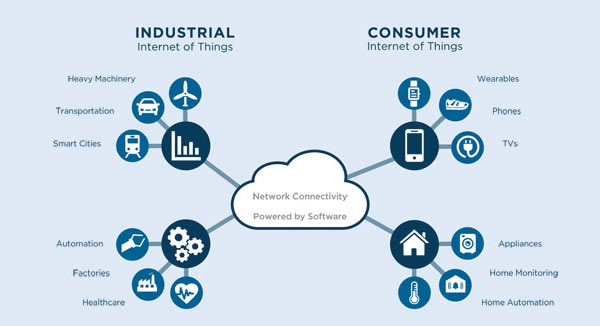
The internet of things (IoT) is the technology that allows objects -- like home appliances and fixtures, cars, or devices -- to send and receive data via the internet. For me, it helps to visualize it. When I think of the word "internet," for example, I think of a giant center of content, resources, and cute dog photos -- and the people who can share and obtain this information, all while communicating with each other, via a massive network that keeps us connected. When it comes to the IoT, then, imagine adding inanimate objects to the situation, exchanging information and communicating with each other (and their end users) via the internet. It allows these objects to execute different commands and actions, making them "smart" or "connected." For that reason, IoT typically has to be comprised of devices with power -- things that can be turned on or off, like lights or a refrigerator. But that's not always the case, which we'll get into later. And that's just on the household level. On a much larger scale, IoT is used to connect and power entire transportation or manufacturing systems. It's referred to many as an "ecosystem," in that it's essentially an interconnected community of interacting people and objects, and the environments in which they operate. This diagram represents it in a pretty simple, comprehensive way:
Note the cloud in the center of the diagram. It's easy to confuse the cloud -- a system of digital data storage that runs on the internet, versus a hard drive -- with IoT. And while they work well together, they're not the same thing. As Business Insider puts it, "The IoT generates massive amounts of data, and cloud computing provides a pathway for that data to travel to its destination."
Which is really cool, and all -- but how does it apply to your day-to-day work?
As it turns out, IoT might have more to do with you than you think, beyond the ability to control your coffee maker remotely.
So, Why Should You Care?
Consumers everywhere -- many of whom could very well be your customers or within your target audience -- are becoming more and more connected. As of January, about 4.917 billion of us are connected via mobile alone (up 5% from the previous year).
And as we, as humans, become more connected -- so do our surrounding lives and routines. How easy would it be for you to get through an average workday without your mobile device, for example? Personally, it almost seems impossible. It's all I use to make calls, get directions, and hail a car through a ride-sharing app when I need to get somewhere quickly. Plus, it's how I keep an eye on my pet, by way of a handy dog cam app.
Chances are, I'm not alone in my dependence on connectivity. Many of your customers probably are, too. So, where does your brand fit in?
You might not think you have a product or service that, say, can be connected to the internet or to users via a digital network in the ways we described above. But when you consider that 30.7 billion devices are expected to be connected by 2020 (there were 15.4 billion in 2015), you may not be thinking ambitiously enough.
Case in point: When beverage distribution company Diageo wanted to find a unique (and digital way) to connect sons and daughters to connect with their dads on Father's Day, the company connected 100,000 bottles of whiskey -- real, drink-filled, glass bottles -- to the internet. The reason? So that these 100,000 dads could connect to receive a personalized video message from their sons or daughters.
You have to wonder, if Diageo can turn a bottle of booze into a connected device, what can your brand do? (That campaign, by the way, resulted in a 72% increase in sales in the two weeks prior to Father's Day.)
If you're not sure where to begin, here are three steps to get started.
1) Pay attention to the technology available to you.
Recently, at its annual Developer Conference, Samsung introduced Project Ambience: a small dongle that can be plugged into home objects and devices -- like an everyday speaker, for example -- and turn them into "smart," connected devices.
Now, bear in mind that this technology is equipped only to work with Bixby, Samsung's voice assistant. But it's a start. In my humble opinion, Project Ambiance is one small step at the start of a long, productive road toward smart technology's full capabilities. Other manufacturers are working on similar initiatives (such as Baidu DuerOS and Amazon Alexa, which have created tools for developers to build these AI assistants into applications and products) -- eventually, and hopefully, we'll reach a point where technology is developed that can work with any number of voice assistants.
For that reason, it's a good idea for marketers to keep their fingers on the pulse of resources like these and how they're evolving, so that when they become available for use within your field, you can be one of the first to utilize them.
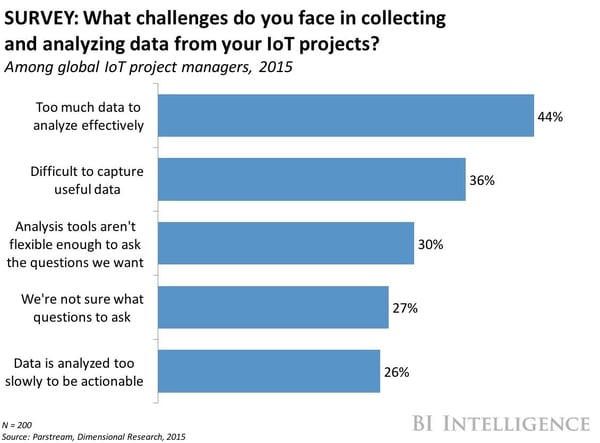
2) Anticipate the problems you'll run into.
When you kick off any new campaign or initiative, there's always chance that you'll run into a challenge. Sometimes, they're unanticipated -- but whenever you can plan for contingencies, do it.
That's one reason why I love the data in the image below. Although it's from 2015, because IoT is still an evolving piece of technology for many marketers and brands, it's good to keep in mind as you embark on incorporating it into your own strategies. Have a look, and think about the ways you can preemptively solve these challenges.
3) Start brainstorming, and look for inspiration in history.
One of the most important elements of staying ahead of the curve in marketing is -- if you'll excuse the cliche -- maintaining an open mind. Let's revisit the words I opened with: "Those of us who ignored [new technology] quickly fell behind the curve."
So, don't ignore it. Embrace it. Start thinking about the ways it can apply to what your business offers.
And if you're seeking inspiration, the Diageo example I used above is just one instance of how marketers have successfully used IoT. There's the ceiling fan company that use IoT to help customize its users' experiences with products. Or, have a look at the manufacturing automation company that uses connected, smart devices to reduce inventory cycles in plants.
In other words: There's still time to figure out where your brand fits in. But don't let it go to waste.
Email marketing remains core to most marketing strategies. A cohesive
blend of copy and design - along with a clear picture of your ideal
audience - will enable you to build an email process that establishes a
connection with subscribers, collects data, and generates results. But
which components of your email campaign matter most? And how do you
leverage those elements to maximize effectiveness?
5 Keys to Email Success
Your email must feature 5 critical elements:
Subject Line - The first words your audience sees when they open their inbox are those that comprise the subject line.
You need to hook the reader with a phrase that compels them to open the
email and find out more. At the same time, you must keep the subject
line concise. The perfect email subject line is a unique mixture of
creativity and information that grabs the reader and incites them to
read more.
Tight Copy -
Members of your audience likely receive hundreds of emails a day. The
copy in your email must quickly communicate the message you want to
impart and intrigue them enough to react. Email marketing, in most
cases, is not the place to spin long-winded stories or share layered
messages. It's a place to hit hard and fast with the idea you're
communicating. Your copy should drive an almost subconscious reaction
and response.
Appealing Visuals - Working hand in hand with the copy is the need to draw readers in with striking email design You
need to grab their attention with compelling visuals that communicate
the key messages of your email while still generating a call to action.
Email design requires active use of white space, an awareness of what
visual cues impact readers, and an understanding of how color theory can
make a difference in causing a reaction.
Personalized Messages - Research shows that personalized email subject lines are even more likely to be opened than standard subject lines. But that's just the start. Personalizing email leads to greater engagement,
higher click-through rates, and improved insight into customer
segmentation. Your customers want to feel that you're trying to
establish a long-term relationship. Personalization helps in reaching
that goal.
Mobile Optimization - Every email you send out needs to be optimized for mobile responsiveness. Data shows that people in growing numbers are accessing their email through their mobile devices.
And your customers are spending more time on their phones and tablets,
so they often go back to review old emails after initially opening the
message. As your customers continue this trend toward mobile
responsiveness, it is paramount that all email sent out as part of a
marketing campaign be optimized to reach the greatest audience.
Even with the growth of social media channels, email is still the most
successful online tool for reaching potential customers. By successfully
implementing the 5 elements listed above, you increase the likelihood
of running a successful campaign.
Interested in Learning More?
Learn more about creating highly personalized email campaigns with industry-leading scalability and ease. Download 8 Stories of Email Success.