Showing posts with label search engine. Show all posts

Wednesday, 27 June 2018

11 Reasons Why Every Affiliate Marketer Should Learn SEO


 As an affiliate marketer, you probably spend a LOT of time thinking of ways to drive traffic to your site.
After all, no traffic = no affiliate sales.
The two main sources of traffic for most websites are usually:
1. Organic Search
2. Paid Advertising
Social media and other sources will also bring visitors to your site, but these are usually your two best bets for consistent, ongoing traffic.

Why Should You Care About Organic Search? 

Of these two main sources of traffic, search always comes out on top. In fact, a recent study by Experian Marketing Services found that on average, 87% of a website’s traffic comes from organic sources. This percentage of course, varies by industry. However it doesn’t change the fact that the majority of traffic in almost every industry comes from people typing their queries into Google or another search engine and clicking on the links in the results. 
This means if your website is not optimized for search, you are potentially losing out on large amounts of traffic. 
But what do I mean by "optimized for search"? I mean, your website should be created and maintained according to several widely accepted best practices for search engine optimization. You should also implement your other marketing efforts (especially content marketing and social media marketing) keeping your SEO goals in mind.

Why Should You Learn SEO?

OK, so we know SEO is important. But, there are thousands of SEO experts in the world. Wouldn’t it just be easier to hire someone to do your SEO instead of trying to understand it all?
Yes, of course. I definitely think it’s a good idea to hire someone with SEO expertise to help you out. However, if you develop an understanding of how search engine optimization works, your affiliate marketing efforts will ultimately benefit from it. In fact, by understanding what your SEO provider does, you may be able to get more out of the services they provide. 
But if you're still not convinced the additional SEO knowledge will do you any good, here are 11 reasons why every affiliate marketer should learn SEO. 
(By the way, our free lesson, Introduction to Affiliate Marketing SEO, is a great place to get started with your SEO learning.)

1. Understand Search Engines

You get that search traffic is important, but do you understand what it takes for your website to do well on a search engine? How do Google, Bing and Yahoo even work?
google
When you learn SEO, you don't just learn a new marketing skill. You actually start to understand how search engines work. This is hugely useful when you're in the business of driving traffic to your site.
Search engines consistently crawl the web for new content (links) and index them so when a person performs an online search, Google/Bing/Yahoo can deliver the most relevant results for their search query. The results are ranked so the most popular link for a search term (or the one most likely to give an answer) appears at the top (number 1 position). 
But how does a search engine determine the most popular and relevant site for a search term? 
Well, we don't actually know. Search engines rely on secret algorithms to decide what pages to show. SEO experts make educated guesses about what goes into those algorithms based on common factors in high-ranking websites. And Google occasionally drops little hints about what's important, too. These have led to best practices and general guidelines for SEO that make it possible for website owners like yourself to build sites specifically to get found by the search engines.  
I recommend checking out Google's website on How Search Works to get a deeper understanding of what really goes on behind the scenes of the number one search engine. 
If you're interested in learning more about best-practice recommendations for ranking on the major search engines, check these out: 
By developing a more thorough understanding of search engines and terms like crawling and indexing, page rank and more, you will become more aware of what it takes to optimize your website and benefit from increased search traffic.

2. Improve Your Website's Design

Once you begin to understand how search engines work, you will see that a good website is not just about a pretty design and some clever content. While the focus of modern SEO is to make websites human-friendly, it's important to remember that how you and I see a website is different from how search engines view it. 
For your website to be truly search engine friendly, it must follow some pretty technical specifications for design and development.
Learning SEO will help you grasp the importance of aspects of website creation, such as:
  • Creating quality content.
  • Making your content indexable. 
  • Organizing your website into a proper structure.
  • The proper use of keywords in your site content.
  • Having quality inbound and outbound links for your website
Here's some advice from Google on how to create a Google-friendly site.
An understanding of SEO will ensure you don't waste your time making website changes that don't deliver results. Plus, for any new websites you launch, you will also know how to structure your site and optimize it right from the start.

3. Optimize Your Content

You don't need me to tell you this, but... content is king.
On your site, on your blog, on social media... everywhere you look, the web is overflowing with millions of pieces of content.
But, how much of it is actually good quality?
In the early days of the web, it took very little to get your website to do well on a search engine. In 2015, that has completely changed. The major search engines are heavily focused on the quality of your website now, and your content has a lot to do with it. 
Quality content is not just about creating a great blog post or a fun infographic. It's about building an entire website that delivers that same quality. For search engines, good content is a sign of a site that is considerate of its visitors; one that tries to anticipate and answer questions. It's all about a good user experience.
11 types of contentCheck out this really helpful e-book by SEO.com on 11 Types of Content You Should Be Creating For SEO Right Now.
Here are some guidelines from the major search engines on how to create quality content for your site:
If you're hiring people to do your content, it's important that they create something that won't get you penalized by search engines. When you learn SEO, you also learn what makes for good content so you can guide your writers, designers, bloggers and other content creators in the right direction. Or, if you're doing it all yourself, you'll know how to produce content that will impress your site visitors and search engines.

4. Figure Out What to Do with Keywords

Most people, even if they don't quite get SEO, understand that keywords play a big role in the world of search engines. This is true.
Keywords are fundamental to the search process. It's how users communicate what they're searching for. The search engines deliver results based on these keywords. 
Search engines measure how keywords are used within your website. This helps them determine how relevant your website is for particular search queries. So, it's essential that you use specific, highly relevant keywords to maximize your opportunities for appearing in search results.
But, be careful of keyword abuse. In the early days of the web, stuffing as many keywords as possible onto a page was a common practice. This no longer works and in fact, will count as keyword abuse and will probably get you penalized. Now, it's more important to use your keywords in a relevant, natural way.
keyword stuffing
Don't be this person! Write naturally so your visitors feel you're having a real conversation. 
Understanding how keywords work will be very helpful for you because:
  • You can identify which keywords are relevant for you.
  • When you do keyword research, you now know what to look for.
  • If you hire a writer for your web content, you can guide them on proper keyword usage.
  • You will understand where keywords need to be used, e.g., on page content, in title tags, in meta descriptions, etc. 

5. Understand How Link-Building Works

Links are another big part of the SEO puzzle. 
Search engines use links to analyze a website's popularity, trustworthiness, authority, and much more.  However, not all links are made equal. A trustworthy site is likely to link to another trustworthy site — not to spammy sites. This often helps a search engine determine the quality of links.
The more popular and trustworthy a site, the more significant it is to have a link from them. 
So, to make the most of your link-building efforts, you need to make sure you're acquiring links from other relevant, popular and trustworthy sites. These will be helpful for your website's SEO. Paying for 1,000 irrelevant links will do you no good.
link building
Link-building is an important task for SEO. Whether you're doing your own link building or hiring someone else to do it, you need to understand how it works to make sure you're only building quality links. 

6. Build Your Online Reputation

When you learn SEO and do it right, your site will start to show up in more search results, thus boosting your brand's online visibility. 
How does a boost in your visibility help you? When you start to show up in the results for all the relevant search terms for your industry, your audience and customers will start to think of you as a leader in the industry.
I'm not making this up. People trust organic search engine results more than paid ads.
On average, people believe organic results are more likely to be current and relevant. They want the most authoritative sources. In short, they believe they are getting the best information via search engine results. 
So when you understand SEO, you can figure out how to optimize your site to appear in the results for more queries that are relevant for your customers. The more they see you, the more they will start to trust your site. 

7. Get More Traffic to Your Website

A website optimized for search engines is definitely going to start getting you more traffic.
Another experiment also found that 60% of "direct traffic" reported in your data may actually be attributed to organic search.
With people more likely to click on search results than paid ads, it's only natural that if your website is more visible online, you will start to see more people visiting your site. 
Search engines are the first point of contact for most people looking for information. SEO helps you understand how to make your site more visible to the right audience, which in turn results in more traffic to your site.

8. Make More Money

make more moneySay your website currently gets a 100 visitors a day. Let's also say that 2% of your visitors click through to your ads and this makes you $2 a day. 
Now, your website is getting a 1,000 visitors a day thanks to solid SEO. You have the same 2% click-through rate. This means you're now making $20 a day!
If you experience a jump in traffic thanks to your SEO efforts, this is eventually going to boil down to increased revenue from your website — especially if your website is optimized to make your traffic convert to sales. Who doesn't like more money?
But to make this extra money, you really have to develop an understanding of what SEO is, how it works and how you can make it work for you.

9. Market Yourself for Free

SEO is free marketing.
Pay-per-click advertising requires you to set daily/monthly budgets that you are willing to spend to buy advertising space on search engines. Each click on an ad will cost you money, and if you're in a particularly competitive industry, clicks can sometimes cost $40-50! 
free marketing
Clicks on organic results don't cost you any money. All you have to do is maintain your position in the rankings, and the traffic you get is completely free.
Of course, you will be spending time and energy optimizing your site in the first place. It's going to cost you some hours, even if it costs you no money. You can also hire someone else to do the initial work, which will put a dent in your budget. But then you can save money by doing your ongoing SEO maintenance yourself — because you'll understand how SEO works! 

10. Protect Yourself From Sketchy SEO Practices

If you're working with an SEO expert, it's doubly important to at least have an idea of what they're going to do for your site. 
There are thousands of SEO providers out there, and while a lot of them are very good, some will engage in sketchy practices. Their aim is to show you results right away, but there's a few problems with that:
  1. These results will be short term.
  2. Your site could end up with a penalty. 
  3. Google could de-index you for spammy SEO practices.
By learning a bit about search engine optimization, you'll learn the difference between what is good (white hat SEO) and what is bad (black hat SEO). Avoid black hat tactics, and if your SEO provider tries to suggest anything sketchy that falls into this category, you know to send them packing straightaway. SEO takes time, so don't be frustrated if you don't jump in the search rankings overnight!  

11. Become a Better Affiliate Marketer 

Your end goal is not to become better at SEO, but to become better at affiliate marketing...right?
By gaining an understanding of SEO, you will:
  • Make better, more SEO-friendly websites, right from the beginning. 
  • Get better at driving traffic to your website.
  • Create better, more relevant content for your site.
  • Build high quality links to your site. 
  • Improve your website's authority in the industry. 
  • Outdo the competition (especially if they're not doing SEO).
  • Spot more opportunities for growing your site and business.
Nobody knows your business better than you, and SEO will only help to enhance that. 
Does this make you want to learn SEO to improve your affiliate marketing efforts? 
If you already do SEO for yourself, what do you think has been the number one benefit of learning SEO for affiliate marketing?
P.S. If you're looking for a tool that shows you whether your SEO efforts are getting you anywhere, we have something for you: AffiloTools automatically tracks your rankings in great detail and in multiple search engines so you can see real results.

Saturday, 23 December 2017

Is Your One-Page Website Killing Your SEO?


 Have you noticed the popularity of one-page websites these days? They seem to be popping up everywhere and for good reason.
Done right, one-page websites can look super creative, clean and classy.
These sites also help keep users engaged because they never have to click around a site and risk hitting a dead end that makes them bounce back to the search results.
But before you start remodelling all of your websites, there’s a little secret the one-page evangelists aren’t telling you...
One-page websites are killing your SEO!

Fashion Before Function

Yes, one-page websites look awesome. If you’re not sure what we’re talking about, check out some of these beauties.
Slick, right?
But much like great-looking high heels that you can’t walk in, these sites are big on looks but low on substance and functionality.
Yes, they function as a website. They do a fine job of delivering information to your visitors… once they are there.
But unless you plan on using social media or paid traffic sources, you will end up very disappointed with these designs.

One-Page Websites and SEO

Search engines index websites to figure out what they are all about and how that relates to their users' searches. Typically, this is done on a page-by-page basis.
That is why Google used the Page Rank scale for so long. You could have one page on a website with a PR of 5 and another on the same site of 0. Likewise, each page’s content was looked at separately. 
Search engines don’t rank web pages for a large list of differing terms. Yes, your page might show up in the results for similar search phrases, but they will typically be very closely related.
For example, if you have a page about surfing wetsuits, you could rank for terms like:
  • Best surfing wetsuits
  • Cheap surfing wetsuits
  • Heated wetsuits for surfing
But it’s very unlikely that any search engines will rank that same page for terms like:
  • triathlon wetsuits
  • scuba diving wetsuits
  • wetsuit patches
The content needed to rank for those terms is just too different to rank for all of them. And that is why we build websites with multiple pages. Each page can focus on a topic and hopefully rank for searches related to that content.
Even with a one-page website that has a ton of content on it, broken up by sections, you won’t be able to convince a search engine algorithm that one page is about multiple things. 

One Site, Lots of Different Content

You might be thinking that your website is going to be about your company, which makes one product, so a one-page website would be perfect.
Pump the breaks, amigo.
Let’s say your company makes widgets. In fact, you make the best widgets the world has ever seen. Last year, you won the Widget of the Year Award at the annual Widget Makers Association conference.
But what makes your widgets so great? Why should people buy your widgets? Is it the technology behind them? The cost? The value? The innovations you have pioneered?
Every aspect that makes your product the one that customers should buy deserves its own page.
That way when people are searching for “latest innovations in widget technology,” one of your pages, which focuses on that aspect of your widget, will show up in the search engines.
And what about “Contact Us,” “About,” “Terms and Conditions” and other important pages on your website? Search engines expect to see this content listed out as other pages and failing to do so can ding your SEO efforts.

Our Take

We love the look of one-page websites; they are all kinds of awesome.
If organic traffic wasn’t a concern and we wanted to make a site showcasing our fancy design skills, then a one-page website would be the way to go. 
But search engine algorithms don’t give style points, and we really like organic traffic!
If you care about ranking your website well for a variety of terms related to your business, product or service, then stick with traditional multi-page websites.
There are plenty of great-looking templates that can still give you a creative and beautiful website with just a little work.

Source

Thursday, 21 December 2017

The Right Way to Think About Google


 Oops, they did it again.
Our friend Google caused a panicked rumble through the tech world late Monday afternoon, when they announced they’d be restructuring under a new holding company called Alphabet.
Never mind that this is something companies do all the time. Never mind that there’s no reason to think it will change what’s happening with search in any way. Never mind the weird, April-Fools-looking new domain.
Google can’t really do “normal things,” because every time they make even a small visible change, most of us wonder,
What will this do to my rankings?
Why the collective jumping at shadows? Well, because if your business depends on your search rankings — and we’ll talk about that in a minute — you probably have a certain amount of Google-induced stress disorder.
Key elements change. Abruptly. And secretly. And you’re left scrambling to pick up the mess.
And to be honest, it can get right on your last nerve.
But if it causes you more than a few moments of irritation, you may benefit from shifting the way you think about the web’s favorite 800-pound gorilla.
Here’s how I’ve learned to think about Google (courtesy of advice from Copyblogger’s founder, Brian Clark). Which means when they pull stunts like this — and they do, with some regularity — my pain is limited to a few curse words and some moderate tweaking.
I have five rules for keeping my sanity when dealing with Google.

Rule 1: “What’s my plan if this goes away tomorrow?”

Any time you use a tool from Google (or from any third party you have no control over), this question will help you.
Sooner rather than later, ask yourself what your backup plan is — if and when the tool (or your search ranking, for that matter) dissolves overnight.
You’ll notice that Brian asked and answered this question publicly about the Authorship program way back in April, 2013 — making us all look like Big Damn Heroes when Authorship did, in fact, blow up.
Did we think that would happen? Actually, we didn’t.
Were we prepared when it did? You know it.
Ask yourself right now what you’ll do if Facebook disappears tomorrow, or Twitter, or your Google search results position, or your pay-per-click campaign.
When tools and programs disappear in the online world, they often do so literally overnight. You need a solid plan in place for when that happens.

Rule 2: Google owes you nothing

Ranking in the search engines is not a civil right.
You don’t “deserve” to have your content found by Google. (Or Bing, or Yahoo, or anywhere else.) That’s not a service that Google has promised you.
Weirdly enough, Google won’t even promise you that they’ll accept large amounts of your money to run advertising on their AdWords platform. They can take that away any time as well. Without necessarily giving you a reason.
Too often, we think that because we put a ton of work into being found on the search engines, that we are somehow entitled to that juicy position on the results page. It doesn’t work that way.
The greater your sense of entitlement about what companies like Google owe you, the more frustration and anger you’ll feel when you get smacked. Which you will, if you’re in the game long enough.

Rule 3: You owe Google nothing

You also don’t work for Google. They don’t send you a paycheck or have you under contract.
Whether or not you want to abide by their thoughts on best practices is completely up to you — and you should make that decision like an adult, weighing the pros and cons and keeping Google in its proper perspective.
Spending hours picking apart every syllable Matt Cutts may utter, trying to understand what he thinks the definition of is is, and making violent changes to your business model because Cutts mentioned he likes or doesn’t like something, is a sucker bet.
Refer back to Rule #2. It doesn’t matter how many hoops you jump through. Whether or not you do everything “the way Google wants,” (which you usually have to guess at, because they have no interest in telling you), they don’t owe you that search result.
As I’m fond of saying, Google is a lot like that really mean girl from high school. Your best shot at getting her to like you is to ignore her while you go about getting social sharing, links, and publicity because you’re trying to reach people. The less you care about what she thinks, the better light she tends to see you in — because real people already like you.
(And if she never gives you the time of day? Meh, you don’t need her anyway. Truly.)

Rule 4: Use the tool for what it’s good for

None of this is to say that having a good search result isn’t helpful. It can be, especially for some topics and business models.
We earlier recommended including the Authorship markup on content because it was quick and easy to do with Genesis, and the potential looked promising.
All of our SEO recommendations work that way. If you can tweak your content without messing it up for your human readers, and without putting every hour of your day into it, go ahead and do that. Use a few simple tools that will let you get your content optimized efficiently.
And if your company has the resources to hire a strong team that devotes all of its time to search, that’s fine as well. But don’t do it if you can’t genuinely afford it, and don’t do it if you can’t weather the inevitable storms.
Recognize that search is a long game. Put it in its proper place. Use other ways to connect with and engage your audience. And if a great search placement shows up over time, that’s terrific.

Rule 5: Serve the audience first

This is the granddaddy of them all.
Google robots don’t have credit cards. They can’t buy your product or service.
Instead of trying to serve Google, serve the people who will eventually become your customers. Create content that interests them and meets their needs. Make it useful. Make it entertaining. Give it some real time and attention.
The audience is where everything good comes from. Google is just one way for that audience to find you.

P.S. Same as it ever was

A slightly different version of this post was originally published in September 2014, when Google had just killed the Authorship program. And it might get republished later, when they do something else that causes a collective heart attack.
We created a new image, and I wrote a new introduction. After the words “you’re left scrambling to pick up the mess,” the only edits I made were changing the word this to it and adding a quick clarifying phrase in the first point.
Why do I point this out? Because nothing’s changed, and nothing is likely to change.
Google is going to shift. Sometimes abruptly. That doesn’t mean you need to go along for the ride. Develop a sustainable approach, and leave the panic attacks and the dysfunction behind.


Thursday, 26 October 2017

What Is SEO and Why Does It Matter?


Wondering what SEO means and how it can help your business?
Worried you don’t have the skills or budget needed to get started?
SEO is affordable and effective, allowing you to reach new customers and increase sales.
Let’s dig deeper into SEO and how it can benefit your business.


What is SEO?

SEO, or Search Engine Optimization, means setting up your website and content to show up through online search results.
While many marketing tactics rely on you reaching out to your audience, SEO gives you the power to reach people when they are actively searching out information related to your products and services.
That’s why it’s no surprise that SEO leads have a 14.6 percent close rate, compared to the 1.7 percent close rate of leads from other channels like direct mail or print advertising.
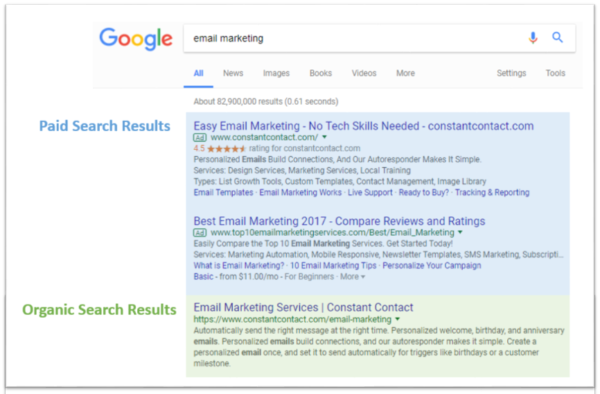
SEO helps you improve your visibility within the organic (or natural) search results, not to be confused with the paid search results.
what is SEO example 1

Want see what SEO can do for your business? Join us for a FREE webinar: How to Show Up on the First Page of Google (And Get More Business from Your Website)


Why is SEO so important?

If you don’t optimize your website for search engines, you risk losing potential customers to your competitors because their websites appear higher in search engine results than yours.
Think of how many times you turn to Google each day to find out which local bakeries have gluten free options or where you can get new sandals at a good price.
When someone searches for information that relates to the products and services you offer, you want to show up.
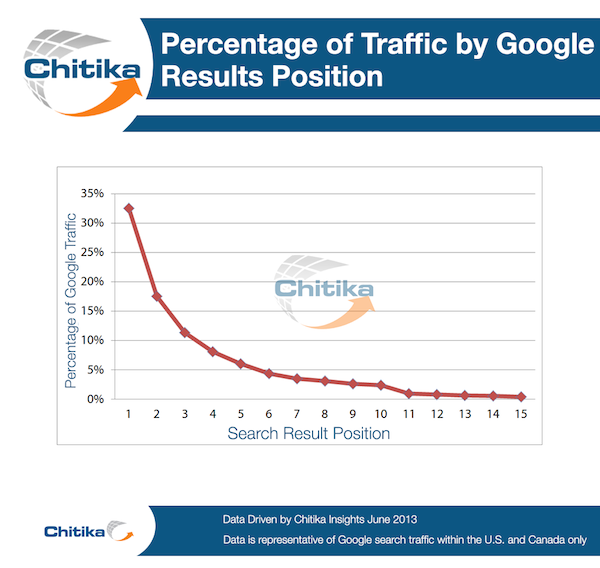
And ideally, you want to show up prominently. Research shows that 60 percent of traffic from Google searches go to websites that appear in the first three search results.


How do search engines determine where your business ranks?

Search engines use algorithms to help provide people with relevant information.
To make sure your website appears on Page 1, rather than 27, you need to focus on building authority on key topics related to your business.
Your website’s authority is determined through onsite and offsite factors.
  • Onsite, search engines give higher rankings to websites that regularly publish fresh content on a specific topic. If you own a real estate agency, for example, publishing regular blog posts on home buying tips would start establishing your online authority.
  • Offsite, search engines like to see that websites other than your own are linking back to your webpages. When other websites link to your content or people share your content on social media, you have a better chance of being listed prominently in search results.


How can you get started with SEO?

Influencing search engines takes time, but it pays off when you start reaching a relevant audience. If you’re just starting out, it’s best to get really specific with your focus.
Rather than writing about general home buying tips, publish content on your website that answers specific questions related to your audience.
Going back to the real estate example, things like: When is the best time to buy a home in New England? Or What is the Boston housing market forecast in 2017?

And once you start writing content, start establishing some early authority by promoting it in your email newsletter and on your social media channels.

Source

Sunday, 24 September 2017

3 Important SEO Steps to Take Right Away


What if we’re thinking about SEO all wrong?

You won’t be shocked to see such a question posed on this site — one that harbors posts in its archive with headlines like SEO is Dead and What if You Could Simply Eliminate SEO from Your Life?

Don’t get me wrong: we’re not anti-SEO.

Heck, we were recently awarded a U.S. patent for the Content Optimizer we developed that now powers the SEO tools bundled with our premium WordPress hosting.


We’re just anti some of the misguided notions and incomplete narratives about SEO that masquerade as good advice.

And one of the most fundamental mistakes I see people make is not fully appreciating the full breadth of each of the three terms that comprise S-E-O: Search. Engine. Optimization.

Notice the placement of that first period after “Search.”

It’s time to think beyond traditional notions of “search engines”


It’s easy to group the terms “search” and “engine” together. And for a long, long time, it made sense to do so.

When we used to discuss “search engine optimization,” we were mostly talking about searches typed into Google, perhaps Bing, or (going back further) Yahoo.

But now it’s 2017.

The new search


Gone are the days of only typed searches. People now conduct more and more searches with voice commands. A recent article on Forbes, 2017 Will Be the Year of Voice Search, makes a compelling case.

And who knows what will happen when we all have chips implanted in our brains that can read our thoughts. We might just be able to think our search and get results via the screens on our contact lenses. 😉

Bottom line: our notion of “search” is changing.

The new engine


Gone, too, are the days of Google being the be-all and end-all as an engine for search.

YouTube has long been hailed as “the world’s second-most popular search engine.” If you’re producing videos, they need to surface for relevant searches on YouTube.

The same concept applies to Apple Podcasts (formerly iTunes). You better believe I thought long and hard about my optimization strategy for the world’s most popular podcast search engine when I launched this show recently.

And think about how many searches Facebook must be getting these days. Even Twitter too. Your social posts are one step removed from your website content … but still one step closer than the person searching was a few seconds prior.

Bottom line: our notion of which “engines” are worth our time to target is changing.

And let’s not forget about optimization


It’s still critical:


You need to structure and deliver your content in such a way that all relevant engines will be able to locate it, understand it, and serve it up in that critical moment of high-impulse and action-oriented curiosity when people perform searches for relevant terms.

And while there are always subtle tweaks you can make to improve your chances of ranking higher based on the particular algorithms each engine uses, many of the factors different engines use are generally quite similar.


So your goal, as a content creator, is simply to make your content as optimized for being found in relevant engines for as many different types of search inputs as you can.

That is search engine optimization on the modern and future web.

And if you’re thinking about SEO in any other way, you’re making a critical mistake.

SEO still matters


You’re also making a critical mistake if you’ve started to believe that SEO no longer matters. It does. Perhaps even more so, and in a more wide range of ways than before.

And it will matter for as far out on the horizon of the internet as I can see.

In some form or fashion, it probably always will — which is why continuing to hone your SEO skills is so important.

So, let’s discuss three critical (but pretty simple) steps you can take right away to improve each of the three elements of your SEO practice.

These are steps that will help you maintain a smart, consistent SEO practice that delivers reliable results into the future.

Step #1: Listen (carefully) to your audience


The first step — which relates to search — is to make sure you actively work to understand the language your ideal audience uses.

That is how you ensure your content has as good a chance at surfacing for text-based searches as it does for spoken searches and, eventually, for thought searches.

Certainly, using tools to search Google’s keyword database is helpful.

For example, the Content Optimizer tool that is built into StudioPress Sites, which I mentioned earlier, can help. This type of analysis provides a valuable window into the terms and phrases people actually search for when looking for content related to your topic.

But remember: this is just one context.

What about when people talk about your topic? What about when they ask casual questions?

This is where social media can be a great listening tool. This is where going to meetups and talking to real people in person can be helpful. This is where free-response audience surveys can provide great insights.


True masters of search engine optimization are masters of listening and empathy.

When you know how your ideal audience talks about your topic, and what kinds of questions are most pressing, you have the knowledge you need to create titles, subject lines, and body content that will be relevant for a wide variety of different semantic contexts.

I know you’re a content creator. Starting today, be an even more active listener than you already are.

Step #2: Focus on more engines


The second step you should take is to brainstorm all the different engines where people may be looking for the type of content you create … and then figure out a way to get yourself into a new one.

For example, consider YouTube. Do you have any videos uploaded to YouTube that answer the kinds of questions that a subset of your ideal audience is almost surely typing into YouTube?

If not, get one in there.

Seriously, start with just one. Do it as an experiment.

The production doesn’t need to be complex. Just take a portion of a blog post and turn it into some text and basic imagery that has a voiceover or background music. If you want some help doing this, check out a site like Lumen5.

Then choose your title wisely and provide a useful description, so that YouTube will know what your video is about and display it in results for relevant searches.

Try it out and see what happens. Then keep identifying new engines where you can add your content.

Step #3: Make sure your website is search-friendly


The third step you should take, which will help immensely with your optimization, is to make sure your website has the most solid foundation it possibly can.

Because when it comes to any search context (text or voice), and when it comes to any engine that may deliver your website as a result (think Google or Bing, but also social media), you need to make sure the hosting and design infrastructures of your site have all the basic elements in place:
Your site needs to load fast — a factor that actually influences several different ranking factors because of how it impacts a visitor’s experience.
Your site needs to be mobile-responsive (or even mobile-first).
Your site needs to be safe and secure.
Your site needs to be coded clearly and cleanly.

I could go on, but I think you get the point.


It’s not just about the words on the page. It’s also about every single element of the page that will impact the experience that search engine robots and real-life visitors will have on that page.

That is why, for example, StudioPress Sites was built to be fast and secure.

And that is why, for example, the Genesis framework was built to be mobile-responsive and as clean as possible, in terms of code.

I chose those as examples because I use them for my personal websites. And sure, I work for the company who makes them, so that’s easy for me to do.

But I am a serious website owner. My side projects are important to me. If I thought I was compromising my site’s optimization just to use Genesis themes or StudioPress for hosting, I wouldn’t.

Take this opportunity to review your current theme framework and hosting. Double-check you aren’t making any optimization tradeoffs either.

A question for you


So there you have it.

We discussed the critical shift in your SEO mindset that you should make right away, which will help you get better results today and well into the future.

And we’ve discussed three steps you can take immediately to put that new mindset into practice:
Search: Listen better and empathize more.
Engine: Identify new engines where your content should appear.
Optimization: Make sure your hosting and website design have a solid foundation.

So, the question is …


Now that you’re motivated by your fresh, new mindset, which step will you implement first?

Comment below.


Perhaps the public proclamation of your intention will inspire you to actually put it into action. 😉


Source

Tuesday, 13 June 2017

Video Content: Super Fun! Super Effective.

 Content creation is such a huge slice of the Internet marketing pie. Ever had someone cut a piece of a pie, and then joke that the rest of it is their piece? When content creation does that, it's not joking.
Google updates its algorithms all the time,
This isn't news, but the changes aren't complicated to understand, either. Basically, it's all about providing value to site visitors. And what do site visitors want? Quality content. BAM! Just like that, you understand it.
And in today's day and age of digital media, it's not all about written articles. Multimedia content opens a whole world of possibility to marketers and audiences. If you do it right, you can score viral levels of attention for your website with video content. 
Not convinced? Check this out...

The Benefits of Video Content

There are SO MANY benefits to using video content, but here are the top three to be aware of:

1. You Can Target Multimedia Search Engines Like YouTube

When we hear "search engine," the names that come to mind are Google, Bing, or Yahoo. It's true that people find videos through those means, but more often than not, people bypass these search engines to search directly in the likes of YouTube or Vimeo.
If you don't have anything to show for their search, you're missing out on some potential traffic. You can see just how much you'd be missing out on in this snippet of an infographic from a Marketing Tech Blog post:
benefits of video content infographic
As you can see, YouTube is the second-biggest search engine (after Google) with more than 4 billion views per day. It's another way for people to find you, so why not take advantage of that?

2. People TRUST Video Advertisements and Recommendations

Yep, that second half of the infographic snippet above is bang on, too. Whether it's because they don't think scammers and spammers would bother with video production, or it's the human element that the visuals and audio can give to video content, consumers trust it.
Videos starring yourself (or a friend, if you're a little camera shy) can be the easiest of all to make, and the most endearing to an audience. Got a webcam? Or a phone with video capability? Then you're most of the way there! More about that in the "how to" section below...

3. It's Just Way More Interesting

People need to be entertained. They're fussy. Even when they want some boring information about a boring product, they want it to stand out and entertain them. Some brands are fantastic at it. 
Here are two boring products with fantastic interesting videos to draw attention to their product and brand:
"Purina Friskies" Cat Food:
"PooPourri" Air Freshener: 
Two boring products, cat food and air freshener, but I have seen these videos passed around friends just for entertainment. That's lot of exposure to people who weren't even searching for those products, but might need them either now or in the future. And that kind of video stays with you for a lot longer than a boring ad.
With the Internet constantly at people's finger tips, they're like a lazy emperor sitting on a throne, waving his hand absent-mindedly as he commands some poor visiting performer, "Entertain me, or I will cut off your head and move on without a second thought."
You need to catch consumers' attention as they watch videos on their iPads, sitting on their "thrones." So the next question is: How?

How to Create Video Content People Actually Want to Watch

The best way to tell you how to do it is to answer four basic questions about video content production.

1. Where Do I Start?

Everything must start with a concept! For some, this is the most fun part. For others, it's a dreaded mission akin to getting that dastardly ring to Mordor. Either way, the best advice I can give you is to look around for inspiration. 
YouTube Searches for Concept Research:
  • Funny ads
  • Your niche name
  • Your product type (e.g., cat food)
  • Your product type reviews
  • "How-to" videos related to your niche
See what comes up, and just watch the videos that naturally stand out to you, not the ones that are boring. What makes them interesting? Do they still have enough information about the product? Think about what you would ideally like to create.
Obviously it doesn't have to just be a narrative video. You might want to just review a product, or create a how-to, but this research should still give you ideas for how you could add an interesting touch to your videos. 

2. What Do I Use to Record my Own Video?

You basically have 4 main options for filming your own videos. They vary in quality and cost but they're all great options to get some video content going.
  • Webcam
    • Great for product reviews, or for how-to's if your webcam is portable, like a laptop cam.
  • Phone camera
    • Super portable, great for filming in any location without hassle, especially for short clips or "vines."
  • Your own camera
    • Own your own camera already? Great! Get some use out of it, play around with what you can do around the house or neighborhood...
  • Hire a videographer for a more professional video
    • This is obviously the most expensive option (unless you invest in a professional-grade camera of your own), but if you're already making some cold hard cash, it can be worth investing in this to get one or two key brand-promoting videos in circulation on the web.
Video production doesn't have to be hard or complicated. You just need to play around with a little trial and error to get your head around what you're filming.
After all, I hear that Albert Einstein was a pretty smart dude, and he said himself, "A person who never made a mistake never tried anything new." It's not about being Steven Spielberg straight away: it's about giving it a go and finding your groove over time, and having some fun along the way.

3. To Stock Footage or Not to Stock Footage? That is the Question...

If you don't want to do any of your own filming, you can always use some stock footage. I need to warn you though, that stock footage can look really, really bad... If it's too obvious, then you're losing a lot of the genuine nature that video content can bring to your brand as it starts to look outright fake and boring.
I'm not saying you can't use stock footage, I'm just saying I want you to do it right.  Make sure that it's high quality... While perusing the Interwebs, as the kids these days call it, I came across this stock footage video:
This video was made by the stock footage site dissolve.com, which makes it another great example of entertaining brand promotion. 
The footage itself is fantastic and beautiful, and you could use similar stock footage with amusing and obvious narration to make a point about your brand and why it's awesome. 
Other good stock footage sites include...
I think the ultimate rule with stock footage is to not use it too seriously. If you are using it in a light or comical way, or even an inspiring story (being careful not to be cheesy or cliché) then it can be really great. 
The bonus with stock footage is that you only have to do the audio. For this you have three main options:
  • Record it yourself: Again, a phone or webcam mic will do in a pinch.
  • Hire a voice actor to do it: You can find them on sites like Fiverr. 
  • Use royalty-free music and subtitles for the message you want, either throughout, or just a title at the end to make your point.
    • Once again, be careful not to be too cheesy or cliché.
    • It's a good idea to use royalty-free music in the background of narration too, not just when using subtitles.
    • You can find royalty-free music by searching for it in Google, but you'll either have to pay for it, or hunt around to find something that's free AND good, which can take a little while... I know because I've done it myself!

4. What Do I Use to Edit my Videos?

Video editing can be the most daunting part for some people. I use Adobe Premier Pro personally, but that requires a bit of money and effort to get and learn to use properly. If you want something simple that won't break the bank, here are two great options for you:
Alternatively, you can hire a video editor to do this for you. A cheaper option would be to use a freelancer, once again from a website like Fiverr. 
If you have a little more spending money to play with and you're after something really professional, even if you filmed the footage yourself on your phone, use a service like Candidio. These guys are really friendly. They gave me a Skype tour of what they have to offer, and I have to say it looks pretty darn good! 
Any of the above options are fine. None of them are "right" or "wrong"; it all just depends on your budget and preferences.

The No. 1 Tip for Video Creation

I want to leave you with my own personal number one tip for creating great videos...
Just have fun!
It sounds silly, I know, but I can't stress this enough. Not only will it keep you motivated to keep working on your videos; it'll keep your videos interesting. If you find it boring, chances are others will too. If you have fun with it, chances are that will show through in the final product. 
Life is too short to make bad videos. So have fun, and make great ones instead. Get some friends to help you out with ideas. Make a day of filming, and do some bloopers for you and your friends to watch with a cold beer or two at the end of the day.
Interview someone who's passionate about the topic of your niche. There's likely someone in your local community who will have a job that aligns with your niche topic, or some students who study it. 
Whatever you do, just give it a go, get something up, and see if you can't get some nice new traffic opportunities for yourself.
A quick final note: Just like with your written content, it pays to do a little keyword research for your title to make sure that people can find it easily in YouTube or even via Google. You can easily do that using the keyword research tool in AffiloTools here. If you're not very familiar with keyword research yet, or it's something you struggle with, there's a free lesson for you here. 
And of course, feel free to comment below if you have any tips for video content that I haven't covered. We'd love to hear 'em!