Showing posts with label Video Content Marketing. Show all posts

Saturday, 17 March 2018

How to Increase Audience Engagement on YouTube using Content Marketing Tools


YouTube is an indispensable platform for social media and content marketers, especially now that audience members are consuming YouTube content like never before. People are spending as much as 72 minutes a day watching video content, and marketers are keen to make the most of this trend to increase audience engagement. However, engaging an audience on a highly competitive platform such as YouTube can be tough. But with the help of the right strategies and content marketing tools, you can have the impact your desire on the social media platform. Here’s a 3-step process to increasing audience engagement on YouTube using content marketing tools or content curation apps such as DrumUp.
 

1. Create channel(s) on YouTube for your types of content

Many people do a great job on this first step. They create excellent content that’s on-point, timely and entertaining. Some brands choose to have one central YouTube channel where they publish all of their content, while others split their content based on categories across multiple YouTube channels.
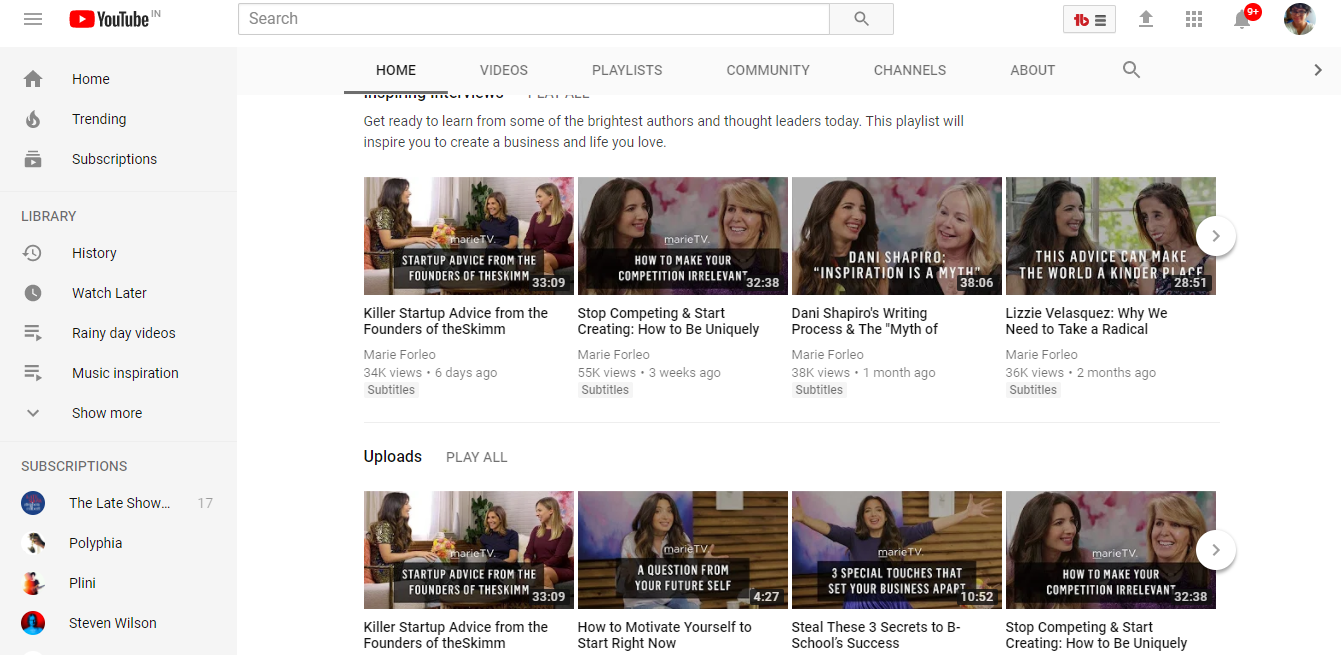
Irrespective of what you choose to do, it’s critical to first have a channel that contains your content. This is your home-base using which you will attract and engage your target audience. Marie Folio’s YouTube channel is a great example. Her brand focuses on start-up advice and inspiration.

4
 

2. Create visually-enticing design

Apart from having a channel for relevant content, it’s also critical to have great design, so you can attract your target groups’ attention.
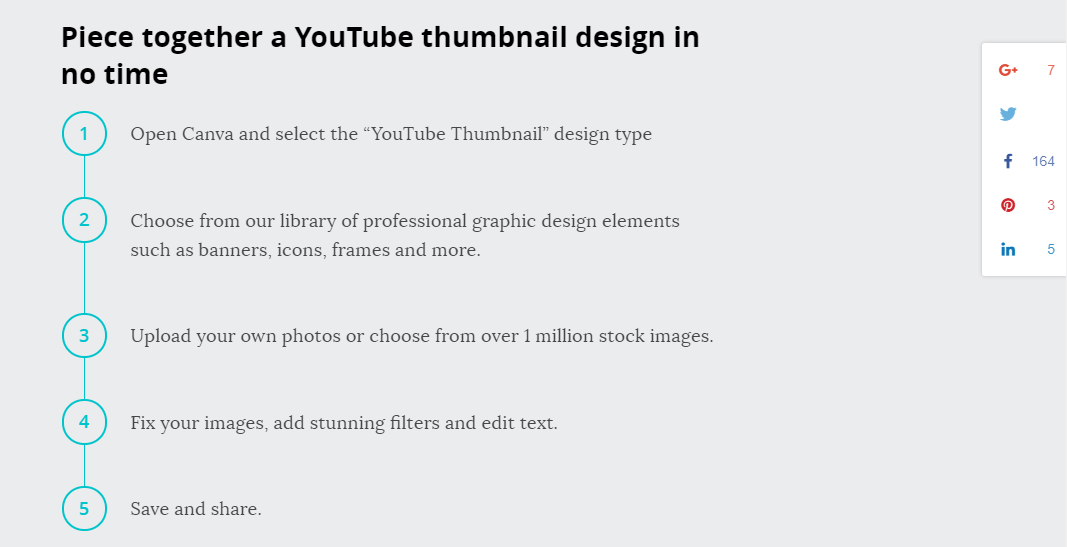
Great design is a combination of having great video titles and alluring thumbnails. Clickbait still works, but how much of clickbait you apply depends on the tone of your brand and your personal preferences. It’s also important to consider displaying your most interesting stills as thumbnails on videos. To do so, you can use photo editor and graphic design tools such as Canva, which allow you to alter already-existing templates for your use.

5
 

3. Promote YouTube videos to your social media followers on Facebook, Twitter and LinkedIn

YouTube by itself is difficult to run, if you’re not already viral or popular. But you can use your existing following on Facebook, Twitter and LinkedIn to increase audience engagement on YouTube.
Here’s an effortless way to do it using DrumUp’s RSS feed reader & content library.

Path 1 – Automatically share YouTube videos to Facebook, Twitter and LinkedIn as soon as they are published.

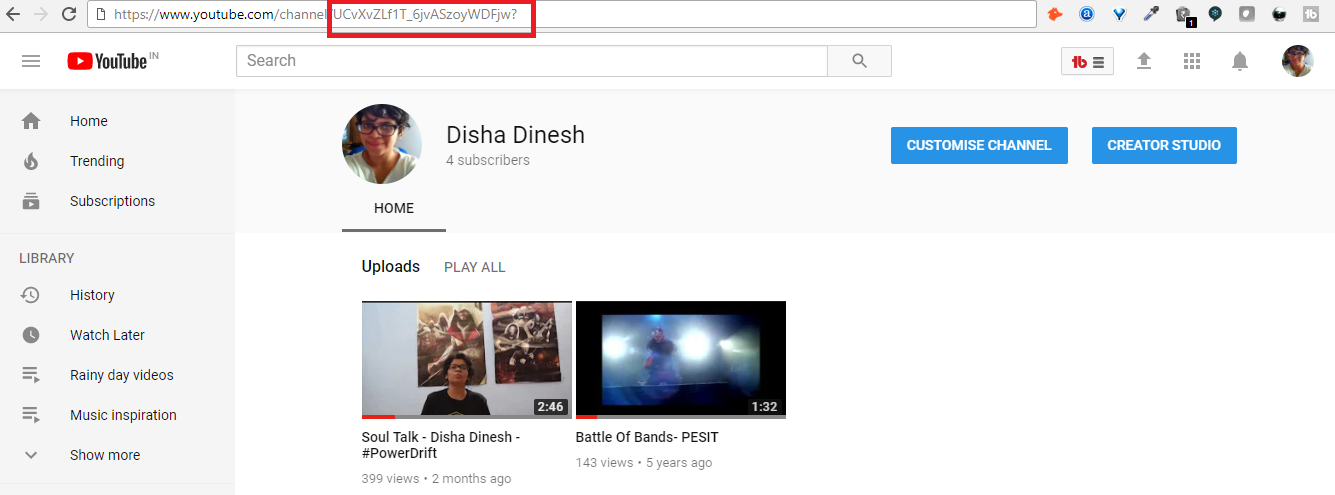
  • Go to your YouTube channel and get the channel ID.

6

     
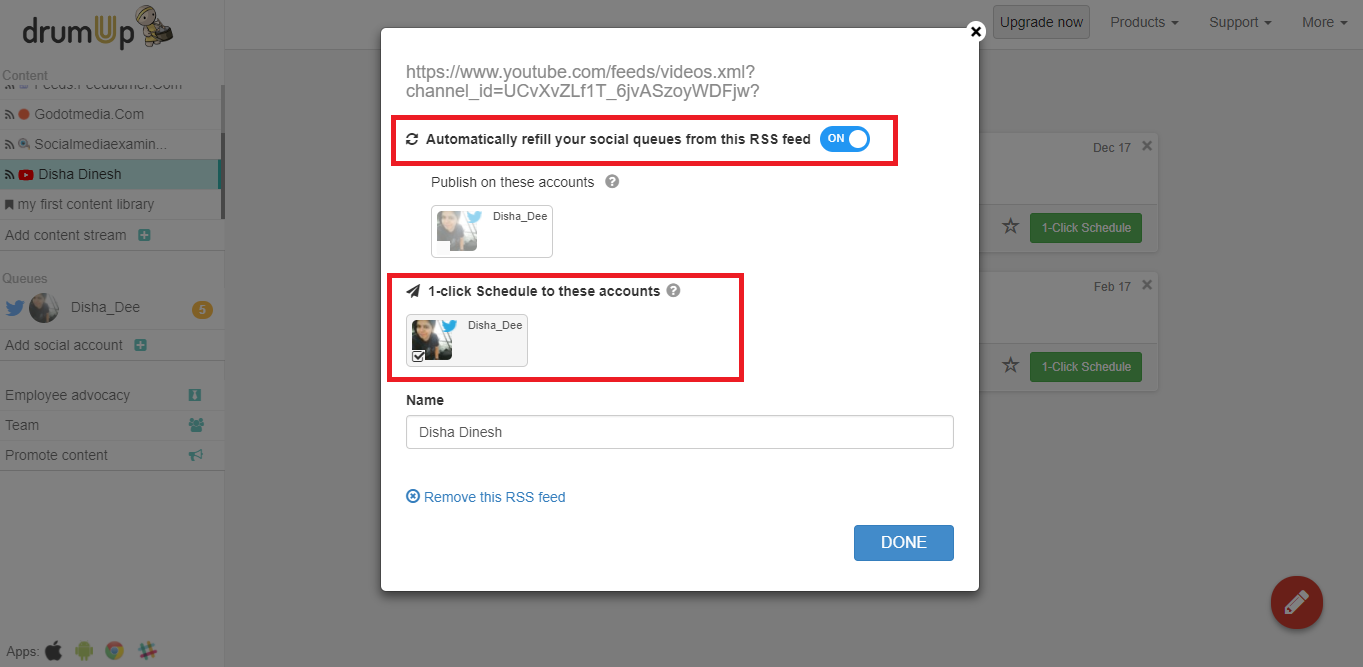
  • Insert the channel ID to this URL https://www.youtube.com/feeds/videos.xml?channel_id=<channelIDHERE>.
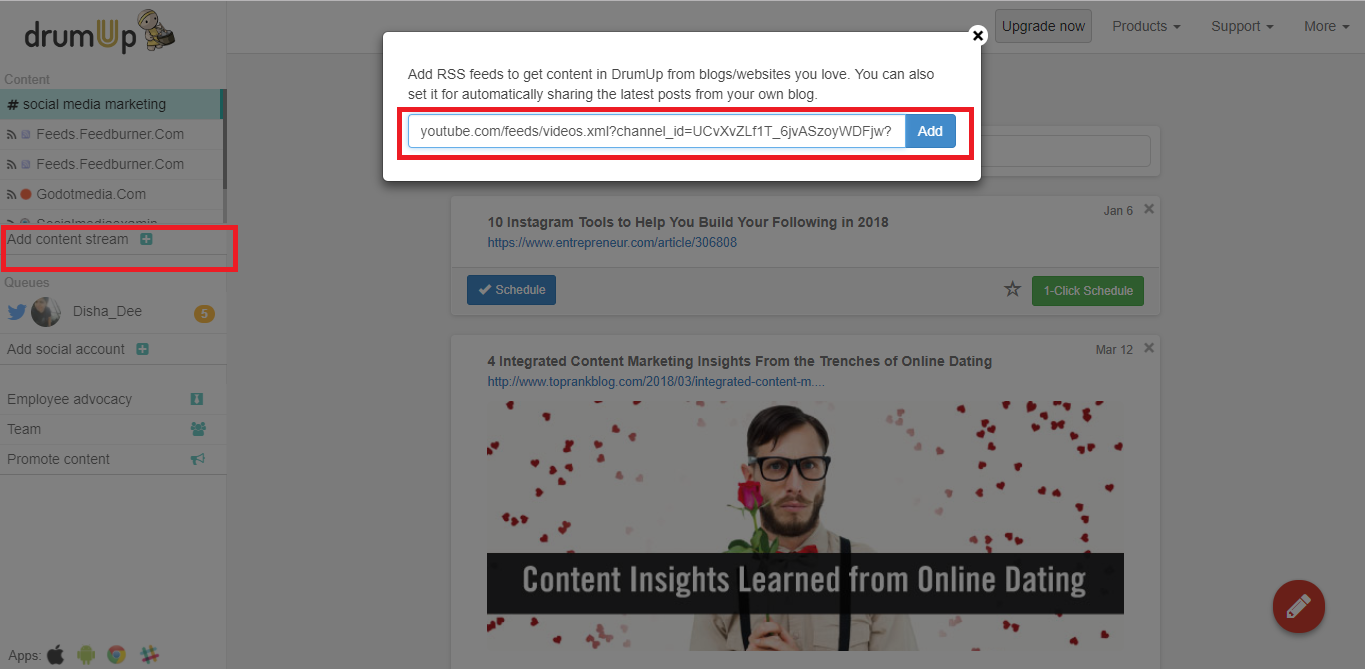
  • Add the complete URL to your DrumUp feed reader.

7

     
  • Choose between custom/1-click/auto scheduling to share content on your attached social media (Facebook, LinkedIn and Twitter) accounts. DrumUp will automatically take you to the screen below once you have added your RSS feed.

8 

Path 2 – Share evergreen videos automatically every once a while to your audience to keep them engaged.

  • Follow Path 1 from Step 1 to Step 3.
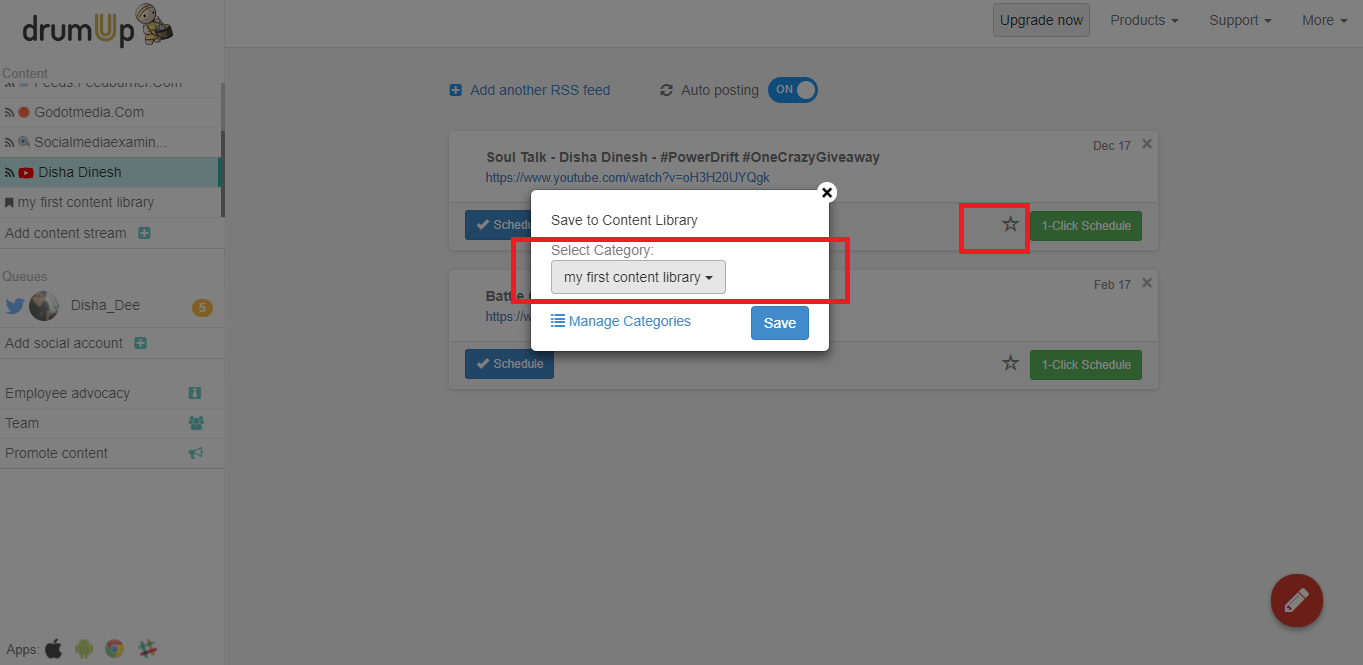
  • Once your YouTube posts appear in the feed channel, choose the videos qualify as “evergreen videos” and add them to a content library by clicking on the Star icon.

9

     
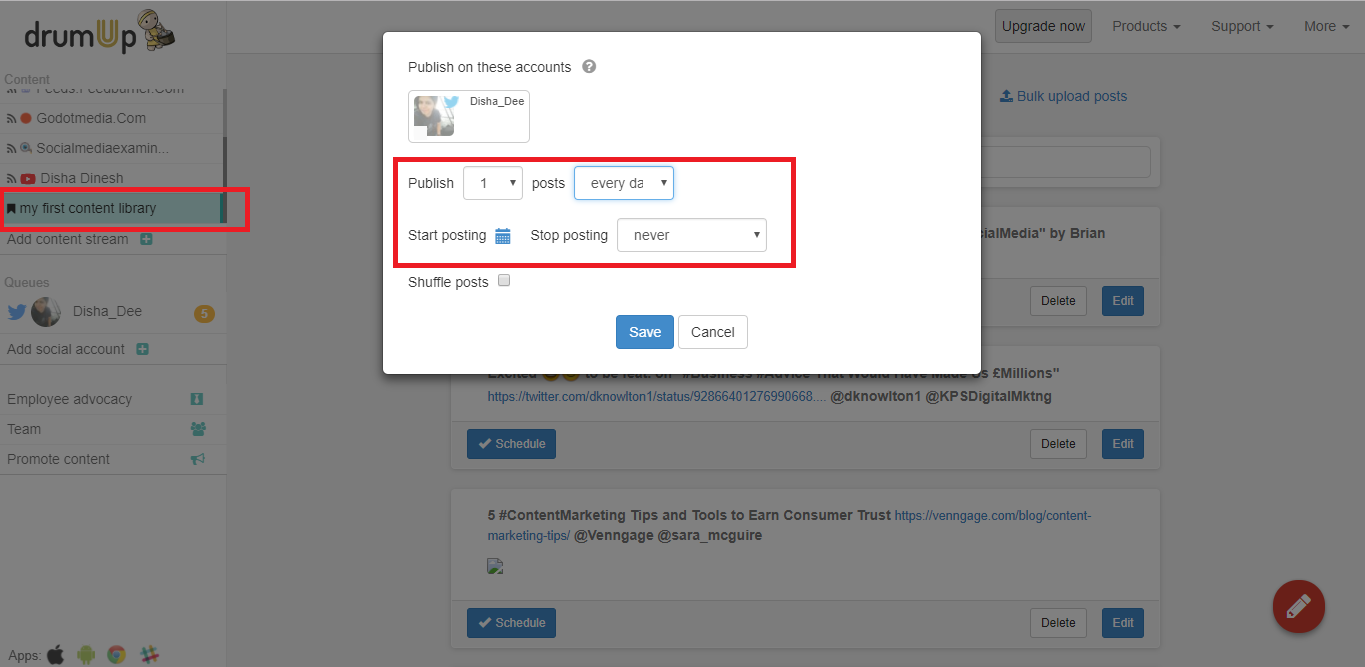
  • Once you have filled your library, choose automatic publishing and set a frequency to keep your audience engaged.

10 

You can apply Path 1 and Path 2 to your own YouTube channel, and/or any other channels that publish content relevant to your target audience.

Video content can be powerful to engaging your audience and convincing them to eventually convert into paying customers. All you need is the right set of content marketing tools and strategies.


Source

Saturday, 10 February 2018

21 Top Social Media and Content Marketing Trends for 2018 – The Ultimate List


It’s official. Brands are now fully invested in social media, having extinguished all doubt about the effectiveness of the medium. Top brands are even experimenting with their social media and content marketing strategy by embracing the latest trends.
As we approach the new year, reviewing past social media marketing performance and planning2018’s strategy becomes an important concern. According to our research, these are the 21 key trends that will have the biggest impact on your social media and content marketing strategy in 2018.

1. Brands will feature more User Generated Content

It turns out that consumers’ trust in brands is on the decline, as corroborated by this study, and brands need new ways to gain consumer trust. UCG or User Generated Content plays the perfect solution by humanizing brand content and increasing social media engagement.
According to a study conducted by TINT, about 70% of 500 social media marketers believe that UGC makes their marketing more human and authentic. Lifestyle brands like Starbucks and AirBnb have focused their social media campaigns on UGC right from the beginning. The result? Epic campaigns like this one.

Alternatively, you could consider curating content suggested by employees. DrumUp employee advocacy platform allows employee-users to suggest content.

2. Brands will invest more in reputation management to combat fake news

At the end of August 2017, Pew Research Centre recorded that 67% Americans looked to social media for news. That is appalling, considering that social networks, particularly Facebook, faced serious allegations of influencing the US Presidential elections in 2016. But it’s not just the politicians who are affected by fake news.
A few months ago, Starbucks fell victim to the scalding effects of fake news when a post complete with the company’s logo and standard fonts, claiming that the company would give away free frappuccinos to undocumented immigrants, went viral. The claimant even created a hashtag – #borderfreecoffee. It’s tough to control damage once a post has gone viral, which is why brands will invest more next year in reputation management.

3. Messenger chatbots will grow in popularity

In July 2017, Facebook launched “Discover”, a hub inside its Messenger app, to help developers discover and test chat bots. The hub, which is searchable, catalogues available Messenger bots. This, however, is the least of the support that Facebook has shown towards bots, the most being that Facebook messenger’s core algorithm itself has chatbot features built into it. “M”, Facebook’s chat assistance is aimed at enabling automatic interactions between brands and fans.
Chatbots hold a lot of potential is providing instant customer service, and we know that social media users prefer the platform for customer service and expect quick responses.

4. Brands will invest more in disappearing content (24-hr stories & posts)

Snapchat disrupted social media by introducing disappearing content. Since the launch of the company, every social media platform has noticeably incorporated some form of disappearing content. And social media users are loving it. According to this report, Snapchat gets about 10 billion daily video views, slightly more than Facebook does. Facebook has responded to the competition by introducing Facebook stories, temporary profile images and camera effects.
There’s a lot that disappearing content has to offer to brands, such as the opportunity to experiment and make mistakes, and use the psychological principles of urgency, timelessness and instant gratification in their marketing.
Check out how WWF (World Wildlife Federation) used Snapchat for the #LastSelfie campaign to depict the urgency of saving endangered species.

5. Influencer marketing will go mainstream

According to Pardot’s latest study, 95% of the social media marketers who work with influencers find the partnership beneficial. Since it’s getting harder to focus on certain target groups on social media, and paid advertising isn’t a stand-alone strategy, marketers will continue to rely on influencer marketing to connect with target groups.
Many consumers, especially those belonging to “Generation Z”, prefer organic brand engagement to being force-fed advertorial content. Gradually, social media advertorial content is being replaced by subtly promoted influencer content.

6. Video content will dominate social media feeds

While video content was prominent in 2017, it will grow even more important in 2018 with Facebook, Snapchat and Instagram focusing heavily on animated content. 76.5% of social media marketers who participated in a survey said that social media video marketing had a direct impact on their business.
Owing to the effectiveness of video marketing and the popularity of video content on social media, social media marketers are likely to continue to heavily invest in video content.
Brands use video for anything from product advertisement to general customer engagement on social media.
Check out LG’s #LowBatteryAnxiety campaign, which was a combination of both.
LowBatteryLife

7. Brands will focus more on creating an impressive social media footprint

The “noise” on social media is very evident. Businesses small and large have begun to use social media for marketing and the result is a mess of content, a lot of which is irrelevant to social media users. To survive the saturation, social media users have begun to find trustworthy sources (for instance pages on Facebook) to follow for all of their news. This has made it difficult for brands to engage their target audience on social media, causing a rush between them to attract and keep loyal followers.
In 2018, brands will try to create more impressive social media footprints to keep their followers hooked. An important part of this exercise is the curation of quality content, original or otherwise and staying at the top of any niche.
One way to create an impressive social media footprint is by curating relevant content from your industry using a content curation app like DrumUp. You can also use the app’s @mention suggestions to notify other users when you share their content.

8. Costs of paid social media advertising will rise

As a result of declining organic social media reach in the last few years, many businesses have begun to rely entirely on social media ads (2017 saw a 74% increase in spending on Facebook ads). This in turn has led to a dramatic increase in the number of social media advertisers. As the demand for social media ads increases, so will the cost for social media ads.
True to the demand-cost relationship, CPM for Facebook ads has risen by 131% and CPC has increased by 136%. However, with the wide range of outlets available for paid social ads, marketers might seek to spread their spending across social networks and ad types.

9. Micro-moments & moment marketing will take centre-stage

Social media marketers are feeling the pressure with the increasing costs of social media ads, focus has shifted to better management of ad costs while maximizing ROI. Moment marketing allows marketers to focus their budget around an event that is likely to increase traction for their brands.
Some marketers are spreading their budgets evenly across frequently occurring micro-moments or “anytime campaigns”, such as weather changes, competitor advertising or flight delays. Other marketers are more focused on macro-events like the Super Bowl. Here’s what Oreo did during the Super Bowl blackout.

10. Live video and interactive broadcasting will be utilized more by brands

Several typically televised shows have begun to broadcast using social media. The 69th Emmy awards was broadcast by the Television Academy and CBS on Facebook Live, with the Backstage Live! Show commanding over 2 million viewers.
Live streaming via social has changed broadcasting, because brands can now easily turn any offline event into a live event, instantly reaching far more than the audience they can accommodate at a fraction of the cost. Live streaming also increases engagement because the viewers can express themselves and interact with other viewers during broadcasts.

11. Employees apart from executives will also focus on personal branding and thought leadership

According Edelman Trust Barometer 2017, consumer trust in CEOs is lower than consumer trust in employees. Brands are beginning to encourage all their employees to build impressive social media profiles, just as employees themselves are beginning to take interest in personal branding activities.
non c suite exec
In 2017, posts from mid and ground-level employees discussing industry issues began flooding LinkedIn and other social networks. 2018 will only see more of such posts.
Brands stand to benefit a lot from employees’ personal branding, with the benefits affecting everything from brand perception to sales and recruitment.

12. Omni-channel marketing will become all-important

According to a Business Insider study, 47% shoppers engage with brands across 10 or more channels, and such shoppers spend 93% more online and 208% more in stores than other customers. Chipotle and Sephora are two great examples of successful implementation of this strategy.
Omni channel marketing
In 2017, brands spent a lot of money ensuring that customers get a seamless experience across channels, and that spending is only bound to increase in 2018. Until social media merges and brands can target customers on one centralized platform, omni-channel marketing will remain a matter of focus.

13. Mobile-focused content will be prioritized as Facebook makes a 100% shift to mobile

At present about 80% of Facebook’s revenue stems from mobile ads, and Contently predicts that by 2020, 59% of US Facebook users will shift to mobile-only usage. Considering this and the fact that major social media players Instagram and Snapchat are already mobile-focused, social media marketers will focus all the more on mobile next year.
Clearly, mobile social users engage with brands more, and brands can benefit from creating content specifically for them.

14. Instagram will overtake Facebook with brand engagement

Bloglovin, an influencer marketing platform, conducted a survey of 2,500 micro-influencers and found that 60% of them saw better engagement on Instagram as compared to engagement on other social media platforms. The reason for this trend is straightforward. Instagram has mobile-focused functionality and is visual in nature, both of which are effective in engaging today’s fickle and overwhelmed audience.
As Facebook races towards as all-mobile presence, Instagram will build on their already solid mobile foundation, leading the audience engagement game and helping brands achieve their goals.

15. Machine learning will transform how marketers run social media ads

There’s more math involved in social media advertisement than many social media managers might care to manage. Plus, there’s only so much accuracy that any human can deliver. That’s why brands are now investing in machine learning based ad management platforms to optimize their social media advertisements.
There now exist social media ad platforms that can run entire campaigns at optimal costs, given only basic campaign parameters. These platforms are even able to identify and set target audiences and choose campaign creatives based on predictions of what would perform best.

16. Facebook’s affordable VR headset will introduce a new playing field for brands

According to a Bloomberg report, Facebook plans to release an affordable VR headset codenamed “Pacific” in 2018. Bloomberg’s source has hinted that the headset will be unlike any available at present, being a standalone device and requiring no external source of power.
After Facebook’s launch of 360 degree photographs and video earlier this year, one can only wait to see what brands will do with these features once the new version of the VR headset hits the market.

17. Facebook Watch will give YouTube a run for its money

On August 9, 2017, facebook announced the release of a new video platform to view television-like shows called Watch. While the initial response (in the US region) was optimistic, the platform’s video views saw a dip in consequent episodes of the few series that were aired. However, this dip doesn’t seem to be a cause of worry for Facebook, because the platform might invest as much as $1 billion in Watch in 2018.
While many might see Watch as a move to compete with Netflix and HBO, the video platform is actually a direct attack on YouTube. The first round of shows commissioned for Watch star YouTube influencers who will bring their fan base along for the ride. Facebook is likely to monetize the video platform once it has an established MAU community.

18. Chatbots will transform personalized shopping and customer service

Clothing brand Tommy Hilfiger was among the first brands to use Messenger’s chatbots after their release. The brand’s chatbot is more than just a shopping assistant, having the ability to engage in intelligent conversations to the extent of offering fashion advice.
tombot
Facebook’s chatbots have proved that social media can drive sales, via automation. A brand doesn’t even have to invest in executive level community managers to engage with prospective customers anymore, as was the norm for community engagement in 2016. Brands can now develop chatbots or subscribe to platforms that offer chatbots to automate chat assistance. This only spells good fortune for personalized shopping and customer service on social media.

19. Brands’ presence on messaging apps will increase

At least 2.5 billion people use messaging apps, globally, but many brands still focus primarily on the web version of social media platforms. In 2018, however, as social networks themselves begin to focus on messaging platforms, brands will also begin to make the shift. Chatbots, in the form of intelligent assistants, will help brands manage conversations with their audience via messaging platforms.
At present, brands are already using mobile-focused platforms such as Instagram and Snapchat to target younger audiences. Some brands are also using Whatsapp and Hike to communicate directly with prospective customers.

20. Augmented reality & 360-degree video/photography will dominate experience marketing

Today’s audience wants an immersive experience, according to a YuMe study, and brands are working at giving it to them. The existence of AR and 360-degree video/photography helps. For proof of the fact, let us consider the following example. Hong Kong Airlines’ 360-degree ad was found to be 35 times as effective as its 2D version.
AR and 360-degree video/photography contribute an additional dimension to a customer’s experience, making it more immersive and memorable. Brands can use this to bring their audience into their offices, stores and events.
Check out this 360-degree selfie by 301i.
360 degree photo

21. Behavioral data will drive marketing decisions

The advancement of social media technology has enabled marketers to track behavior of users, giving them more insight into the performance of their marketing activities. Until now, most marketers have relied on analytics that measure engagement as events. They are now beginning to rely on analytics that measure audience behavior.
Since social media platforms are becoming more mobile-focused, event-based analytics aren’t enough to understand and predict audience behavior. Behavioral data gives social media marketers insight into what engages their audience and how they can create more audience-centric content.
Summarizing the top 20 social media marketing trends for 2018 –
  1. Brands will feature User Generated Content more 
  2. Brands will invest more in reputation management to combat fake news
  3. Messenger chatbots will grow in popularity
  4. Brands will invest more in disappearing content (24-hr stories & posts)
  5. Influencer marketing will go mainstream
  6. Video content will dominate social media feeds
  7. Brands will focus more on creating an impressive social media footprint
  8. Costs of paid social media advertising will rise
  9. Micro-moments & moment marketing will take centre-stage
  10. Live video and interactive broadcasting will be utilized more by brands
  11. Employees apart from executives will also focus on personal branding and thought leadership
  12. Omni-channel marketing will become all-important
  13. Mobile-focused content will be prioritized as Facebook makes a 100% shift to mobile
  14. Instagram will overtake Facebook with brand engagement
  15. Machine learning will transform how marketers run social media ads
  16. Facebook’s affordable VR headset will introduce a new playing field for brands
  17. Facebook Watch will give YouTube a run for its money
  18. Chatbots will transform personalized shopping and customer service
  19. Brands’ presence on messaging apps will increase
  20. Augmented reality & 360-degree video/photography will dominate experience marketing
  21. Behavioral data will drive marketing decisions

                                                                                                                                       Feature image via Pexels.com


Monday, 18 December 2017

The Video Marketing Funnel: Proof it Works and 5 Easy Steps to Follow


 Everywhere you look right now you can see the virtual cries that "THIS IS THE YEAR OF VIDEO MARKETING!" In fact, as I browsed the internet, researching this topic, I saw that claim absolutely everywhere.


The video phenomenon is a huge hype all over the internet, and it's intimidating. Many marketers think of video as a quicksand pit designed to swallow time effort and money for little reward — especially as they don't feel qualified to make something that could compete in the world of viral media. 
It's such a shame because it really doesn't take much. You can do it, it won't break you or your bank, and the potential reward is awesome. 
I asked content marketing and social media strategist Brian Honigman whether he thought that video marketing was essential for marketing success, to which he replied:
"Video isn't a requirement for success with marketing, but it's one form of content all businesses should consider experimenting with to best reach their audience.
Small businesses need to realize that you don't need a film crew and a studio to create compelling video, if you invest in the proper equipment, choose the right ideas and develop footage that's of use to your audience you can drive results with video for your organization."
— Brian Honigman, CEO of Honigman Media, regular contributor to the Wall Street Journal, Forbes and others
So if you're dead-set against creating video, you don't have to fear that it'll bring you down. However, it's a really really good idea! So where's the real life proof that newbies can rock the world of video marketing? I've got a great new story for you...

The Proof 

An example of an everyday marketer (not a video guru) getting traffic and leads from YouTube. 

I was talking to a colleague the other day, and she was telling me about her enthusiasm for video marketing. Before I continue, it's important you understand the background here.
  • She's not a long-term video expert with oodles of experience with YouTube and video creation.
  • She's just running an affiliate site, like many of the people who will read this post.
  • She has a newish website (roughly 6 months old) and has only been playing with YouTube as a platform for part of that time (about 4 months).
  • Her videos are mostly just PowerPoint words on a screen with a voice-over of her talking, plus a little screen capturing.
  • She doesn't have fancy tech, just the microphone on her laptop. 
However - she has managed to get thousands of views already, and it's only very early days. Check out this image of her latest month:
youtube graph
And remember, this is without complicated Hollywood budgets or skill levels. Just a marketer having a crack at YouTube marketing. She even said, "I'm sure these numbers can be improved on. My channel isn't optimized very well. I've been lazy with that."
So how does she make money from this? I asked her, and she told me about her process and why it works (which I'll cover in more detail for you in the steps below).  
"1) I create engaging videos that are of genuine quality. I teach people new things about my niche, things that make them go "WOW" - things they've never heard before. 
2) I put a link to a squeeze page in my video description and encourage people to sign up to it in my video.
3) My squeeze page redirects to a high-converting sales letter once someone opts in. They also receive emails promoting products.
The reason it works well is that people discover me on YouTube, watch my video and view me as an authority in my niche.
I'd say that for every 50 views, I get 1 sign-up. And for every 10 signups on average, I make a sale (sometimes more, sometimes less, 1 in 10 is a safe number) from my front-end VSL (video sales letter) I redirect them to."
It's a neat little funnel, and there is so much you can do with it! You can get traffic, leads and conversions, and grow your brand reach at the same time. And video isn't like on-site articles; you won't get penalized for duplicate content. You can share your videos across the board on social media. It's the medium that just keeps on giving. 
So now, from my discussion with my colleague and a bit of poking around, I've broken it down so you can take advantage of the process yourself. 

Is Video for You?

You need to assess how competitive the YouTube environment is in your niche to see how difficult it'll be for you to break into. 

While the above example is showing great promise of success, I can't promise that this'll work across the board. You have to think about whether or not your niche will have a lot of competition on YouTube.
An example of this is the ridiculously high number of make-up tutorial videos on YouTube.
make-up tutorial on YouTube
Yep, that's right: 32,900,000 results. Almost 33 million video make-up tutorials. And I can tell from the video thumbnails that the video standard is going to be quite high. If you were to make one of those videos, you'd have a lot to compete with.
In saying that, many niches have under-utilized YouTube, and have a lot of room for new videos. Comparing the above example to affiliate marketing tutorials, you can see there are only 84,200 results, and I can tell from these thumbnails that the videos have a much lower production quality level:
affiliate marketing tutorials
You can do your own search on YouTube for the types of videos you're thinking of making, whether it be a tutorial or how-to for your niche audience, or a video blog series. See how many videos there are, and what kind of quality there is.
If there are masses of high-quality videos, that doesn't mean it's impossible or that you should avoid video marketing. It just means that you'll have to put in a little extra effort when it comes to finding a unique angle so that you can stand out among the crowd or cater to more specific searches.
If there are few videos, or they're really generic and you know you have more to say on the topic, then you should definitely give it a go. 

Step 1: Decide Where You'd Like to Send Traffic

This will help you to sculpt the content of your videos to the target audience of that page. 

You don't always need to send traffic to the same place with your videos, you can change it up and link to wherever on your site is most relevant to each video.
But if you really want a solid strategy for conversions, it's probably best to have an idea of the best place to send them before you create the videos. Here are the top couple of options for you to consider:

Option A: If You Have a Mailing List, Send Them to Your Squeeze Page

Sending your viewers to a squeeze page like the one in the image below is the best option for converting your YouTube traffic into a large amount of enthusiastic leads. 
squeeze page
If you don't have a squeeze page, you should at the very least have opt-in's of some kind on your site or you're missing out on a great deal of leads and ongoing conversions! If you don't have a mailing list and newsletter set up but you'd like to, the fastest and easiest way is via AffiloJetpack, so feel free to check that out if you're interested.
If you do have a squeeze page already, just make sure you've optimized it to get the best results. I recently wrote a blog post about this here, so pull any tips or tricks from there as necessary. 
Think about the type of person you'd like to sign up to your mailing list. What are they looking to know? What are they enthusiastic about? Keep this in mind through the next few steps. 

Option B: Send Them to Your Most Relevant High-Converting Content

The other place to send your YouTube traffic is your content, particularly if your on-site content and the YouTube video add value to one other. 
content
This option is generally for you if:
  • You don't have a mailing list set up, or
  • Your target is to get more engagement for your on-site content
Choose the content that will be the most useful to your audience, preferably something you know that converts well. Think about the audience for this content. What are they looking to do? What challenges are they facing that your site helps them with? Keep this in mind through the next few steps.

Step 2: Create Some Videos

It doesn't have to be rocket science: There are simple ways!

This is the part that frequently turns people off. I asked Brian Honigman about this, and he replied:
"Video seems overwhelming because everyone's fearful that they'll do it wrong or that it won't be perfect. With creating video, it's important to experiment first to see what works and doesn't work for you. There are endless videos, articles and courses on how to do video, it's just a matter of taking the time to find out what works for your business."
- Brian Honigman, CEO of Honigman Media, regular contributor to the Wall Street Journal, Forbes and others
I could spend all day going over your options as far as video is concerned, but thankfully I have a quirky little blog post from not too long ago that covers the topic already in detail for you called, "Video Content: Super Fun! Super Effective."
video content lesson
You'll find what you need to know there as far as how to film or edit your videos simply and effectively, but I'll cover the main points to keep in mind for this purpose here:
  • Look around YouTube for other videos in your niche (how-to's, general discussions etc...) 
    • What do they do well? Anything you could emulate that wouldn't be too difficult to pull off?
    • Is there any way you could do a similar thing but better? 
    • What unique information can you give them?
  • You must think about how your video can help your audience with their problems, or enlighten them to options that they might not have thought of.
  • Make sure you keep your content relevant to the page you're sending people to (whether that's a squeeze page or on-site content).
    • Your target audience should be the same for both.
    • If you're sending them to content, you could even explain the gist of some of that content to people in a video then send them back to the full lesson.
  • Important: Include a call to action in your video!
    • Ask them to click on the link in the description below.
    • Tell them how they'll benefit from going there. Is there a freebie they can sign up to get? Or more useful content there for them? 
    • An example of this might be to say at the end: "Thanks for watching. Remember to click on the link in the description below to get [benefit]."
Once you've created a video or even a short series of videos, it's time to upload them to YouTube. I'll quickly show setting up a channel for anyone who doesn't already have one, and then I'll run through the best process for adding your videos. 

Step 3: Set up a Channel for Your Brand (If You Haven't Already) 

This doesn't take long, and it becomes a neat little brand-associated hub for any videos you create. 

You really do want a channel separate from your regular Google account so that you can personalize it to your brand. If you already have a channel set up, skip forward to step 4. If not, it's really super simple; just follow along the instructions in this step.
Start by making sure you're signed into your main Google account, then head to www.youtube.com/channel_switcher. You'll see a button with "Create a new channel" on it. 
Create Channel
Then all you need to do is fill in a channel name (preferably in line with your brand/website name), and then select a category (which will more than likely be product or brand).
enter details
Then there's just the Pages Terms, and you can click "Done." Simple as that. Once you get into your channel, there are a few areas you might want to edit to align with the images and information associated with your brand. These include a profile picture, cover photo (called "channel art"), and the "About" information for your channel.
Channel Updates
channel description
Quick tips for your channel information:
  • Use the same brand images that you have on your website.
    • This will make the connection between your channel and your site obvious, and strengthen your brand image overall.
  • Have a compelling description.
    • Make sure you state clearly and simply what people will find on your channel.
    • Then add a quirky phrase or some personality; YouTube is for information but also for fun!
Once you've edited these to look like a good channel profile, you're ready to start uploading your videos. 

Step 4: Upload Your Video(s) to YouTube

Think carefully about your title and description. Include all relevant information, and don't forget to link back to your site. 

Whenever you're signed in and navigating around on YouTube, you'll see there's an "Upload" button in the top right corner. 
upload button
When you've got your video(s) ready, simply click this button. Then it's really easy to drag and drop a video in, or you can select one by clicking on the big central icon. 
upload video
Then, while your video is uploading, you can add a title for your video, a description letting people know what they'll learn by watching, and a few tags describing the main topics in your video. 
Make sure that you don't forget to put that link back to your website in the description here, especially if you've mentioned it in your video. Otherwise, it's like inviting everyone to a party at your place and then not being home: Awkward. 
Then click "Publish" and your video is live and ready to go.

Step 5: Spread the Love! Get Your Videos Some Initial Exposure

You need to take your YouTube videos and promote them in a variety of places where your target audience will be likely to see them.

There are a few ways you can get more views for these videos, especially when you've just launched them and they need a base number of views to show that they're worth watching.

Paid Traffic (Optional, Good for Getting off the Ground)

You can direct paid traffic to your YouTube videos by advertising through AdWords here.
I asked my colleague from the case study earlier in this post if she recommended AdWords and she said this: 
"Definitely, I did that. To get enough traffic, I had to pick a really big, open couple of keywords ('dropshipping' and 'dropship') and advertise for all searches using those keywords.
I found for me, the best place for a content-driven video was in the 'recommended video' on the sidebar and in the search results. I think I spent no more than $50; it was really cheap."

Social Media

Often you'll be trying to figure out what you should be posting on social media to build your brand image. In this instance, you get a win-win when you post your videos to social media. You get something of value to share with your followers, and you can promote your video at the same time.
Try to be active on the social media pages of other authorities in your niche. If you see people asking about the topic of your video or you find a discussion in which your video would genuinely be relevant (don't force it!), share it there.

Forums

Forums are not a thing of the past. Many people still use them to keep up with topics of interest to them or to ask questions. This can be a great place to find topics for your videos, but also for you to link to your YouTube videos when they'd be of use. You help others by answering their questions, and you get to promote your material at the same time.

Don't Forget Your Takeaways!

takeaways
So the aim of the game is to go away and...
  • Assess whether or not video marketing will be worthwhile for you.
    • Is your niche particularly competitive on YouTube?
    • Do you have something unique to bring to the table?
  • Create your YouTube channel.
  • Create a small series of videos to begin with.
  • Include a CTA in your video.
  • Upload your videos to YouTube.
  • Include a link to your squeeze page or relevant content in the description.
  • Promote your YouTube videos wherever you can do it (without forcing it).
  • See if you can't get some views, turn some of those views to leads, and some of those leads to conversions.
I'd like to leave you with one final tip from Brian Honigman. I asked him, "If you could give someone just one ultimate video marketing tip or piece of advice, what would it be?" He answered:
"The main thing to think about when developing video content on behalf of your business is to ensure it's related to the interests of your audience and not overly promotional of your company's offerings. Think about what would drive value to your customer base, while still relating to what you sell.
For example, Moz, the marketing software company, has become known in the SEO and overall marketing industry for their video series Whiteboard Friday. In this video series, members of the Moz team explain how to approach certain marketing topics like link building or content marketing myths and more.
This series is done in house and is extremely simple, but has driven widespread results for the organization since it's of value to their customer base without having to regularly call out their marketing software through the videos.
Strike this balance with your video marketing efforts in order to ensure success."
- Brian Honigman, CEO of Honigman Media, regular contributor to the Wall Street Journal, Forbes and others
Let me know in the comments below if you have any questions whatsoever about video marketing, or any comments about it if you've already given it a go. I'd love to hear from you. 
Best of luck with your video marketing!