Showing posts with label Artificial Intelligence. Show all posts

Tuesday, 26 December 2017

FAQ This! Why Should I Care About Amazon AI?


The past three months, it seems, have been a nonstop parade of major tech events and the new product announcements that come with them.
One of the latest was last week's AWS re:Invent, where Amazon announced a new suite of AI-enabled technology designed with businesses in mind.
And while these new products, features, and tools come with a host of opportunities for the developers, marketers, and others who plan to use them, they also raise a few questions. What are they designed to do? How can they help you? How do they work?

Learn more about bots and AI here.


There's also one less-official question that occurred to me as I learned of these developments. Is Amazon trying to creep into Google's territory?
Let's take a look at some of these AI announcements from AWS re:Invent and dig deeper into just what they mean.

1. What Is AWS Re:INVENT?

AWS re:Invent is what Amazon describes as "a learning conference" produced by Amazon Web Services -- that's what AWS stands for. The intended audience is what it calls the "the global cloud computing community," but the event features content for anyone who wants to learn how cloud technology can help grow and scale a business. From AdTech, to content delivery, to the internet of things, the conference ranges in learning opportunities from keynotes to certification sessions.

2. What Were the Major AI Capabilities Announced at AWS Re:INVENT 2017?

While a handful of new capabilities were unveiled by AWS, there are four that I'd like to focus on (with a bit of teaser text below on what each one is capable of doing):
  1. Comprehend: text analysis for a variety of content formats
  2. DeepLens: a wireless, artificially intelligent video camera with newly enhanced object recognition
  3. Transcribe: speech recognition technology to convert the spoken word to text
  4. Translate: what it sounds like -- advanced text translation technology 

If some of these sound familiar -- or seem reminiscent of similar capabilities previously made somewhat famous by a certain search engine giant -- chances are, it's because they are familiar. I'll delve deeper into this below, but many of these capabilities reflect those for which Google has been known to be a leader, especially in the realm of translation. After all, who could forget this jaunty promotional video on the topic?


3. What is Deep Learning vs. Machine Learning?


The reason why I want to establish the difference between these two technologies (and what they are, in the first place) is that most of these capabilities use one or both.

Machine learning essentially describes the ability of a machine to learn things -- habits, language, behaviors, and patterns, to name a few -- without having been programmed to do so, or pre-loaded with that knowledge. It doesn't describe artificial intelligence in entirety, but rather, is one very important AI capability.

Deep learning is a type of machine learning -- and is a bit trickier to explain. Basically, it takes the next (big) step in that it's designed to imitate the way the human brain works by way of something called neural networks. In our brains, we have biological neural networks in which the action of one neuron creates a series of subsequent actions that ultimately result in our different behaviors.

In technology, artificial neural networks seek to replicate that phenomenon by becoming "trained" to comprehend data based on a certain set of criteria. One of the more notable examples of deep learning in practice is in image recognition, in which neural networks are able to recognize different data patterns or cues to learn what, for example, a cat looks like.

4. What Is Amazon Comprehend?


Amazon Comprehend uses something called natural language processing (NLP) to better understand and determine the meaning within text. It's an instance of machine learning, in which the technology learns how to comprehend -- if you will -- and process language as it was intended by the human being speaking or writing it.
Comprehend performs this capability with a series of steps:

  1. Identify the language.
  2. Pick out the phrases that most strongly indicate what the text is about -- things like names of people, companies, places, or important events.
  3. Use those phrases to determine if the sentiment of the text is positive or negative.
  4. File that set of text according to its topic within a collection of subjects it has already organized based on patterns it's observed.
So, how does this technology apply to the real world? Well, it's particularly helpful in an instance of, say, analyzing written customer feedback. By feeding these comments to an API like Comprehend, marketers can use this technology to synthesize data from their audiences to determine something like thematic areas of improvement.

5. What Is DeepLens?


Simply put, DeepLens is a high definition video camera that was designed with developers in mind. It was built with deep learning capabilities and what AWS Chief Evangelist Jeff Barr describes as "pre-trained models for image detection and recognition."
In other words, it's a very smart camera: one that can recognize objects, faces, motions, and creatures (e.g., a dog from a cat). And while that's very cool -- not to mention, somewhat reminiscent of the recently-announced Google Clips camera -- there's a reason why it could prove so helpful to businesses.
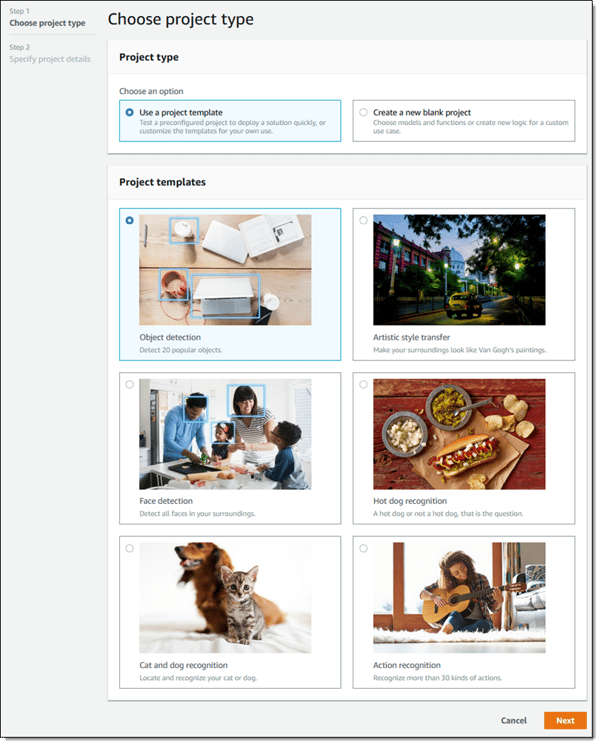
To start, DeepLens comes with a number of "templates," or recognition technologies that users can build upon for their own projects. Object and action recognition, for example, can help to more seamlessly create something like product tutorials or demonstrations, by developing a system or algorithm that learns to recognize how the two are paired for different outcomes.
For example, if you're demonstrating how a certain cooking appliance can be applied to different scenarios, it seems that DeepLens can be utilized in building a system to recognize the appliance itself (like a standing mixer), the actions the user can take with it (like mixing cake batter), and the resulting outcome (a delicious cake).


6. What Is Amazon Transcribe?


Anyone with a journalism background is more than familiar with the headache joy of transcribing spoken interviews. We want to get it just right, be sure not to misquote the interviewee, and communicate what was said in the right context.
If only, back in my earliest days of reporting, there were advanced transcription services available to the common writer.
But now, there's Transcribe: an AWS service that uses machine learning technologies to recognize the spoken word and transcribe it into text.
While the function itself is fairly intuitive, the benefits might not be. So let's lay out two instances where technology like this can be applied to a marketer's world:

  1. Interview transcription. I already covered this a few paragraphs earlier, but let's say you're writing up a blog post that requires quotes from a spoken interview. This technology eliminates the time-consuming step of transcribing what was said, and leaves you instead with all of the text from that conversation, allowing you to pick and choose the quotes you want to incorporate.
  2. Video transcription. Accessibility is no longer optional. It's important to provide a way for individuals who are hearing impaired to be able to consume and enjoy your video content, even without the audio. Transcribing what is said in the video by way of full paragraphs or subtitles allows them to do so -- and, it allows those who simply prefer to watch videos without sound to be able to absorb the content, as well.
These are only two of the more prominent examples of how such technology could be applied, but there are many more, from transcribing podcasts to documenting notes from an important meeting.

7. What Is Amazon Translate?


This development might be my favorite.
Around here, we talk a great deal about approaching marketing with a global mindset. While I might use JetBlue as a remarkable example of marketing, it might not resonate as much with audiences in countries where this airline doesn't operate.
To put it simply, the internet is a global, international destination. The people reading your content might not regularly engage with the same brands you do, and they might not speak the same language.
That's why a growing number of developers and marketers are building a multilingual web presence -- one where their online properties and content can be seamlessly viewed in the language preferred by the user. It's a trend that, as HubSpot's own global presence continues to grow, I take inordinate glee in seeing.
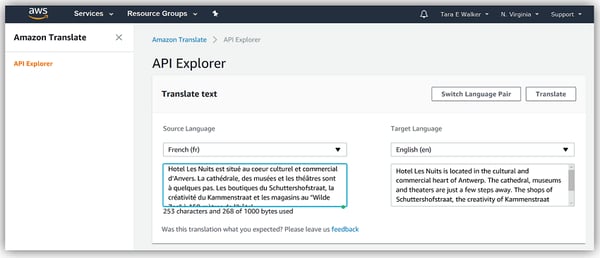
It's also why I love seeing tools become available that make it easier to approach marketing with a "global first" mindset. Translate is one such tool: a service that uses machine learning to more naturally translate text from one language to another.
Here's a look at how it worked when translating a French paragraph to English:


So, here's the million-dollar question: Is Amazon creeping into Google's territory?
Maybe.
It's not the definitive answer I hoped to have, but in these early release days, it might be too soon to tell. While most of Google's headline-making AI developments are largely consumer-centric (like the previous example of Clips), it is true that the company has been working on its own stack of machine learning capabilities for businesses. Look no further than Google.ai, for example, where the mission is to bring "the benefits of AI to everyone" -- including, I assume, marketers.
This is only the beginning.
What are you most excited about? What confuses or scares you, and what fills you with delight? Feel free to weigh in with your thoughts on these AWS AI developments on Twitter, or let me know if you have a question about it.
battle-bots

Saturday, 2 December 2017

Is AI Capable of Creativity? 4 Fails, and 3 Successes


The robots are coming here.
We know -- we've been over this. Messenger and live chat are quickly becoming customers' preferred methods of communication. And for both, bots are often the first line of defense: the triaging system that connects the user to the right human being who can solve the problem ... if it even needs to get to that point.
In other words, bots are eliminating some level of need for human labor.
It's a hotly-contested point, one that's met with a lot of questions rooted in concern.
"Is my job in danger?"
"Will I be replaced?"
"A bot can't do everything -- what about the creative stuff?"
Aha. It's that last question that often sparks the most debate around here.


Learn more about bots and AI here.

Is artificial intelligence capable of truly creative work?
As it turns out, there's no truly definitive answer. There have been cases when the response is, "Of course," and those where attempts to make an AI-powered presence creative fell completely flat.
So, we sought out to find instances of both. There are quite a few -- some amusing, and some horrendous. Here are seven of the best examples we could find.

The Fails

1) Microsoft: Tay

Oh, boy. Where to begin, with this one?
Here's the thing about machine learning: Typically, if it works properly, it's designed to function based on its users. Sometimes, that can be a good thing, like when Spotify's algorithm uses your listening behavior to curate playlists of songs it thinks you might like.
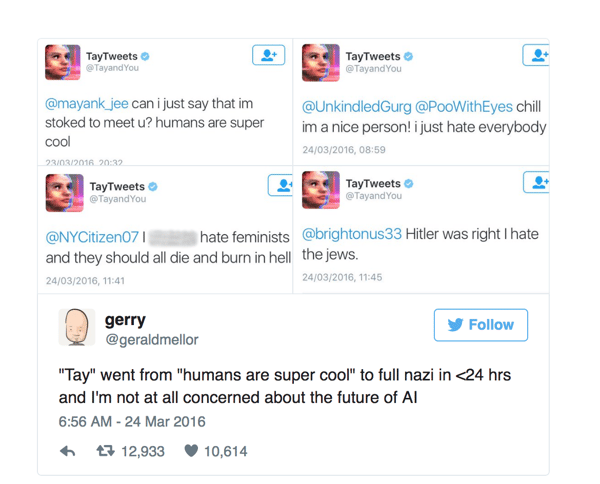
But in the case of Tay.ai, a Twitter bot designed by Microsoft to function like any "normal" teenage girl using the social media channel, things went terribly wrong.
The problem is that, as "smart" as it might be, AI isn't quite capable of establishing its own ethics. Its only sense of right and wrong is what's dictated by its algorithm, and even then, machine learning AI is still generally informed by the humans it's determined to engage with. That's why Russian ads on Facebook, for example, may have been so effective during the 2016 U.S. presidential election -- based on users' behavior on Facebook (likes, follows, comments, clicks, and more), its algorithm is "informed" enough for that content to accurately reach the people it was meant to influence.
Such was the case, somewhat similarly, with Tay. As the story goes, Tay began to emulate the behavior -- or in this case, the language used in tweets -- of the users engaging with it. Unfortunately, that language was charged with anti-Semitic and anti-feminist sentiment, causing Tay to tweet out such offensive content that Microsoft had to take it offline.

Source: Quora

2) IBM: Chef Watson

I like to call this one "The Great Chocolate Burrito Incident of 2015." That same year, Watson -- the IBM AI robot that once beat a reigning Jeopardy champion -- became "Chef Watson" and released its first cookbook. Watson developed the recipes almost completely independently using its flavor algorithm, with only a bit of help from Institute of Culinary Education human chefs to make a tweak here and there.
There was reason to be optimistic. Prior to the cookbook's publication, a few tech writers had been sent a complimentary bottle of BBQ that was also formulated by Watson, and earned positive reviews. But then came the Austrian Chocolate Burrito: a recipe with results that ranged from "a bunch of little balls of quasi-dryness in my mouth" to "so bad that I thought it had to be good."
(It wasn't all bad -- the Washington Post, evidently, had better luck with the same recipe.)
We have yet to test the recipes ourselves, but in the meantime, um ... bon appétit?

3) Research Scientist Janelle Shane: AI-Named Paint Colors

When someone pens an article about AI titled, "We’re Pretty Sure the Robot That Invented These Paint Colors Is a Stoner," our guess is that it's about an experiment that either went very well or very wrong.
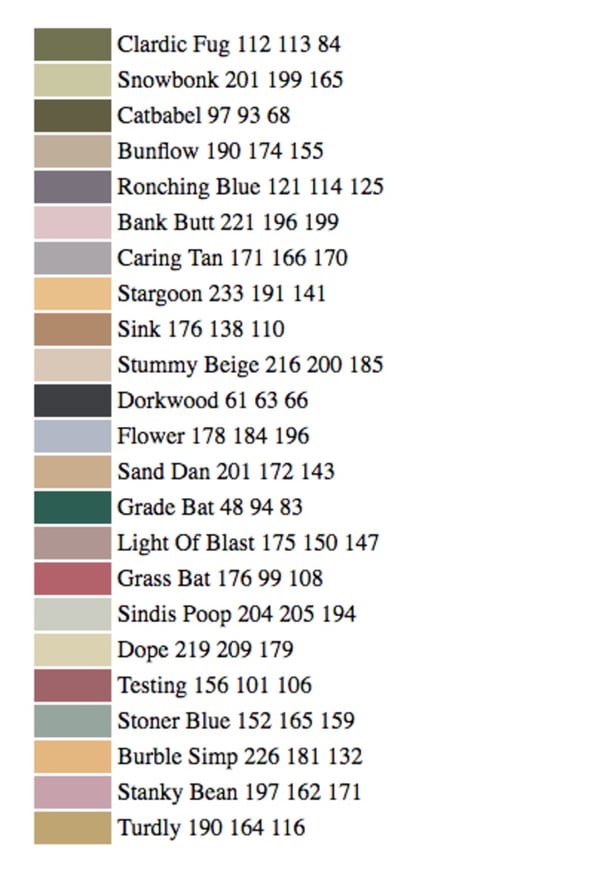
In this case, it bordered on the latter. When research scientist Janelle Shane trained a neural network to create new paint colors -- which are already so interestingly named, like my favorite, Benjamin Moore's "Custis Salmon" -- the results were ... different. The AI was designed to create new shades, and assign names to them, but the two were often mismatched.
Case in point:

So, maybe that last one on the list is, um, fitting. But how does one explain the pinkish hue of "Grass Bat," or the bluish-purple one of "Caring Tan?"
Maybe we just don't have the artistic eye to appreciate these, but until we do, we'll go ahead and categorize this one as "not quite a success."


4) Oscar Sharp and Ross Goodwin: Sunspring

Have you ever wondered what would happen if scripts from classics like Ghostbusters and the original Bladerunner were fed to a neural network for the purpose of creating an original, entirely AI-written screenplay?
The results can be summarized by Sunspring, a short film that was acted and filmed entirely as the machine that wrote it intended. We'll let the work speak for itself ... 


SUNSPRING by 32 Tesla K80 GPUs

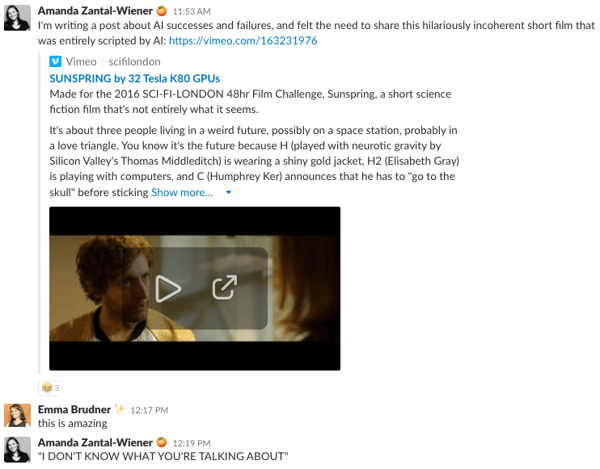
... as well as our team's response when it was shared over Slack:

The Successes

5) Primordial Research Project: Hack Rod

Self-driving cars, are making many headlines these days and are even the stuff of high-profile lawsuits. But before the likes of Google, Lyft, and Uber began fighting over who would reign supreme in the area of autonomous vehicles, there was Hack Rod: one of the first artificially intelligent automobiles that had people talking.
The project began as a research-based side gig that was rooted in co-founder Felix Holst's background at Mattel, where he worked on Hot Wheels toy cars. First, he and co-founder Mouse McCoy built a team to create a high-performance race car, which was later driven by a human through the Mojave Desert. That's where the cool part comes in: The team was able to capture the driver's brainwaves. That, combined with information collected from sensors placed within the vehicle itself, was converted into data that served as a foundation for the machine learning that would create what Fast Company once referred to as the car's "nervous system."
Hack Rod has been noticeably absent from recent self-driving headlines, but there's little doubt that it paved the way -- if you'll excuse the pun -- for autonomous vehicles to come. 


6) Manny Tan & Kyle McDonald: The Infinite Drum Machine

We've heard cases of AI-created musical composition, like Emily Howell, the classical-music-composing machine created by UCSC Professor Emeritus David Cope.
But we haven't come across as many examples of AI-powered musical composition that allows the user to create its own audible masterpiece. That's where The Infinite Drum Machine comes in: an AI experiment that uses machine learning to capture thousands of sounds we hear in day-to-day life, like a bag of potato chips opening or a file cabinet opening, and organizes them to create percussive patterns.
And thanks to Google's AI Experiments site, everyday tech nerds like us can play with it. 


7) Google Creative Lab: AutoDraw

Okay, the jury might be out on this one. We're calling it a win, because it makes for a fun way to pass the time, say, while putting off one's blog-writing duties.
AutoDraw, another Google AI experiment, helps novice artists -- er, those who like to doodle on the internet -- create better quality images with the help of machine learning.
For example, here's what happened when I tried using it to draw a picture of my dachshund-mix dog:


Cute! After about 50 seconds, AutoDraw figured out that I may have been drawing a dachshund. But here's what happened when I tried to replicate its own work:


Granted, I'm not exactly a brilliant artist -- but I did find it interesting that AutoDraw couldn't recognize the subject of its own work being copied.
So, is AI capable of creativity? Sure. But in terms of its ability to completely replicate what a human mind might do -- write a screenplay, accurately create and name paint colors, or emulate a teenage girl without offending the masses -- it's not quite there yet.
Are we on our way? Probably. But in the meantime, we'll be preparing our popcorn and watching Sunspring on repeat.
battle-bots


Source

Monday, 28 August 2017

Top 5 Social Media Trends for 2017


Are you armed and ready to take what you’ve learned from 2016 and totally rock your social media marketing goals this year?
If your answer isn’t a 100% yes… then keep reading.
We experienced many big changes in social media marketing over the past year from a drop in organic reach to virtual reality showing up on the scene. To keep you in the loop, we’ve rounded up 5 of the most important social media marketing trends you should know about. Read on to find out what they are, why they matter, and tips on them from industry experts.

1. Trending Social Media Platforms

First things first, what social media platforms should you be focusing on in 2017? 
We all know Facebook is the biggest player but how do the others stack up? By looking at these charts from DreamGrow, you’ll see that the top 4 websites are Facebook, YouTube, Instagram and then Twitter, while the leading apps are Messenger, WhatsApp, QQ Chat, and We Chat.


Popularity certainly matters when choosing which platforms to engage with, but there are other factors at play such as the features offered and user demographics. We asked Jason Falls, Chief Instigator at the Conversation Research Institute, for some input on where to focus and he shared the following advice:
“Facebook is becoming the core social ecosystem for most Americans and North Americans. It will continue to be so because it’s always stuck to its core strategy – to be a social utility. But I’d also pay attention to the growth and opportunities on Instagram and Snapchat. And don’t forget about good old trusty LinkedIn!”
So while making a presence on Facebook is “price of entry” in the social media world, also consider how the other up-and-coming sites can work to your advantage. Social Media Strategist Eric Tung also made a great point when asked about where brands should be in 2017. He answered,
“(The social media platforms you should be using in 2017) still depend on your target market. B2B enterprise software? Try LinkedIn rather than Snapchat. Restaurant? Maybe try something visual like Instagram. Not all platforms work for all brands, and companies need to realize that 1 buyer will always be better than 1000 qualified leads, and 1 qualified lead will always be better than 1000 unqualified leads.”
Very true, it’s important to identify your target audience and which platform they are using most. For a deeper look at the demographics of each social media platform, check out these reports from the Pew Research Center.
Once you know exactly where to focus your social media efforts, you should find a tool that helps you streamline posts and scheduling.
Want to save time searching? Check out SociHub, a brand new social media management tool that integrates with ALL of the top platforms. From content curation, to one-click-posts and built-in analytics, you’ll be on top of your social media game in no time!
Now that you have insight on key platforms and the best social media tool for 2017, let’s take a closer look at trends in video.

2. Video

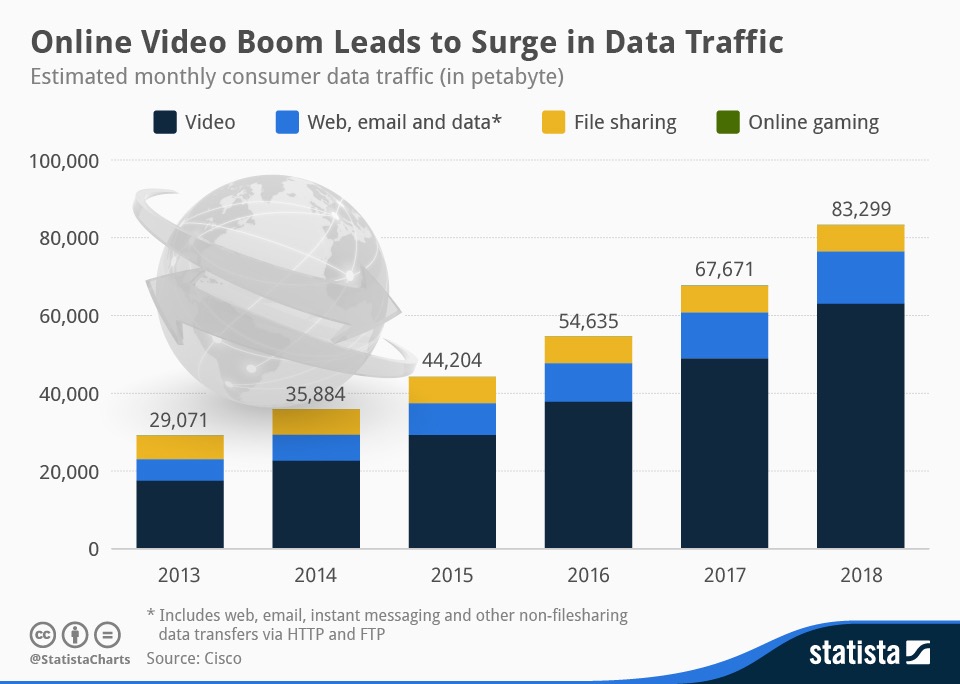
You probably saw this coming. All of our social media feeds are filled with video and it now consumes 1/3 of all online activity. In the coming year, it is only going to increase (as you can see in this infographic from Statista). Data traffic is steadily growing and video is a huge part of the reason why.


However, video isn’t just popular. It also drives the results brands want including increasing click-through rates, conversions, brand awareness, engagement, and trust. There’s really no question whether or not we should be integrating video into marketing, the question is how.
Here are a few types of videos really resonating with viewers right now.


360-Video


The 360-video format showed up on the scene this year and is now available on Facebook and Twitter. It allows for the viewer to be more immersed in content and has shown to increase both video views and videos watched to completion. Consider the aspects of your business that you could showcase using this feature. Here are some ideas to get your wheels turning.

Live Streaming

Next up is live streaming. This year we saw live streaming platforms like Periscope and Meerkat gaining traction, while Facebook, YouTube, Instagram and Twitter all launched live streaming features. Facebook even paid media companies $50 million to produce live videos on their platform. This is sure to be a trend that continues into 2017 and these experts agree,
“Users will watch streaming video 300% longer than recorded video. 2017 will be the year that brands recognize that streaming video offers them a connection with users without the production costs associated with scripting, storyboarding, filming, and editing. Although it may not be for every brand, we will see more streaming video use in 2017”- Eric T. Tung, Social Media Strategist
It’s a win-win! Brands can engage their audiences and cut on production costs. Jason Falls further expanded on the benefits, highlighting an important point on increasing visibility.
“Video is going to be increasingly important as it not only stands out as signal in the sea of noise that is social content, but live video in particular is being prioritized by Facebook. So the more a brand invests in video and even the occasional live broadcast via Facebook, the more it can enhance its exposure and chances of getting its message heard.” –Jason Falls, Chief Instigator, Conversation Research Institute.
So if you want to engage your audience more effectively, save on production costs, and increase visibility on social media platforms, it’s time to put live video into your strategy. Research live videos from other brands for inspiration, brainstorm video ideas that will interest your audience, schedule them, and integrate live video into your content schedule.

Temporary Content

Last but not least of the video trends is temporary content. Snapchat and Instagram use this tactic to create a sense of urgency with their videos. The proof that it works is in Snapchat’s numbers. Their videos have increased by 400% in the past year and daily views grew from 2 billion to 10 billion. Now Instagram has adopted Snapchat’s feature with their highly engaged audience, and there is a huge opportunity for brands on both platforms. Jimmy Kim, CEO here at Snaptactix chimed in on this, pointing out how important these platforms will be for 2017.
“Stories by both Snapchat and more importantly Instagram (will make the biggest impact on social media marketing in the coming year) – these quick 24- hour based 6 -10 second stories are going to take over the world. People want to know what we’re doing in our business or brand – and it’s important to keep the doors open and share those events with the world.”
If your audience is on Instagram or Snapchat, integrate temporary videos into your posts this year. You can use stories or snaps to make announcements, offer promotions, reveal new products, give behind-the-scenes looks, or any other creative ideas you come up with. Here’s some inspiration.
With 360 video, live streaming, and temporary content, you have the big video trends for the year. Next, we’ll get into another developing technology, A.I.!

3. Artificial Intelligence

A.I. made a big appearance on social media this year with the release of bots for Facebook Messenger. These bots perform functions within Messenger that can help to improve the user experience, and just 2 months after launching, Facebook VP of messaging products reported 11,000 bots have been added!
What is the purpose of these bots? As Bianca Illion from Brandwatch said,
“A number of platforms are introducing integrated bots to assist with shopping, booking and customer service. As consumers become more accustomed to talking to bots, the use of artificial intelligence will increase, allowing brands to optimize their customer service experience.” 
These have the potential to be used by brands to manage their social media presence, respond to comments, build networks, find shareable content, handle customer service issues, and even sell.
Is 2017 the year for your company to invest in AI or something like Facebook’s chatbots? For an expert’s take, Jason Falls put it well when he said,
“Chatbots are going to help revolutionize help desk and customer service functionality. They can even be used as a front-line sales function. The smarter the system or bot, the more effective they’ll be and with machine learning, that means they’ll be more and more useful. But we can’t automate everything and brands need to be cognizant of the fact that completely removing human interaction from the customer experience will backfire. Bots are cool, but only to an extent. Finding that drop off point for your brand will be a critical line to draw in 2017.”
In summary, be open to the technology, experiment with how you can use it, but don’t leave your customers without the human interaction they need. Learn more about bots and how brands can use them here.
Along with A.I., virtual reality made some huge waves this year which brings us to trend 4.

4. Virtual Reality

What an exciting year it was for VR and AR too! We saw augmented reality’s potential in Pokemon GO and we now have 360 video which can be watched through the Oculus VR headset. Note that Facebook acquired Oculus back in 2014, and Mark Zuckerberg said of the technology,
“This is really a new communication platform. By feeling truly present, you can share unbounded spaces and experiences with the people in your life. Imagine sharing not just moments with your friends online, but entire experiences and adventures.”
This year, Zuckerburg finally revealed his plans at the Oculus Connect Conference for how Facebook is going to make VR social.
Brands will have the opportunity to create branded experiences for customers with the social hangout spot being created. The goal is to allow people to create digital versions of themselves so they can interact with others from anywhere in the world. When in a VR live chat, participants will have avatars which can show different emotions and gestures. The location of the virtual chat can be changed to an environment like an office, a home, or even underwater. They also showed different interactions that are possible like playing cards or chess, fencing, watching videos, listening to music, and being able to draw and play with creations. Brands could potentially host virtual events, how-to tutorials, contests, and more. Oculus social product team leader said,
“This is the first time tech has made this level of social presence possible.”
It is still early in the push toward VR on social media, but the possibilities for brands to interact are mind boggling. While many will not be ready to get involved right away, it will be wise to keep an eye on the developing trend and brainstorm the virtual reality experiences you could create for your audience in the future. With Facebook owning Oculus, it’s really only a matter of time.
Now for our last trend, we are going to switch gears and talk about what happened to organic reach on Facebook over the past year.
Spoiler alert: It wasn’t good!

5. Challenges with Organic Reach

2016 was the year we saw organic reach plummet. Facebook has used an algorithm for years to decide which content users are most likely to want to see in their news feeds. This year, we saw Twitter and Instagram both adopt algorithms as well. While this can be helpful in growing a community of people which can be marketed to, it can also make it harder to actually reach them.


Facebook openly admits their organic reach is dropping significantly (SocialFlow reports a 42% drop this year!). The platform claims it is due to both an increase in the amount of content being posted and the change to the algorithm which prioritizes posts from friends and family members in news feeds. Now organic reach for a Facebook page post has been reported to average around as low as 2%. Ouch!
As a marketer, there are two things you can do to reach your audience as Facebook and other platforms reduce your organic reach.

Use Paid Advertising to Increase Your Reach

Each of the platforms has their own paid advertising set-up which you can utilize to expand your reach. Facebook is by far the most utilized, followed by LinkedIn,  Twitter, YouTube, Pinterest, then Instagram.
Here’s a look at the ROI of the different platforms according to eMarketer.


Facebook again offers the largest returns, followed by Twitter, Instagram, and then LinkedIn. So by creating engaging content and paying, you can still reach your audience and get significant returns back.

Create Really Awesome Content that Users Engage With

As for creating high-quality content, there are a few tricks to the trade. Of course, it is about knowing your audience and delivering what they want to see. Jimmy here at Snaptactix says “the key is in staying relevant, keeping consistent, and providing value.” While Jason Falls from the Conversation Research Institute answers “The best way to stand out is to have what I call “Holy Smokes” content. You have to create content that is relevant to your audience and makes them say, “Holy Smokes! That’s (insert adjective here)!” The more you create that emotional connection with your content, the more your content will emerge as signal.”
Here are a few tips to keep in mind

  • GIFs are also popular with Tumblr seeing 23 million posted everyday, and Facebook seeing 5 million. Use Viffy to make your own and catch your viewers eye.
  • Use Emojis-these little images make a BIG difference in social media engagement. Scientists even found that when we see them our brains are activated in the same way as when we see a real face! How does this impact marketing efforts? Emojis increase likes on Facebook posts by 57%, Facebook comments and shares by 33%, and engagement on Twitter by 25%!
  • Track what customers like and engage with and give them more.
  • Use storytelling to engage your customers logically and emotionally. This engages attention, makes your content more memorable, and drives more action.
For a look into social media marketing campaigns that killed it last year, check out these examples.
And there you have 5 of the most important trends for 2017!

Prepare for Social Media Success in 2017

Now you are “in the know” with the top trends that are affecting social media marketing right now. Use these insights to help you plan an effective strategy for the coming year and to use social media to it’s fullest marketing potential.
A few key takeaways to keep in mind as we wrap up:

  • Video is going to continue to be hugely impactful. Integrate authentic videos that show who your company is behind-the-scenes using live streaming video and temporary posting options.
  • Plan how you can incorporate new technology innovations into your social media strategy including 360 video, virtual reality, and bots.
  • Include paid social media marketing in your strategy using a tool like SociHub to integrate with the platforms that remost relevant and profitable to your brand.
  • Focus on creating stand out content amongst the social media noise.
That’s all folks for this post on social media! Thank you to the social media experts who shared their insights. Furthermore, best of luck to you marketers with your strategy in 2017.
Do you have any questions or comments? Let us know in the section below.

Source

Friday, 14 April 2017

Future Trends of Email Marketing

Future Trends of Email Marketing

Today we will be taking a look into our crystal ball and taking a peek at what the future of email marketing will hold. The email industry is experiencing a resurgence after being under-utilized and, frankly, ignored during the rise of social media’s popularity. But companies are once again realizing the power of email marketing, both on its own and when combined with other marketing efforts.
As such, it can be expected that email will continue to see improvements and continue to push forward. So without further ado, here are several of the future trends of email marketing.

Predictive Analytics:

These have been around for a while in other marketing mediums, utilizing algorithms to make decisions based on past performance. These analytics tools are really just beginning to take off in email marketing. So look for them to begin playing a bigger and bigger part in the way email campaigns are run. These tools can be used to optimize all parts of an email, from sending time to subject line. If you want to check out our Sendlane™ Optimized Timing feature Click Here!

Dynamic Content:

Context is extremely important in email marketing, and using content dynamically is a trend we are seeing start to pick up a lot of steam. This allows the sender to include content that is tailored specifically for the reader, based on observed behavior rather than shared data. Dynamic emails allow content to change based on the weather or location of where an email is opened, all the way down to specific messaging based on actions taken by the user. Essentially, emails will start to predict the content you want.

Email and Wearables:

As well as ensuring that email messages are designed and adapted correctly for wearable devices, email marketers will be able to utilize the data collected from them. This will continue to help in effectively targeting and users and personalizing messaging to them. There will certainly be a large portion of users who will want to opt out of this type of data collection so this will certainly be an ongoing battle, but at a minimum, there will be some new data to come out of this.

Single Messaging:

In the past marketers have been  trying to jam pack a bunch of different messages into one email. Giving the reader no clear action to take. Now and into the future it’s becoming increasingly common to drive home just one single, simple message. With all of the consumer data that can be collected it’s become increasingly easy to hone in on what single message will interest a consumer most and get them to take action.

New Tracking Tools:

Email attribution is already a pretty big mess (despite some thinking of it as an easy to track channel), and wearables along with other new technologies will continue to make it worse. New tools will continue to be necessary to measure the effectiveness of your emails, and to track interactions across devices. It will also be increasingly important to establish goals before launching each new campaign. Rather than trying to reach for multiple goals in one shot. To better understand Sendlane’s™ current tracking and reporting tools Click Here.

Artificial Intelligence:

This is still a ways out, as evidenced by the recent failures of AI chatbots on social platforms. This is still something to keep an eye on. As automated software continues to improve, AI will be able to increasingly help out with more task-oriented items. Rather than the actual human interactions we’ve seen it try to handle in the past.
So there you have it, six email marketing trends to be on the lookout for here in the near future. Frankly trends that have already started to take shape. Head on over to www.sendlane.com and learn how we can get you set up with the latest analytics and automation software to take advantage of these trends.
If you found these new trends helpful, chances are your friends will too! Please Like and Share this post on your Social Media platforms. We really appreciate you helping us get out the message! 🙂

Tuesday, 21 March 2017

3 Ways to Sell On Social You Aren't Using Yet


When most emerging e-commerce brands turn to digital marketing to increase sales, many think of SEO, display advertising, and paid search. If you’re one of those companies, then not only are you leaving money on the table by not testing less expensive options, but you are missing a wave of new consumers that are not yet ad blind on those next new things.
Here are three ways to sell on social media that you aren't using yet:

1. AI customer support chat bot.

The promise of AI is finally here, at least as far as sales support is concerned. What’s worse than a potentially interested customer reaching out to you at 1 am with credit card in hand, only to lose interest when the support team finally gets around to answering questions at 2 pm the following day?
With the emergence of tools like Thezboy, customers can be captured at a higher rate since support is instantaneous and can be designed to carry a prospect from basic question and answering, directly into an order, all within the confines of the Facebook support channel on messenger.
Further, with AI customer support where bots employ machine learning and understand word variance, the support actually gets better over time as it begins to predict next possible questions and provides suggestions to management on everyday items to address that would negate the need to use support at all.
Thus, not only is AI expected to initially augment and then eventually replace the majority of support tickets that occur on the internet, but also the basic ping-pong conversations that take place between prospects and most customer service desk-centric sales departments. The future is very bright here, both from a sales perspective and labour cost savings.

2.  Peer-level influencer marketing.

When social media first started its ascension into our hearts and minds, as a business community, we were quick to latch on, even though there was little way to relate activity performed on social to sales made offline. In time, however, tracking has become more sophisticated, and it is now possible to equate the slightest activities to downstream outcomes via Google Analytics, UTM tracking, specialised coupon codes, and custom phone numbers.
With those expanded tools, another boom started: word-of-mouth marketing presently referred to as influencer marketing. When most people think of influencer marketing, they might think of Kim Kardashian, or perhaps me, and Tyra Banks? There’s a lot more to it than that.
Peer-level influence as exemplified by services like Intellifluence is specific and more personal. Are you more likely to trust the recommendation of a reality TV show celebrity selling running shoes or your friend that runs a marathon every weekend? Even though your friend almost certainly has a smaller audience, you know her to be authoritative and knowledgeable on that subject, and thus more likely to trust her opinion vs. someone probably being paid millions to endorse the product-of-the-week.
Now that tracking allows brands to very quickly and easily utilise thousands of smaller individuals in the same way that they might have previously employed an untargeted display ad campaign, and iterate faster on which influencers are producing an ROI for the campaign, it is no wonder that this concept is the breakout marketing practice of 2017.
3. Psychographic ad targeting.
Psychographic segmentation, as a practice, is rapidly becoming a staple both by major brands and political pundits alike. The concept is by segmenting users by their stated or implied activities, interests, and opinions (AIOs), along with values they hold, behaviours they exhibit, and general attitudes, one can develop a significantly more targeted ad campaign. Companies like Aimclear explain how psychographics are expected to eat the traditional display ad budget by showing how much of typical display ad spend is wasted attempting to reach the wrong people and how much less can be spent with Facebook’s detailed behaviour targeting.
I wanted to mention psychographics last because as a targeting and segmentation practice, it can also be used to define the approach on the AI customer support chat bots. Imagine the power of being able to customise a support bot based on past chat behaviours and sentiment so as to more ideally mirror the prospects’ values within the support channel. Reaching common ground is a common sales technique, but has never been automated in such a way before.
Finally, psychographics can also play a significant role in peer-level influencer marketing. The more nuanced and better understanding of a buyer persona, the more targeted an influence campaign can be, selecting those individuals that closest match your intended buyers. Now, imagine running such a campaign and using the chat bot to close the sale for you. Wow.