Showing posts with label Bot. Show all posts

Monday, 12 February 2018

The 6 Critical Chatbot Statistics for 2018


Although they’ve technically been around since the 1950s, virtual chatbots only recently became popularized, as brands implement them to reach more customers with greater efficiency.
KLM Royal Dutch Airlines, for example, launched a chatbot via Facebook Messenger called “BB” (stands for BlueBot). The primary function of BB is to help passengers book tickets and keep them up to date on flight status, gate changes, and similar data-driven functions.
The company built the chatbot to assist its human support team, which handles more than 16,000 customer interactions weekly, according to coverage on the MarTech Today blog. In just the first six months of operation, BB sent nearly two million messages to more than 500,000 customers. Recently, KLM expanded the reach of the chatbot by hooking it up to Google Home, adding an audio/voice layer—an interesting augmentation.
I wrote about the rise of chatbots in my book, Hug Your Haters, and since then the rollout of chatbots has become even more extensive. But as I wrote about recently here at Convince & Convert, the truth is that a lot of chatbots (and live chat technologies) frustrate and disappoint customers, the very group they are supposed to aid.
Despite the missteps in execution, most consumers (in all generational categories) are relatively bullish on what chatbots can do, when, and how.
This became clear in a 2018 research project that surveyed more than 1000 adults in the USA, aged 18 to 64, balanced by age and gender. The survey sampling was provided by SurveyMonkey Audience, and the study itself was written and conducted by Drift, Salesforce (disclosure: Salesforce is a sponsor of my podcast, SocialPros), and myclever.
You may download a copy of the entire study here—no email address required. I have summarized the findings for you in this post, the 6 Critical Chatbot Statistics for 2018.

Chatbots and Amazon Alexa Are Equally Popular

Certainly, as we found in the Hug Your Haters research, telephone and email are still the most common forms of interaction between customers and companies.
60 percent of survey respondents say they have used these mechanisms to interact with a business in the past 12 months.
38 percent say they have used online chat in the prior year.
30 percent indicate they’ve used a company’s mobile app to interact.
28 percent have engaged with a business in social media.
As of 2018, 15 percent of American adults (per this survey) say they have used a chatbot to interact with a company in the prior 12 months. This is almost precisely the same percentage of Americans who own a smart speaker (Amazon Alexa, Google Home, et al.) as of January, 2018 per research from our friends at Edison.

37 Percent of Americans Would Use a Chatbot in an Emergency

The survey respondents were asked what they would use a chatbot for, if available.
Interestingly, the most common use case for chatbots is “getting a quick answer in an emergency” at 37 percent. Personally, if I have an emergency, I’m not sure THAT’s the time I’m likely to turn to a robot for fast and accurate guidance.
The second-most-common use case is “resolving a complaint or problem” at 35 percent. This makes a ton of sense, and I profiled several companies (most notably, HP) in the Hug Your Haters book that are using chatbots to augment customer service, like KLM above.
Getting detailed answers or explanations is how 35 percent of respondents might use a chatbot. This is problematic today, as many of the circumstances where early-stage chatbots fall apart is in nuanced, specific requests from customers. Because chatbots—even with artificial intelligence—can only respond to what they are programmed to respond to, detailed answers are not where they tend to shine.
34 percent of respondents say they would use a chatbot to find a human customer service assistant. This one is pretty meta. If we have to use a robot to find a real person, that doesn’t say much for the capabilities of the robot, does it?
Other uses of chatbots make more sense (at least to me). They include:
  • Making a reservation: 33 percent
  • Paying a bill: 29 percent
  • Adding yourself to a mailing list: 22 percent

24-Hour Service Is the Number One Chatbot Benefit

Participants in this survey were also asked about the primary benefits of chatbots, provided they were available and working for the online services these Americans used most.
Speed and availability are where chatbots are perceived to provide the most value to consumers.
Specifically, 64 percent of respondents said “24-hour service” is a benefit of chatbots.
The second most mentioned benefit is “getting an instant response,” mentioned by 55 percent of the participants.
“Getting answers to simple questions” (55 percent) and “easy communication” (51 percent) were also mentioned by more than half of respondents.
Perhaps unsurprisingly, “friendliness and approachability” (32 percent) are not areas where consumers believe chatbots are particularly strong. This is despite the manifest efforts of many brands to make their chatbots more “human.” Plenty of work to do in this regard, it appears.

Chatbots Are Equally Popular Among Millennials and Baby Boomers

This finding surprised me somewhat. The research discovered that the perceived benefits of chatbots are roughly equivalent among younger Millennials consumers and older Baby Boomer Americans. In fact, in several areas, Boomers are actually MORE bullish about chatbots’ potential that are members of the younger cohort.
For example, 61 percent of participating Baby Boomers say a potential chatbot benefit is “getting an instant response,” while just 51 percent of Millennials say the same.
Let’s recognize that “potential benefits” do not equal “usage,” but these findings indicate that older Americans are at least open to the premise of useful chatbots.

Nearly Half of American Adults Would Prefer to Deal with a Human

In the survey, participants were asked a simple and important question: “What would STOP you from using a chatbot?”
The number one answer is a tough one for chatbots to overcome, at least for a while: our innate desire to interact with other humans.
43 percent of adult Americans say they prefer to deal with a real-life assistant, rather than a chatbot.
I guess you can look at that as a half-full or half-empty statistic. On one hand, nearly half the country would just prefer to handle their business with another person. Fair enough. However, nearly six in 10 Americans do not object to using a chatbot in some circumstances.
As chatbots improve, it will be fascinating to see if this objection fades away.
The second hurdle for chatbot usage is actually related to the first. 30 percent say that they “worry about the chatbot making a mistake.”
Conversely, on the other end of the response scale, 15 percent of survey participants indicate that NOTHING would stop them from using a chatbot. That’s a high level of trust in technology!

Users Prefer Chatbots Over Apps When Communicating with Companies

In almost every case, respondents indicate they believe chatbots offer more benefits when communicating with businesses, in comparison to apps. The biggest difference is in the area of “getting quick answers to simple questions,” where 69 percent of participants say chatbots are up to the task, compared to 51 percent for apps.
Users also believe chatbots to be superior in the areas of “24-hour service” (62 percent versus 54 percent and “ability to easily register a complaint” (33 percent versus 24 percent) among others.
Apps fare better than chatbots in just three categories, but they are all important:
  • Convenience (chatbots, 53 percent versus apps, 57 percent)
  • Ease of communication (chatbots, 35 percent versus apps, 41 percent)
  • A good customer experience (chatbots, 28 percent versus apps, 30 percent)
It’s interesting that in the circumstances where users believe chatbots to be superior, they’re FAR superior. But in the core function of easy, convenient, and customer experience, apps are perceived to be better, for now.
The full study also includes comparisons between chatbots and email, and chatbots and the telephone.

Chatbots are popping up like dandelions, and companies are rolling them out to save money and (in theory) add customer convenience. In 2018, overall consumer reaction to chatbots is positive, but still somewhat wary. This is probably wise, as chatbots will only get better as the artificial intelligence underpinnings improve, and businesses learn lessons (sometimes the hard way) about how best to utilize this new technology.

Source

Tuesday, 26 December 2017

FAQ This! Why Should I Care About Amazon AI?


The past three months, it seems, have been a nonstop parade of major tech events and the new product announcements that come with them.
One of the latest was last week's AWS re:Invent, where Amazon announced a new suite of AI-enabled technology designed with businesses in mind.
And while these new products, features, and tools come with a host of opportunities for the developers, marketers, and others who plan to use them, they also raise a few questions. What are they designed to do? How can they help you? How do they work?

Learn more about bots and AI here.


There's also one less-official question that occurred to me as I learned of these developments. Is Amazon trying to creep into Google's territory?
Let's take a look at some of these AI announcements from AWS re:Invent and dig deeper into just what they mean.

1. What Is AWS Re:INVENT?

AWS re:Invent is what Amazon describes as "a learning conference" produced by Amazon Web Services -- that's what AWS stands for. The intended audience is what it calls the "the global cloud computing community," but the event features content for anyone who wants to learn how cloud technology can help grow and scale a business. From AdTech, to content delivery, to the internet of things, the conference ranges in learning opportunities from keynotes to certification sessions.

2. What Were the Major AI Capabilities Announced at AWS Re:INVENT 2017?

While a handful of new capabilities were unveiled by AWS, there are four that I'd like to focus on (with a bit of teaser text below on what each one is capable of doing):
  1. Comprehend: text analysis for a variety of content formats
  2. DeepLens: a wireless, artificially intelligent video camera with newly enhanced object recognition
  3. Transcribe: speech recognition technology to convert the spoken word to text
  4. Translate: what it sounds like -- advanced text translation technology 

If some of these sound familiar -- or seem reminiscent of similar capabilities previously made somewhat famous by a certain search engine giant -- chances are, it's because they are familiar. I'll delve deeper into this below, but many of these capabilities reflect those for which Google has been known to be a leader, especially in the realm of translation. After all, who could forget this jaunty promotional video on the topic?


3. What is Deep Learning vs. Machine Learning?


The reason why I want to establish the difference between these two technologies (and what they are, in the first place) is that most of these capabilities use one or both.

Machine learning essentially describes the ability of a machine to learn things -- habits, language, behaviors, and patterns, to name a few -- without having been programmed to do so, or pre-loaded with that knowledge. It doesn't describe artificial intelligence in entirety, but rather, is one very important AI capability.

Deep learning is a type of machine learning -- and is a bit trickier to explain. Basically, it takes the next (big) step in that it's designed to imitate the way the human brain works by way of something called neural networks. In our brains, we have biological neural networks in which the action of one neuron creates a series of subsequent actions that ultimately result in our different behaviors.

In technology, artificial neural networks seek to replicate that phenomenon by becoming "trained" to comprehend data based on a certain set of criteria. One of the more notable examples of deep learning in practice is in image recognition, in which neural networks are able to recognize different data patterns or cues to learn what, for example, a cat looks like.

4. What Is Amazon Comprehend?


Amazon Comprehend uses something called natural language processing (NLP) to better understand and determine the meaning within text. It's an instance of machine learning, in which the technology learns how to comprehend -- if you will -- and process language as it was intended by the human being speaking or writing it.
Comprehend performs this capability with a series of steps:

  1. Identify the language.
  2. Pick out the phrases that most strongly indicate what the text is about -- things like names of people, companies, places, or important events.
  3. Use those phrases to determine if the sentiment of the text is positive or negative.
  4. File that set of text according to its topic within a collection of subjects it has already organized based on patterns it's observed.
So, how does this technology apply to the real world? Well, it's particularly helpful in an instance of, say, analyzing written customer feedback. By feeding these comments to an API like Comprehend, marketers can use this technology to synthesize data from their audiences to determine something like thematic areas of improvement.

5. What Is DeepLens?


Simply put, DeepLens is a high definition video camera that was designed with developers in mind. It was built with deep learning capabilities and what AWS Chief Evangelist Jeff Barr describes as "pre-trained models for image detection and recognition."
In other words, it's a very smart camera: one that can recognize objects, faces, motions, and creatures (e.g., a dog from a cat). And while that's very cool -- not to mention, somewhat reminiscent of the recently-announced Google Clips camera -- there's a reason why it could prove so helpful to businesses.
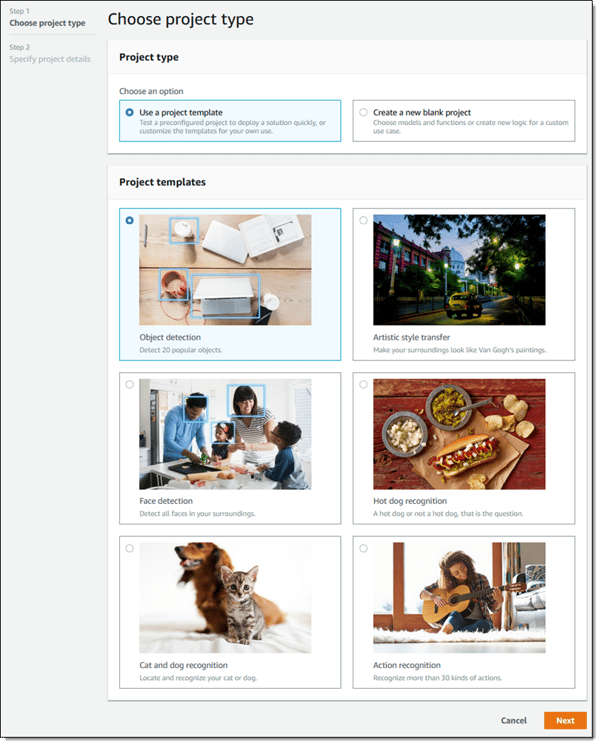
To start, DeepLens comes with a number of "templates," or recognition technologies that users can build upon for their own projects. Object and action recognition, for example, can help to more seamlessly create something like product tutorials or demonstrations, by developing a system or algorithm that learns to recognize how the two are paired for different outcomes.
For example, if you're demonstrating how a certain cooking appliance can be applied to different scenarios, it seems that DeepLens can be utilized in building a system to recognize the appliance itself (like a standing mixer), the actions the user can take with it (like mixing cake batter), and the resulting outcome (a delicious cake).


6. What Is Amazon Transcribe?


Anyone with a journalism background is more than familiar with the headache joy of transcribing spoken interviews. We want to get it just right, be sure not to misquote the interviewee, and communicate what was said in the right context.
If only, back in my earliest days of reporting, there were advanced transcription services available to the common writer.
But now, there's Transcribe: an AWS service that uses machine learning technologies to recognize the spoken word and transcribe it into text.
While the function itself is fairly intuitive, the benefits might not be. So let's lay out two instances where technology like this can be applied to a marketer's world:

  1. Interview transcription. I already covered this a few paragraphs earlier, but let's say you're writing up a blog post that requires quotes from a spoken interview. This technology eliminates the time-consuming step of transcribing what was said, and leaves you instead with all of the text from that conversation, allowing you to pick and choose the quotes you want to incorporate.
  2. Video transcription. Accessibility is no longer optional. It's important to provide a way for individuals who are hearing impaired to be able to consume and enjoy your video content, even without the audio. Transcribing what is said in the video by way of full paragraphs or subtitles allows them to do so -- and, it allows those who simply prefer to watch videos without sound to be able to absorb the content, as well.
These are only two of the more prominent examples of how such technology could be applied, but there are many more, from transcribing podcasts to documenting notes from an important meeting.

7. What Is Amazon Translate?


This development might be my favorite.
Around here, we talk a great deal about approaching marketing with a global mindset. While I might use JetBlue as a remarkable example of marketing, it might not resonate as much with audiences in countries where this airline doesn't operate.
To put it simply, the internet is a global, international destination. The people reading your content might not regularly engage with the same brands you do, and they might not speak the same language.
That's why a growing number of developers and marketers are building a multilingual web presence -- one where their online properties and content can be seamlessly viewed in the language preferred by the user. It's a trend that, as HubSpot's own global presence continues to grow, I take inordinate glee in seeing.
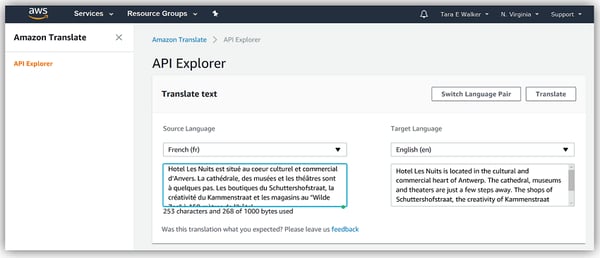
It's also why I love seeing tools become available that make it easier to approach marketing with a "global first" mindset. Translate is one such tool: a service that uses machine learning to more naturally translate text from one language to another.
Here's a look at how it worked when translating a French paragraph to English:


So, here's the million-dollar question: Is Amazon creeping into Google's territory?
Maybe.
It's not the definitive answer I hoped to have, but in these early release days, it might be too soon to tell. While most of Google's headline-making AI developments are largely consumer-centric (like the previous example of Clips), it is true that the company has been working on its own stack of machine learning capabilities for businesses. Look no further than Google.ai, for example, where the mission is to bring "the benefits of AI to everyone" -- including, I assume, marketers.
This is only the beginning.
What are you most excited about? What confuses or scares you, and what fills you with delight? Feel free to weigh in with your thoughts on these AWS AI developments on Twitter, or let me know if you have a question about it.

battle-bots

Monday, 4 December 2017

The Future of Messenger Marketing: What It Is, Where It’s Going, & Why The Future Is So Very Bright For Businesses


Find out what’s coming and how businesses are already deploying Messenger Marketing strategies to grow relationships with customers in this post.
If there’s one thing all business owners can agree on, it’s that you have to approach your customers in the places where they’re already hanging out.
If your customers are sports-loving guys who watch ESPN and the NFL Channel, you wouldn’t advertise to them on HGTV and Lifetime, would you?
Of course not.
You’d put your ads on sports networks where your target market will see them.
And that, in a nutshell, is why Messenger Marketing is set to become the world’s single biggest marketing channel in the next 5-7 years.
Messenger Marketing – noun – the act of leveraging mobile, chat platforms to facilitate conversations and commerce with prospects and customers.
There’s no denying the fact that we’re moving away from emails, SMS and phone calls. More and more we’re using mobile-friendly messenger apps like Facebook Messenger, iMessage, and WhatsApp to keep in touch with friends, family, and even businesses.
It’s the quickest, easiest, and most convenient way to reach someone.
Is it any wonder, then, why Facebook Messenger Marketing is the most exciting new marketing channel to come by in a long, long time?
Just look how quickly messaging apps surpassed social networks in monthly active users:
Future of Messenger Marketing: graph depicting how messenger apps have surpassed social apps
Source: https://blog.bufferapp.com/messaging-apps
The steepness of that curve should tell you something: messaging apps have a naturally huge appeal. They’re too easy and intuitive not to use.
So, what’s to come? In the next 1,700 words, I’m going to give you a glimpse into the future of Messenger Marketing and apps, along with a few hints about some of the sophisticated new tools we have in the pipeline for ManyChat.
Before we jump to the future of Messenger Marketing, let’s talk about what it is and why it’s so important for your business to start using it to connect with your customers.

What Is Messenger Marketing?

Messenger marketing is a new and increasingly popular way to communicate with prospects, leads, and customers.
As a marketing channel it boasts better engagement than any other channel out there, including…
  • Email
  • Direct mail
  • Social media
  • Push notifications
  • Skywriting
…you name it.
So what does that mean? Very simply, it means when you send your customers a message on Facebook Messenger, more people will open, read, and interact with your messages.
And those messages can either be live (say, a real-time conversation between a customer service rep and a customer), or they can be automated using a chatbot (much like an email autoresponder series). But unlike email, which has come to feel like work for most people, Facebook messages are quick & easy to respond to.
As a result, they get sky-high open and click-through rates.
If it sounds a little bit like SMS marketing, you’re on the right track.
However, with Messenger Marketing, you can do a lot of things you can’t with SMS, like sending beautiful messages that come complete with clickable call-to-action (CTA) buttons, GIFs, galleries, and more.
Basically, Messenger Marketing combines the instant delivery & attention of SMS with the attractiveness and automation power of email. Messenger also feels more personal than email, but less invasive than SMS—striking the perfect balance for businesses looking to communicate with customers.
And thanks to more and more integrations (such as our new integration with Zapier), you can now easily and automatically add Messenger contacts to your email list, register them for a webinar, and much more.

What Can You Do With Messenger Marketing?

The beauty of Messenger Marketing is that you can still do all the stuff you’re used to doing in your marketing efforts…
…it just makes everything easier and more effective.
When someone sends you a message they’ll be automatically added to your ManyChat subscriber list. From there you can add them to your email list and continue to follow up with them via email.
You can send them content, sell them products, ask for feedback, and more—all within the native messenger app.
The ability to add clickable call-to-action buttons in messenger gives you the freedom to customize messenger marketing for any business.
For example, look how easy it is to register someone for a webinar:
Derek Halpern uses ManyChat to register attendees to his webinar
Depending on which link you click, Derek’s chatbot can automatically register you for the webinar, give you the details on how to attend, or offer to send you the recording.
You can also use ManyChat to segment your visitors and find out what their interests are, so that you can present them with relevant and personalized product recommendations:
DigitalMarketer uses ManyChat to offer a white paper to their customers
Or, simply use a chatbot to deliver deliver white papers and other lead-nurturing content:
DigitalMarketer uses ManyChat to deliver white paper to their audience
Cutting-edge ecommerce companies are using messenger marketing to send transactional messages (whether on desktop or mobile) — sending purchase confirmations, letting people know when their product has shipped, and so on.
Look how Code&Quill, a brand that creates specialty notebooks for creatives sends all the information their customers need about their orders:
Code&Quill uses ManyChat to send confirmations and tracking information to customers

Code&Quill customer message using ManyChat on desktop
Of course, you’re already able to do all of this through email. But email feels cold and impersonal, and even the best email marketing departments in the world still get open rates under 30%.
In contrast, Facebook messages provide your customers with the personal, one-on-one interactions they want, with open rates currently hovering around 85%. And if they have a question, all they have to do is reply to your message—and someone from your company will be able to respond instantly.
And that’s what’s so great about Facebook Messenger Marketing. It gives you all the automation you could want, but in a way that’s also private and personal. As a result it provides less friction for the end user, helping you to develop a deeper relationship with your customers.
It was that goal—less friction for the end user, helping businesses to develop a deeper relationship with their customers—that drove us as we built ManyChat; the platform can already accomplish those things. But in the near future you’re going to see companies doing even more remarkable things with Messenger Marketing.
The best is yet to come.
And for a glimpse into what the future might hold, let’s take a quick trip across the world—where the future is now for messaging apps.

The Meteoric Rise of Messengers: The China Case Study

I’ve said before that in the next 5-7 years, Messenger Marketing is going to capture 80% of all B2C communication.
It’s going to replace email, websites, phone calls, and SMS as the primary way businesses communicate with customers. It’s not going to be “just another channel.”
It’s going to be THE channel.
And if you’re skeptical about any of this, look no further than China—where this exact thing has already happened.
In China, over 900 million people use WeChat each month, making it the most widely used app in the country. It’s the dominant way people communicate, pushing SMS and email to the sidelines—even at work, where many employees use WeChat for business communications (instead of email). The app allows for free video calls, easy sharing of large files, and instant group chats. Instead of exchanging business cards, you simply use WeChat to scan someone’s QR code and snag their contact information.
It’s done more than that, though.
In many cases WeChat has actually replaced websites altogether. Many bloggers in China have turned to WeChat as their primary channel for distributing content, generating massive readership without ever even posting to a traditional blog.
Did I mention it’s also a revenue monster—largely replacing cash and credit cards? WeChat Pay is everywhere in China: you can use it to pay for purchases at physical and online stores, request taxis, order movie tickets, and even buy a drink from a vending machine.
According to the 2017 WeChat User Report, 87-94% of users in China pay for offline purchases using WeChat…compared to 38-51% using cash and 29-36% using debit/credit cards:
WeChat graphic depicting the vast majority of offline purchases being paid for using WeChat in China
Source: https://chinachannel.co/1017-wechat-report-users/
Statistics like this are really cool because they give a glimpse of what’s possible, of what’s coming, in the rest of the world. And when you combine that with all the capabilities of Facebook…all the rich data and targeting options hiding in our profiles…
You can see why the future of Messenger Marketing is so exciting.

The Future of Messenger Marketing

Imagine you’ve just spent a night at a hotel.
After you check out the next morning, you look at your phone and notice a notification from Facebook Messenger. You check it, and see that the hotel has sent you an automated message asking, on a 1-5 scale, how your stay was.
If you respond with a 1-3, the chatbot automatically asks you if anything was wrong and what they can do to improve. If you respond by telling them about the cockroaches you found under the bed, a customer service rep immediately replies to your message and credits you with a free stay.
If you respond with a 4 or 5, the chatbot automatically thanks you and gives you a link to leave a review online. They also tell you that, in the future, you can book a room by simply sending them a message with the date and type of room you want.
Doesn’t that sound quicker, easier, and more convenient for everyone involved? (Especially compared to the nightmare of opening graphic-heavy emails and navigating a poorly designed website on your phone?) And of course, the hotel chain will be able to store the data from this conversation in a central system and use it to provide better service in the future.
In short, scenarios like this are what the future holds for Messenger Marketing.
You’ll be able to set up chatbots that automatically send a message based on the last interaction the person had with your company—whether it was watching a video, making a purchase, viewing a certain product page on your website…you name it.
When someone needs to contact you, they won’t go to your website. Instead they’ll send you a Facebook message. Messenger will become your single point of interaction with customers—the one place where they can easily reach you anytime they have a question, need help, or simply want to make a purchase (which they will also be able to do directly through Messenger).

Powerful New Features Coming to ManyChat

I can’t give too many specifics just yet…but let’s just say we have a LOT of really exciting new tools and features coming out for ManyChat.
First up is an all-new way to create your Facebook Messenger experiences with a versatile and easy-to-use builder that will help you visualize the setup of the logic and sequence behind your chatbots. Built into this new tool will come a suite of intuitive analytics that will simplify the process of optimizing your Facebook Messenger campaigns.
We’re also working on more sophisticated and robust ecommerce systems that will help online retailers to generate more sales while providing better customer service through Facebook Messenger.
Better live chat capabilities are on the way, as are a whole host of triggers and automations to help you maximize sales & revenue while providing a seamless user experience for your customers.
Stay tuned for more news on these coming features as we roll them out in the coming months!

Want to Grow Your Business With Messenger Marketing?

Make no mistake: Facebook Messenger Marketing is going to be a huge marketing channel for everyone—consultants, ecommerce companies, brick & mortar stores, public figures and celebrities, event organizers, and more—for the foreseeable future.
Everyone can benefit from integrating Facebook Messenger into their marketing strategy. And given how fast Messenger Marketing is growing, the sooner the better.

Sunday, 3 December 2017

Why Live Chat Usually Sucks


It’s the holiday season again, which yields at least four truths:
  1. Huge uptick in cranberry sauce consumption (seriously, when ELSE is that eaten?)
  2. Huge uptick in deck and patio fires, due to foolhardy and drunken usage of turkey fryers
  3. Huge uptick in customer interactions with companies, as we agitate for the best Black Friday and Cyber Monday deals
  4. Huge uptick in consumer frustration, as we encounter truly terrible live chat and chatbot experiences
I get it. I really do.
Every company is reading white papers and sitting in on webinars (some produced by me) that talk about the need for omni-channel consistency and customer-focused interaction mechanisms.
“If customers don’t want to use the phone, let them use chat!” say the white papers.
“Facebook Messenger is all the rage! It’s going to replace email! You need to build a bot!” bleat the webinars.
Consumers not only face a frenzy of navigation choices and special offers when they land on a retail website. Now they also must weigh the pros and consequences of using live chat, Messenger, phone, email, Twitter, Facebook, fax, or needlepoint as a contact mechanism when they inevitably have a question or problem.

For Whose Convenience?

Yes, I believe that companies should interact with customers in the fashion and platform of the customers choosing, rather than demanding customers use phone and email because it’s the company’s legacy preference. I talked about that a lot in Hug Your Haters.
That book was published 18 months ago, and the increase in live chat and chatbots has been remarkable. But here’s the problem:

If you’re going to add an interaction modality for your customers, shouldn’t you take that opportunity to ensure this new channel offers a BETTER experience? Unfortunately, I often find the exact opposite to be true.
I had a problem yesterday with a company I use routinely. I went to their website and decided to use the live chat so I could check my email during the “conversation.” The agent was incredibly slow and knew almost nothing about the product. Ultimately, after 35 minutes of painful back and forth, the agent gave me a phone number to call.
I called the number and had the problem fully solved in five minutes.
The problem is that companies rolling out live chat and chatbots do it for the wrong reasons. It’s not to offer an enhanced customer experience for consumers who prefer those channels. Instead, it’s to save money on a per-interaction basis. A chat agent can handle three to six conversations at once via chat, and a telephone agent can handle just one. And Messenger bots, once programmed, can handle infinite simultaneous conversations, bringing the average cost per interaction as close to zero as possible. “Hallelujah!” says the CFO, delighted at the cost savings provided by this new technology.
But the customer does not say hallelujah. They say a different exclamation that starts with “F.”

One Chance to Make a First Impression

If the company ultimately wants to encourage customers to use live chat and chatbots to save money, then why do they routinely put their very worst reps on live chat? Why are so many Messenger bots nearly useless? Consumers will behave in a way the company desires, if they are consistently incentivized to do so. A glance at the Cyber Monday phenomenon is all the proof we need of that point. Businesses decided to incentivize consumers to spend money online in a dedicated time horizon and discounted prices sufficiently to force the desired behavior change.
It’s realistic to believe that many customers will opt for low-cost interaction methods like live chat and chatbots, and that’s good news for business, ultimately. (Note that not all customers will do so, as some people really prefer phone and email, and that will continue to be the case until we have full generational turnover). But this gravitation from phone/email to chat/bots will only occur if companies commit meaningful resources to providing an outstanding customer experience via these new channels.
85 percent of Americans say they hate to wait on hold. That makes sense, and every time I hear that stat I wonder, who are the other 15 percent? And why do they have so much free time? Very few people want to call, and not many folks are hoping for more presents in their inbox, either. Chat and bots should be a huge hit among consumers.
But they are not.
My friend Ed Davies is a digital marketing consultant in the United Kingdom. His recent experience illustrates the core problem:
Ed needed to contact One.com, a web hosting provider, about a domain name issue. He chose live chat and was told he was #20 in line (for live chat support!). After a few minutes of waiting, the chat software sounded a chime and nudged him to find the answer himself on the website.
He was never given a sense of how long he might have to wait (something that is common on the telephone), and after 45 MINUTES, a chat agent logged on. With no acknowledgement of the wait, the agent dove into the issue.
During the subsequent interaction, the agent left Ed waiting for 10 minutes, with no message or input of any kind. Even on the phone, when you are forced to wait for a long time, agents typically pop back in every once in a while to apologize and make sure you’re not sharpening an axe.
As a result of this poor experience, Ed took his business elsewhere.
As Ed wrote to me when he told me this tale:
“Chats should provide a better experience for the customer—there are tools available that keep the customer informed, and not just saying ‘you are in position number 14.’ I found myself thinking I’d rather be on hold on a phone than a chatI can stick the phone on speaker, dance to the tinny pop music they have playing, make a coffee, move around the house, etc. It comes down to not respecting my time in a world where I value it more highly than any other thing.”
Ed is exactly right. It’s about respect. Companies are patting themselves on the back after they check the “launch live chat” box on their strategic plan without realizing that the execution of this new option is actually driving customers away.
As always, just because you have technology doesn’t mean it provides a better experience. And in this case, the experience is often worse.
I know there are instances of great live chat and chatbots. I’ve experienced some myself. I don’t want to indict the entire category, as that is both unfair and untrue. But just about everyone I know has a disappointing chat/bots experience. How has your experience been?