Showing posts with label Email Newsletter. Show all posts

Monday, 27 November 2017

How To Write Email Newsletters That People Actually Want To Read

 
A few weeks ago, the CEO of GMB Fitness, Andy Fossett, looked out at a crowd of marketers and said, “Don’t. ever. blast. your. list.”
We all know this. But Andy’s eyes said what we were all thinking, “I cannot believe I still have to say this to a group of marketers. You people should know better.”
And we should. “Blasting” your list is one of those foundational email marketing violations that can get you banished for life from advanced marketing circles. Other violations include: using the greeting “Hi Friend,” not segmenting your list, and “pushing” content to “get the word out.”
Each of these violations makes up a core element of the infamous “Email Newsletter.” You might know them better as the things in your inbox you “Mark as read.”

Click here to download our free beginner's guide to email marketing.

Self-respecting email-marketers scoff at email newsletters.

And yet…we’re seeing a resurgence of (dare I say it) GREAT email newsletters cropping up everywhere.

If you don’t believe me, check your own inbox. How many of you look forward to Tim Ferriss’ 5-Bullet Friday (and copied it yourself with a not-so-clever, “Friday’s Top Hits” or some other knock off)? Or Austin Kleon’s famous “10 Things Worth Sharing” Newsletter. Or Ann Friedman’s “The Ann Friedman Weekly,” also sent on Fridays.
Yeah, that’s what I thought. The newsletter is having it’s moment, which begs the question: Why on Earth are these working?!
Every company with internet access has attempted the newsletter and failed miserably, boasting open rates that are lucky to hit 17%.
The vast majority of newsletters get struck by the email-marketer’s-kiss-of-death: “Mark As Read.”
What are these newsletters doing that’s making them work??
I decided to investigate. Spoiler alert: the answers will (not) surprise you. In fact, they’re so #facepalm obvious you’re going to kick yourself for not seeing it. I certainly did.
Here is why the email newsletters don’t suck and how you can make sure yours don’t either:

💌 They’re super niche.

If you work in a traditional company, odds are the email newsletter is your way of satisfying the CMO’s frantic need to “get the word out” whenever he randomly decides he needs to because he didn’t do the hard work of planning a proper launch or promotion strategy.
That is the wrong way to do this.
The right way is to focus exclusively on the kind of people who make up your specific audience and deliver content that only they will appreciate.
Again for emphasis:
Deliver content that only a specific audience will appreciate
You don’t want everyone: just the right people. (Kinda like having product/market fit) This is why they don’t have to segment and can send ONE email to everyone. Their lists are niche and specific.
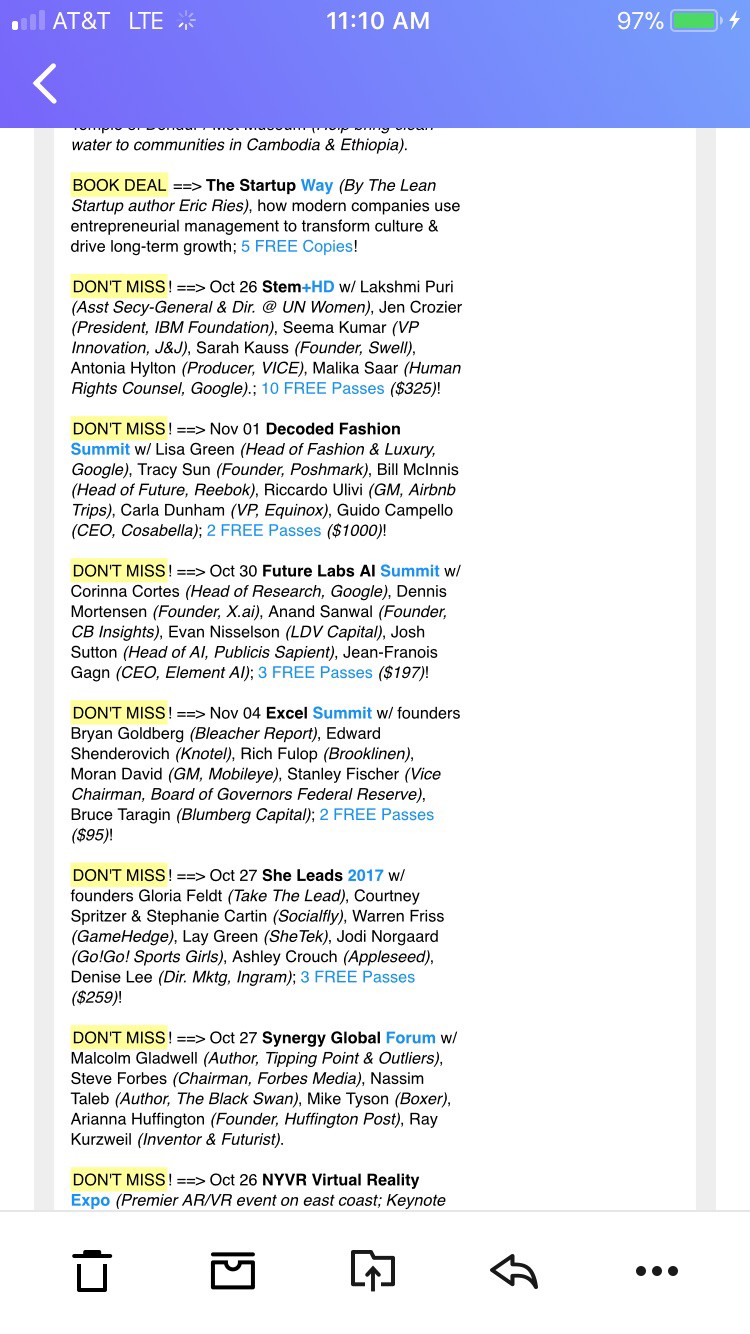
My favorite example of this is Gary’s Guide -- a New York specific “digest” of what’s happening in the NYC tech scene. It has the most comprehensive list of events, classes, series A/B/Whatever funding updates, and job listings of anything on the internet. The best part? It looks like it hasn’t been updated since 1992.
email-tg-01
And, yet, it’s considered one of the best go-to sources for what’s happening in the NYC startup scene. That’s because it’s not trying to be everything to everyone.
Gary’s Guide is just for startups and people wanting to break into the tech scene in Manhattan. In other words: It’s niche AF.
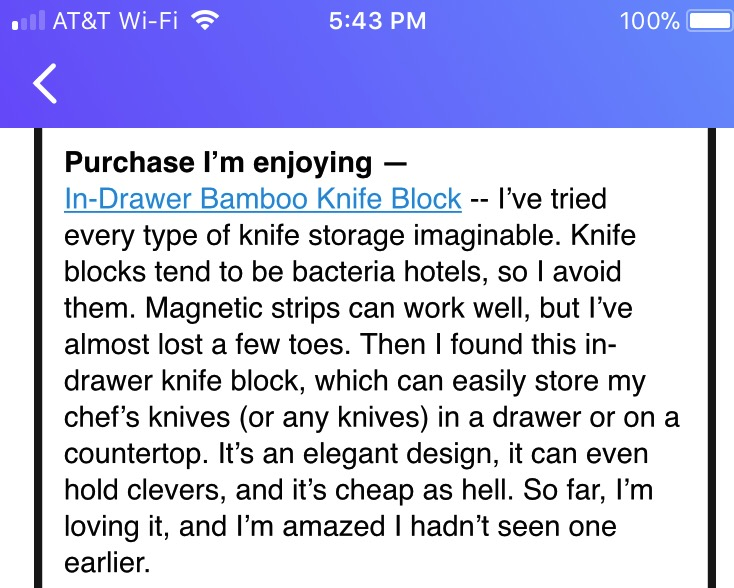
Tim Ferriss is also very niche, despite his famously massive subscriber numbers. His audience is made up of bio-hackers and aspiring digital nomads and Tim delivers exactly what they want: latest “hacks,” supplements, gadgets, and, of course, stoicism!!! It’s got wonderfully nerdy book and documentary recommendations too.
If you’re not interested in those topics, you won’t appreciate his bullets:
email-tg-02
What’s more is these bullets feel personal (we’ll get to that in #3). Like he’s your friend telling you what he’s reading, watching, and listening to. His readers don’t even care that these are mostly affiliate links because it’s so relevant and valuable to them.
Look:
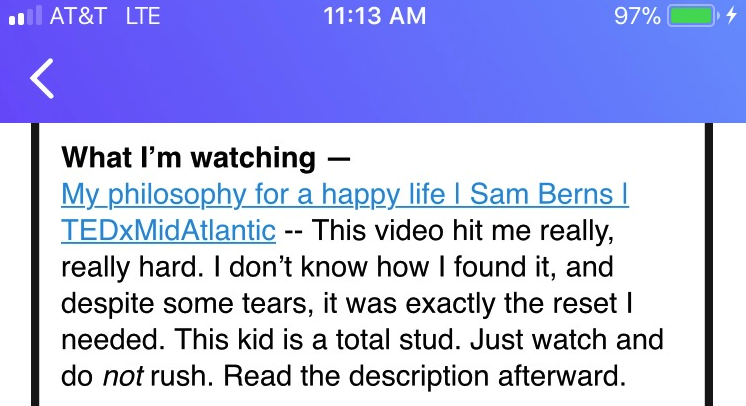
email-tg-03
Again, this feels like he’s your friend, casually sending you an email. And it’s niche becuase he knows his readers are aspiring top performers and watching TED Talks at double speed, so he includes the detail, “Watch and do not rush.” It’s like he’s looking out for you.
These newsletters work because they cater to a small, specific group of people. Tim and Gary are not trying to please everyone -- in fact, they’re actively trying to turn people off.
For example, if you get excited from reading this article and subscribe to the newsletters I’m profiling here, you’ll likely be disappointed because they’re not interested in pleasing you. They’re interested in pleasing their people.

💌 The content is actually good.

I told you this would be obvious. You can’t skimp on this one and yet everyone tries to. That’s how “roundup” became such a dirty word. Paper.li, Refind, and other tools started automating curation and sending you pure crap (or simply too much). Newsletters started white labeling those automation services and claiming they were “curating,” but that is not curating.
Curating is hand picking. If you’re the curator of an art gallery you’re not going, “Eh f*ck it,” and just slapping something random on the wall to meet your weekly quota.
To curate is to be discerning. Careful. Methodical. Thoughtful.

email-tg-04
For example, this is a poorly curated photo. It makes no sense right here.
Austin Kleon is the master of this. His links are thoughtful and relevant. You can tell he’s actually read what he recommends and isn’t siphoning the hard work of curation to his latest content manager hire (I’m assuming he has one, but you’d never know by reading the newsletter).
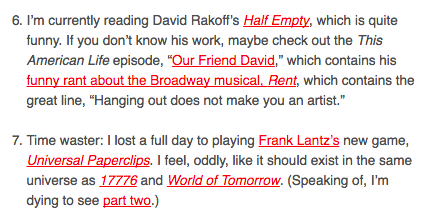
Here’s an example of how he delivers quality curated content:
email-tg-05
This takes clickbait to a whole new level. Instead of using a baited headline, he hyperlinks the hook: “Which contains his funny rant about the Broadway musical, Rent.” Who doesn’t want to read that?!?! (ok unless you’re his niche, you probably don’t, but the point still stands)
Kleon knows what his audience cares about because it’s what he cares about. He’s built a career and a brand around creativity and the arts. And funny drawings. And he delivers.
To nail this requirement you need a deep understanding of your audience and what they care about.
If you’re asking, “How am I supposed to know what people care about?” Do yourself a favor and get a degree in accounting and call it a day. I’m not sure you can be saved.
TL;DR: Don’t be lazy. Your audience is trusting that you’re doing the hard work of finding the diamonds in the rough. And they will reward you by coming back, week after week.
If you fail to deliver, (say it with me): “Mark as read.”

💌 Context. Context. Context. And personality. But mostly context.

Again, duh. But let me explain before you shut the screen cursing my name for telling you what you already know.
The reason these “roundups” and “blasts” work is because they’re housed within useful context. They’re not actually a long list of boring headlines you skim.
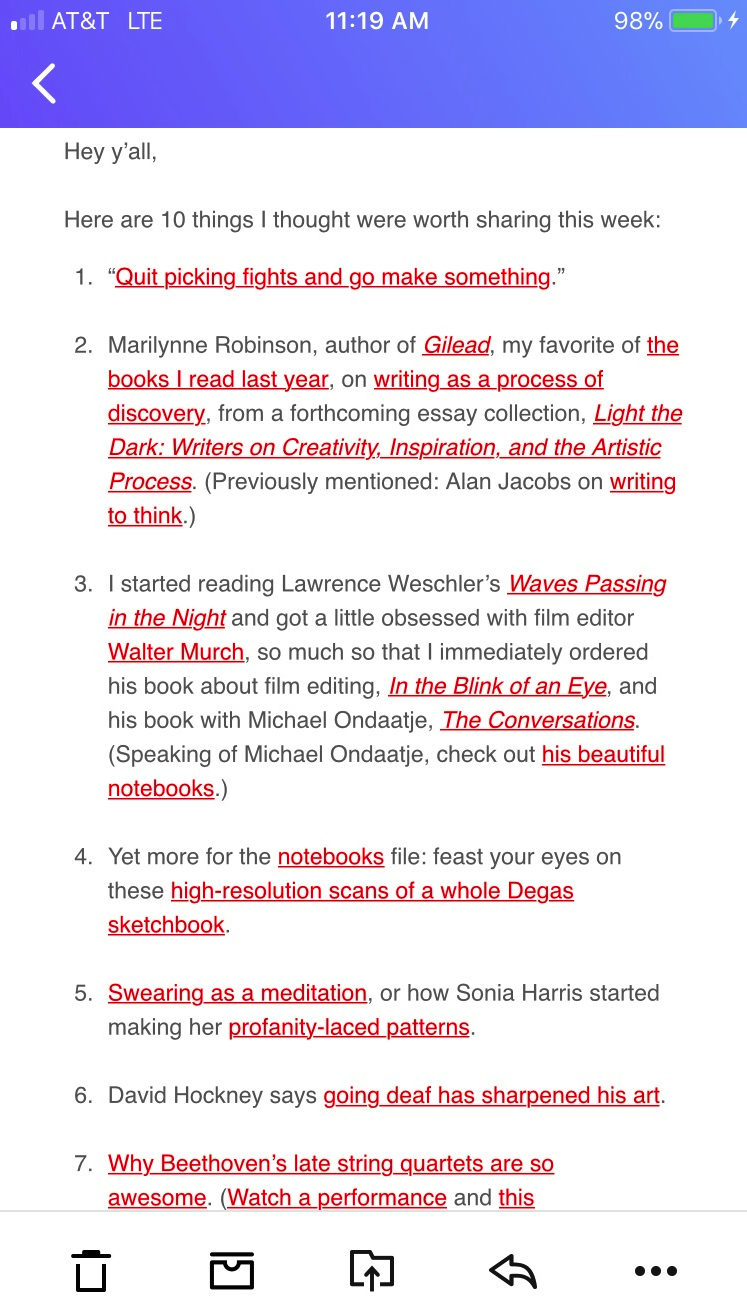
Let’s break down a bit more how Kleon does it:
email-tg-06
  1. It feels like he’s writing this directly to you (“Hey yall”). He’s conversational. Not overly chipper or super buttoned-up (here’s looking at you B2B).
  2. He doesn’t simply hyperlink the headline of an article and move on. He tells you why you should check it out or why he did. By hyperlinking the context he sort of gameifies the content. You don’t know what you’ll get until you click!
  3. He writes in the same pragmatic-and-hilarious tone he uses in his best-selling books (which is how most people discover him) which keeps his core audience happy and feeling connected to him (which is key!).
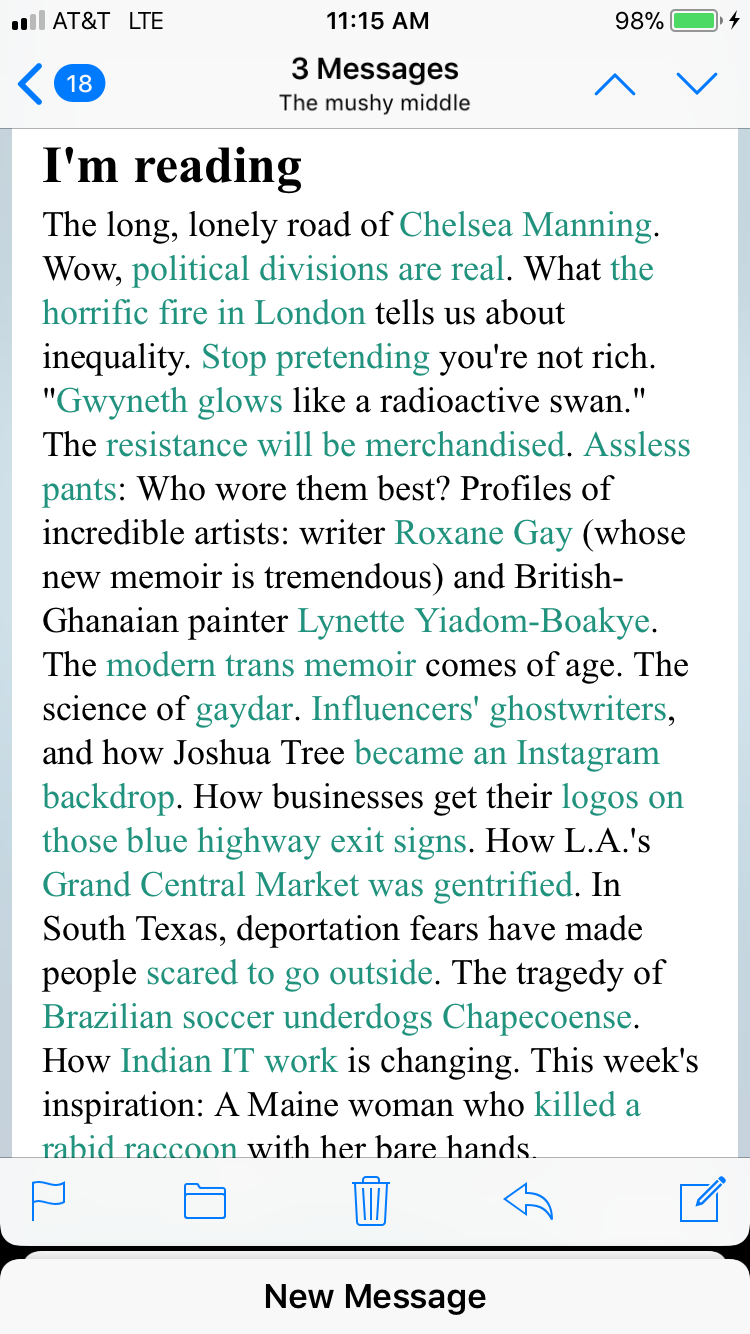
Ann Friedman is also a master of this. Look how she weaves in a “roundup” of links into a paragraph of context (also a violation of copy-law: never publish a giant unbroken block of text!!!). Yet, she is famous for these giant blocks of relevant articles.
Relevant to her readers. If you’re not a left-leaning progressive hungry for information on current events, women’s issues, race issues you probably won’t enjoy these pieces (see #1).
email-tg-07
She follows the same format as Kleon.
She’s personable, relevant, and gamifying the hyperlinks inside of context. It feels like you’re getting a rant from your best friend.
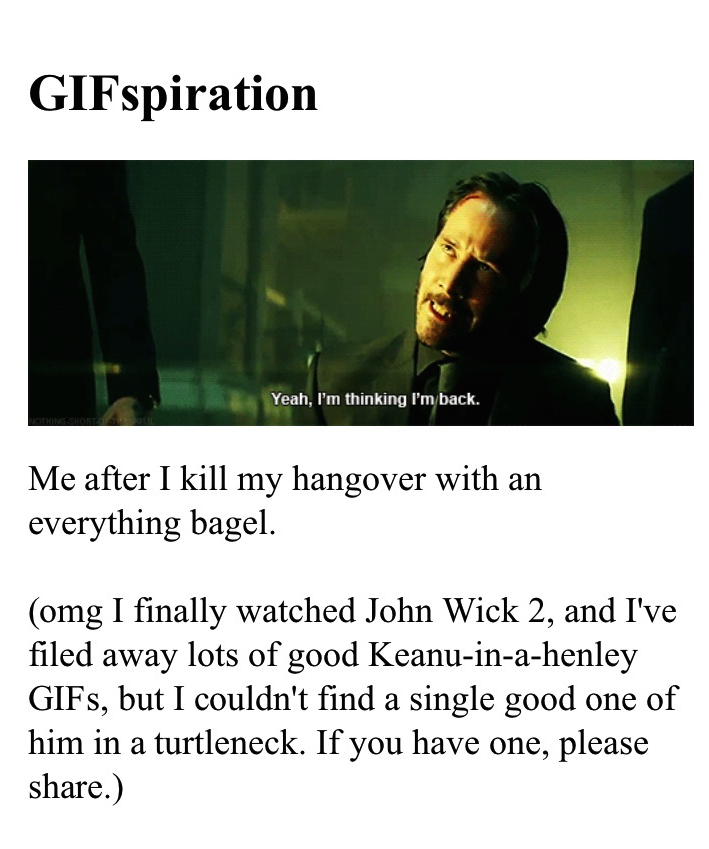
Since that content can get pretty heavy, she does what your actual besties would do: add a hilarious inside-joke GIF.
email-tg-08
If you’re her market it’s funny.
Another master of the email-newsletter-blast-that-sounds-like-it-was-written-by-your-bestie is Luvvie Ajayi, famed blogger and NYT bestsellerwho writes the LuvvLetter. Read this and tell me it doesn’t sound like it’s coming from your bffaeae updating you on her life:
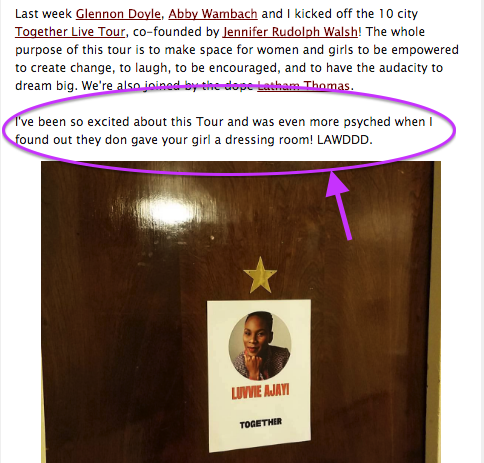
tg-email-09
You can HEAR her saying this to you.
These “blasts” don’t feel like blasts because they’re executed extremely well. They emphasize personality, casualness, and respect the rule of email that says it’s not just a one-way communication. These emails feel like 2-way conversations you’re having with friends updating you on their lives.

💌 They don’t visually assault you.

I’m the last person qualified to talk about design seeing as I’m a copy-centric bafoon who frequently ignores the value of good design (I have been proven wrong. many. many times), but here we are.
Newsletters that look like you repurposed a template from MailChimp are part of why people don’t read them. (I know, I am sorry MailChimp. There was a time for those.)
Design exists to serve content. Design showcases content, it is not the star.
You should never say, “Wow, this was well formatted.” You should say, “Damn, I love reading this.”
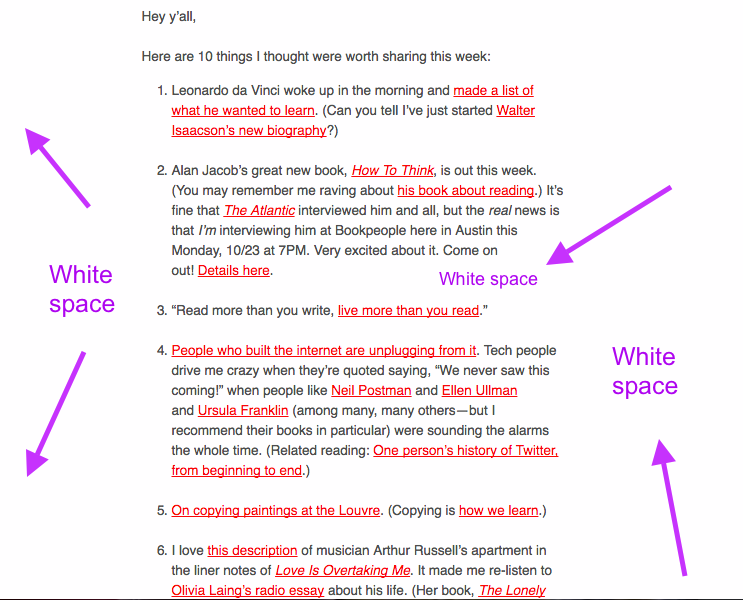
Even Ann’s “giant block of text” is housed in a sea of whitespace so it’s not competing with colors and fonts and buttons and other noise.
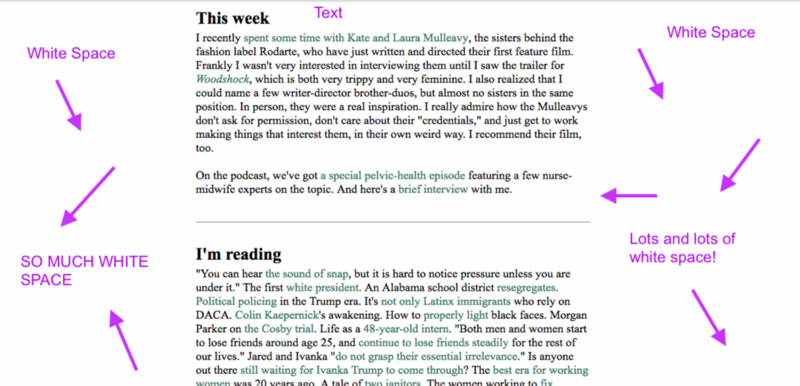
tg-email-10
Same with Austin Kleon’s:

tg-email-11
The banners are visually appealing too, without feeling like you’re getting a Well+Good digest (aka: digital newspaper…that’s a whole ‘nother post).
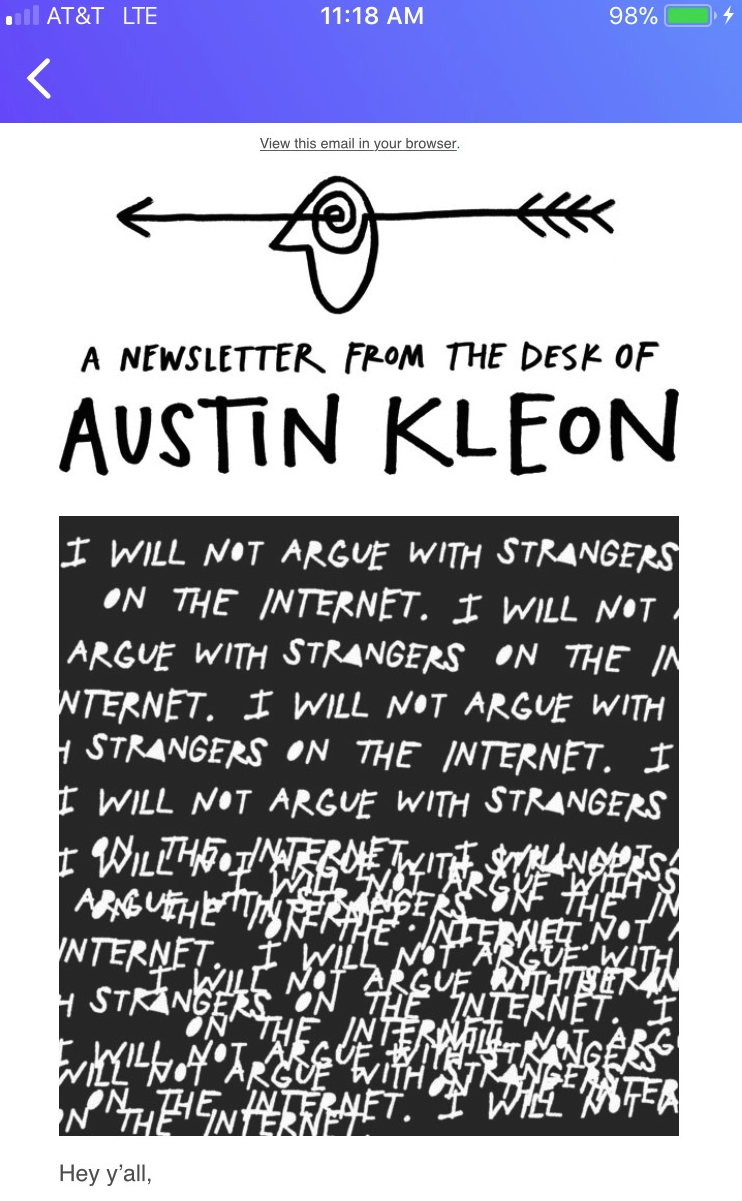
tg-email-12
Luvvie is also clean, despite having a lot more content than the other examples. Her newsletter doesn’t read like a digital newspaper bombarding you with stories. Her formatting is simple and (dare I say it) dated, but her audience doesn’t seem to care.
These newsletters are consistent in that they showcase one content block at a time, making it easier on the reader to skim and get downloaded on the content they’re looking forward too (instead of being visually assaulted). Look how clean this is:
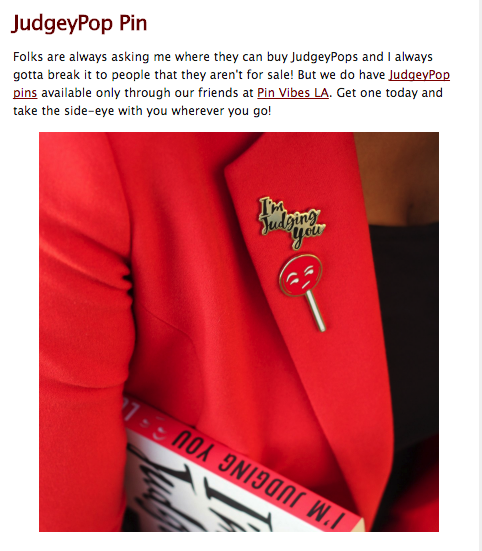
tg-email-13

This isn’t rocket science.

…And yet the majority of marketing departments get it wrong. Newsletters are not a convenient tool for getting your company-specific information to your customers. They are a vehicle for communicating with your audience — just like all email is.
Listen, I’m as shocked as anyone that one-way communication “blasts” are working, but they are. And after closely examining why, it turns out these newsletters aren’t *totally* violating email marketing laws since they’re upholding the important ones:
  • Don’t “throw” offers at people (don’t throw anything at people).
  • Act like a person. Don’t be weird (like overly chipper or too buttoned up).
  • Write to your readers, not your colleagues, your boss, or your phantom Gary Vaynerchuck.
  • Be divisive. Not the in Trump-V-Hilz way, but in the “this is for people like me” or “this is not for people like me” way. It should be clear immediately who your newsletter is for and who it’s not for.
  • Keep doing what works, stop doing what doesn’t.
If we have any chance at clearing the internet (and certainly my inbox) of clutter, than we need to get this right. It’s not rocket science, but it does require some hard work and legitimate caring about your audience (I mean it. None of that pretending crap. Your readers always know).


Thursday, 16 November 2017

Email Newsletter: 7 Best Practices That Marketers Need to Know


All of us think we know how to write a newsletter. What could be simpler? Now think again about how many bland newsletters you see in your inbox everyday. Follow these best practices to send email newsletters your subscribers will actually open and read.

1. Determine if you really need a newsletter.

Ask yourself if you’re doing a newsletter because you have consistently relevant content to share with your audience or if you’re just following what everyone else is doing. If your answer is the first one, then proceed. Make sure, though, that you set clear, measurable objectives. Are you aiming to drive more leads, close more deals, boost retention? Knowing what you want to achieve lets you focus your efforts, set goals, and measure success.

2. Set expectations.

Do subscribers know what they’re signing up for? Be clear up front about what they’ll be receiving from you. Is it an early glance at new products, special coupons and discounts, inspiration, or how-to information? Make sure you’re meeting customer expectations and not bombarding their inboxes with content they didn’t want.
It is also a good idea to say how often they will hear from your brand. Once a week? Once a month? At the least, you should quickly establish a routine cadence with subscribers and stick to it. Your subscribers trusted your brand enough to share their email addresses. Abusing that trust is a good way to land in a spam folder or with high unsubscribe rates.

3. Keep content balanced. 

Unless you’ve set clear expectations otherwise, your newsletter should not be a coupon book. A good rule of thumb for newsletter content is 90% educational and 10% promotional. This allows room for a focused call to action but makes sure that the large majority of content is meant to serve the customer first.

4. Stick to your brand. 

Like all communications you send, your newsletter should adhere to your brand’s standards for design, voice, and tone. Don’t be afraid to have fun, though. Users who subscribe to your newsletter tend to be the ones most engaged with your brand and ready to hear from you.

 5. Think mobile first.

According to Litmus, “Fifty-four percent of email is now opened on a mobile device.” And that number is projected to continue growing. You should be thinking mobile, mobile, mobile. Follow responsive or mobile-optimized practices when designing your newsletter templates. 
This means keeping content limited to fit on a mobile screen. Make sure buttons are large enough to tap. Also, limit image sizes to avoid lagging load times. For more tips on designing mobile-first emails, check out the Email Design Toolkit.

6. Keep your newsletter exclusive.

Your newsletter subscribers are likely some of your most engaged brand fans. Reward them with exclusive or early access content.

7. Test, track, and refine your newsletter.

Keep going back to the goals you set at the beginning. Measure what’s working well and what needs improvement. Are you hitting your goals? If yes, good job. Go ahead and set higher ones. If not, ask why. Then continue tweaking and testing your newsletters until you do.
Done well, email newsletters are a great way to stay connected with your audience and keep them engaged. Get started building exceptional email journeys today.


Sunday, 5 November 2017

Writing a High-Performing Email


 Introduction

Imagine you’ve got a new product or feature you want to tell your subscribers about.

You sit down to create the email campaign, but you have no idea what to write. How do you write a subject line that gets your email opened? And how do you explain your new product to your subscribers in a way that will get them to click-through and buy it?

Writing high performing email campaigns can be a challenge, but it’s critical to your success as a marketer.

So in this guide, we’ll teach you how to write a high-performing email campaign that your subscribers will open and click, and will subsequently drive sales and revenue for your business.


The importance of great writing in your email campaigns

According to research by Microsoft, smartphones have left humans with such a short attention span that even a goldfish can hold a thought for longer.

According to researchers, who surveyed 2000 participants and studied the brain activity of 112 others, the average human attention span has fallen from 12 seconds in 2000, around the time the mobile revolution began, to eight seconds today.

A goldfish is estimated to have a 9 second attention span.

This growth in smartphone usage and the subsequent reduction in attention span has significantly increased the importance of great writing. If you can’t write a great subject line that captures people’s interest, then you’ll never get them to open your campaign. And if you can’t explain your offer quickly and easily, you’ll never get them to click-through and purchase your product.

So how do you write a high performing email campaign that gets opened and clicked?

In the tips below, we’ll walk you through each stage of writing an email, and give you tips and best practices you can put to use in your very next campaign.


5 tips for writing a high-performing email campaign

1. Use a familiar from name

The From name is one of the most prominently displayed elements of your campaign when it arrives in your subscribers inbox.

On many desktop and mobile clients, it’s displayed with a larger text and heavier font to help people quickly identify who the email is from.

Topshop - Familiar From Name
Given its prominence, it’s probably not surprising that 68% of Americans say they base their decision to open an email on the From name.

So how do you optimize this critical part of your campaigns and help boost your open rates into the 30%+ range? The key is matching it up with your audience’s expectations.

For instance, imagine you subscribed to an email newsletter from the BuzzFeed website. Would you expect to receive emails from ‘BuzzFeed’ or from ‘Dan Oshinsky’? Given that you’ve signed up for these emails from the BuzzFeed website, chances are it’s the earlier, even though it’s actually Dan who is creating and sending their campaigns.
Buzzfeed - Familiar From Name
On top of matching the From name to subscribers expectations, it’s also important to consider the number of characters you include in your From Name as many mobile devices have a limit to how many they display.

Device Name Number of Characters Displayed
iPhone 6 32
iPhone 5 23
iPhone 4 23
Samsung Galaxy S4 32  
As you can see, although it varies based on device and screen orientation, keeping your From name under 23 characters will likely mean it will display in full regardless of the device or screen orientation the recipient is using.


2. Write a short, benefit focused subject line

After the From name, the subject line is the second most prominent element in the inbox when it comes to driving opens.

On most devices, the subject line is formatted with darker, heavier text in an attempt to make it stand out among the other details of the email.

Topshop - Focused Email Subject Line
Given its prominence in the inbox, it’s inevitable that it will have a significant effect on open rates. So how should you be optimizing your subject line to drive conversions?

The first thing to consider is length. Although research has shown that the length of subject lines doesn’t have a huge effect on open and click-through rates, it is advisable to keep them under 30 characters long so as to ensure they appear in full on both desktop and mobile devices.

Beyond length, there are a number of power words you can include in your email subject line to help improve open rates. These include:


First word: Open % Change Last word: Open % Change
[firstname,fallback=customer], what’s this? 14.68%
Invitation 9.45% 7.69%
Introducing 7.36%
We 5.87%
A 4.09%
Your/You/You! 4.07% 6.20%
Year, eg. 2014 3.89% 2.84%
Update
3.69%
New 3.26%
Month name, eg. June 3.25% 3.34%
Special/Specials 2.75% 2.08%
News 1.31% 2.22%
Sale/Sale!
2.40%
Events
1.97%
Offer/Offers
1.86%

As you can see from the above table, personalization (represented above by the dynamic tag ‘firstname,fallback=customer’) has the largest positive effect on open rates, while the inclusion of personal pronouns such as ‘Your/You/You’ shows that speaking directly to your subscribers is an effective way to increase open rates.

While it’s great to consider length and include proven power words, it’s important not to over-optimize your email subject lines to try and milk a few extra opens. Tricks like including ‘FWD:’ or ‘Re:’ in your email subject lines may get people to open your campaigns, but when they realize it isn’t a genuine forward or reply they’ll be disappointed and likely not read on and/or click-through, defeating the purpose of sending the campaign.

So make sure that, regardless of what optimizations you make to your email subject line, it’s still an accurate description of the content in your email or your subscribers will be left disappointed upon opening your email and likely not open another campaign from you again.


3. Write compelling preheader text

The preheader is the short summary text that follows the subject line when an email is viewed in the inbox

Birchbox - Compelling Header Text
The pre-header text is a critical component your subscribers use to decide whether or not they open your campaign and engage with your content. So how can you optimize your preheader text for mobile devices?

Given that the preheader text appears next to the email subject line, the two need to work together to tell a cohesive story rather than be thought about as two separate parts of your email campaign.
Derek Halpern does a great job of this in the announcement campaign for his latest webinar.

Derek Halpern - Compelling Header Text

As you can see, the subject line talks to a very specific audience (people who don’t yet have 1,000 subscribers) and while it makes the email super appealing to those people, it does limit its appeal to others.

So he counters this by using the preheader text “Got more than 1000? Open anyway…” to address the other recipients who have more than 1000 subscribers already.

By using the subject line and preheader text together, Halpern makes the email appealing to a wider number of recipients and increases the chance they’ll open the email and click-through.


4. Write simple, compelling body content

With your well-thought-out From name, subject line and preheader text driving opens, it’s time to focus on click-through rates with quality body content.

There seems to be this perception among marketers that good writing is a magical art. As if professional writers know a whole bunch of words everyday marketers don’t that will magically turn prospects into customers.

The truth however, is quite the opposite. Good writing isn’t about using any particular magic words, but about getting your audience to understand your offering and the benefits it brings them in the simplest way possible, as that’s what drives people to purchase.

Take a look at this campaign from Campaign Monitor customer Freshbooks, announcing the launch of their new Fundbox Integration feature:

Freshbooks - Compelling Email Body Content
Freshbooks do a great job of making it crystal clear what the product does and what the benefits are for the user (get cash for unpaid invoices). There’s no jargon or buzzwords, just some simple content that makes it clear what the offer is.

While your product may be different, there are a number of formulas you can use to help you write great email content. The PAS, 4 P’s, and BAB formulas are all easy to follow frameworks that help marketers like you write high performing email campaigns by positioning your product or service as the solution to your customer’s pain points.


5. Optimize your button

The buttons you use in your email marketing campaigns are the final step towards getting someone to click-through from your campaign and visit your website, and the words you choose for them can play a big part in determining whether someone will click-through or not.

But what do you write to ensure your button gets clicked?

The key is to use the button to reinforce the benefit you promised your reader throughout the rest of the email.

A good example of this is the campaign for the premier of one of Showtime’s new television programs, Penny Dreadful.

Instead of using generic button copy, Showtime utilizes the button copy to reinforce the exclusivity of this event by reminding its readers this is not just any television episode – but a season premiere.

Showtime - Optimize CTA Button
Here at Campaign Monitor, we’ve done several A/B tests comparing benefit-focused copy to generic copy and each time the benefit-focused copy has increased click-through rates by about 10%.

On top of using your button copy to reinforce the benefit, it can also help to use it reduce perceived barriers. You can do this by removing friction words.

Friction words are those that imply your reader has to do something they don’t necessarily want to do.

Common friction words include:
  • Download
  • Apply
  • Order
  • Submit
Think about it for a second, nobody wants to spend time downloading or applying for something, they simply want the end benefit downloading or applying for the item brings.

So to reduce the perceived effort of your readers, replace these friction words with frictionless words like ‘Get’ or ‘Learn’ and follow them up with a benefit statement (I.e. Get your free account).

When Michael Aagaard at ContentVerve tested this, he saw a 14.79% increase in conversions just by changing one word.

ContentVerve - Increase Conversions - Optimize CTA Button

In conclusion

The steady growth in smartphone usage and the subsequent reduction in human’s attention span has meant that great writing in your email campaigns is more important than ever.

If you can’t write a killer subject line that captures people’s interest, then you’ll never get them to open your campaign. And if you can’t explain your offer quickly and easily, you’ll never get them to click-through and purchase your product.

So next time you’re creating an email campaign to announce your latest product or feature, use the 5 best practices mentioned above to help you write a high performing email campaigns that gets opened and clicked, and ultimately drives sales & revenue for your business.


Source