Showing posts with label Marketing copy. Show all posts

Sunday, 21 January 2018

How to Write Copy People Notice, Read, and Trust: Lessons from "The World’s Best Copywriter"


The phone rang a couple times before he picked up.
“Hello?”
“Hi,” I said. “Is this Pat Corpora?”
“Yes, it is.”
“It’s Eddie Shleyner,” I said. Silence. “I sent you a message on LinkedIn … about the Sampler. You replied with your number … told me to call.”
In 1995, Pat published The Doctor’s Vest-Pocket Sampler of Natural Remedies, a piece of direct response mail designed to sell a bigger, more complete book called New Choices in Natural Healing.
In other words, the free “sampler” book was designed to garner the attention, engagement, and trust necessary to sell prospect’s on the real product, the money-maker.

Download our free guide here for tips to become a better writer. 

 “Oh!” he said. “Hi, Eddie.” He sounded enthused. I could tell he was a nice guy. “How can I help?”

“Well,” I said. “I’m sure you know, the Sampler is famous.”
Pat smirked. “Okay.”
“At least it is among copywriters,” I said. “That’s why I’m calling: I’m writing an article about the Sampler -- because it’s a master class in written persuasion -- and I want to make sure I get the facts right.”
“Sure.”
“Well, first of all,” I said, “how many did you send out?”
“Oh, I’m sure we mailed 50 million copies,” said Pat. He paused. “Yeah, about that many.” He paused again. “It was a huge number.”
“And how many books did that sell?”
“Oh, millions.”
“Millions?” I said.
Millions. It was our most successful mailer ever.”

How did Pat sell all those books?

He hired Gary Bencivenga to write the copy.


Bencivenga is a Hall of Fame copywriter. He’s on par with John Caples and Eugene Schwartz, David Ogilvy and Joe Sugarman. He knew what he was doing. That is, he knew how to write copy that captured attention, garnered engagement, and drove readers to take action.
Like any effective copywriter, Bencivenga was part writer, part psychologist. As a writer, he was able to produce clear, concise sentences. As a psychologist, he excelled at thinking like his prospect. He understood her, empathized with her. And that’s what this article is about.
It’s about the big-picture concepts you can learn by studying one of Bencivenga’s most successful controls. In other words, this article won’t teach you how to write like a copywriter as much as it’ll teach you how to think like one.
You’ll learn the rules of the trade, the fundamentals of crafting ad copy people notice, read, and trust.

How to write copy people notice, read, and trust.

If you don’t already own The Doctor’s Vest-Pocket Sampler of Natural Remedies, you can buy one on Amazon for a buck or two plus shipping. If you’re a serious student of copywriting, I recommend ordering your copy as soon as possible, reading it daily, and transcribing it often.


When you receive it, smile. You're holding one of the finest direct marketing assets ever created.
What makes it great? It follows three important principles:

1. It hones in on a single, primary desire.

That’s why people notice it in the first place.
People buy things to achieve their desires. Period.
“Every product appeals to two, or three or four of these mass desires,” writes Eugene Schwartz in his classic book, Breakthrough Advertising. “But only one can predominate.”
The Sampler’s target audience was older, likely suffering from an ailment, likely fatigued from the side-effects of conventional medicine, and likely eager for alternatives. Natural alternatives. Bencivenga honed in on this.

How to Hone In

Once you know, with absolute certainty, what it is your prospect desires:
a) Make the desire plainly visible and unmistakably clear.
This will ensure that the prospect sees it.
The Sampler displays the words “NATURAL REMEDIES” in big, bold, capital letters on its cover. In fact, those words appear twice, which brings us to my next point …
b) Repeat the desire over and over, using synonymous terms.
This will keep the prospect engaged without wearing her out on the same verbiage.
The Sampler alludes to the concept of “natural remedies” using many different terms, including “self-help remedies” and “non-surgical remedies” and a half-dozen others. Each is a new and engaging way to remind the prospect about the same thing. Each variation whispers, “This is what you want, Dear Reader. Remember? This is what you need!”
c) Sound realistic.
This will allow the prospect to take your copy seriously.
The Sampler doesn’t over-step its product’s promise. For instance, the word “antidotes” sounds more compelling than “remedies” but it’s also less plausible, which is why Bencivenga never uses it. After all, he’s selling a book with thousands of medical suggestions. They’re not all winners. Reasonable people know this.
If you say something that plants doubt in your prospect’s mind, even once, you might lose her. Fantastic claims are risky because they're hard to believe. Temper your promise to give the message a chance.

2. It doesn’t look like an ad.

That’s why people read it.
The Doctor’s Vest-Pocket Sampler of Natural Remedies doesn't look like a mailer. It looks like a book:
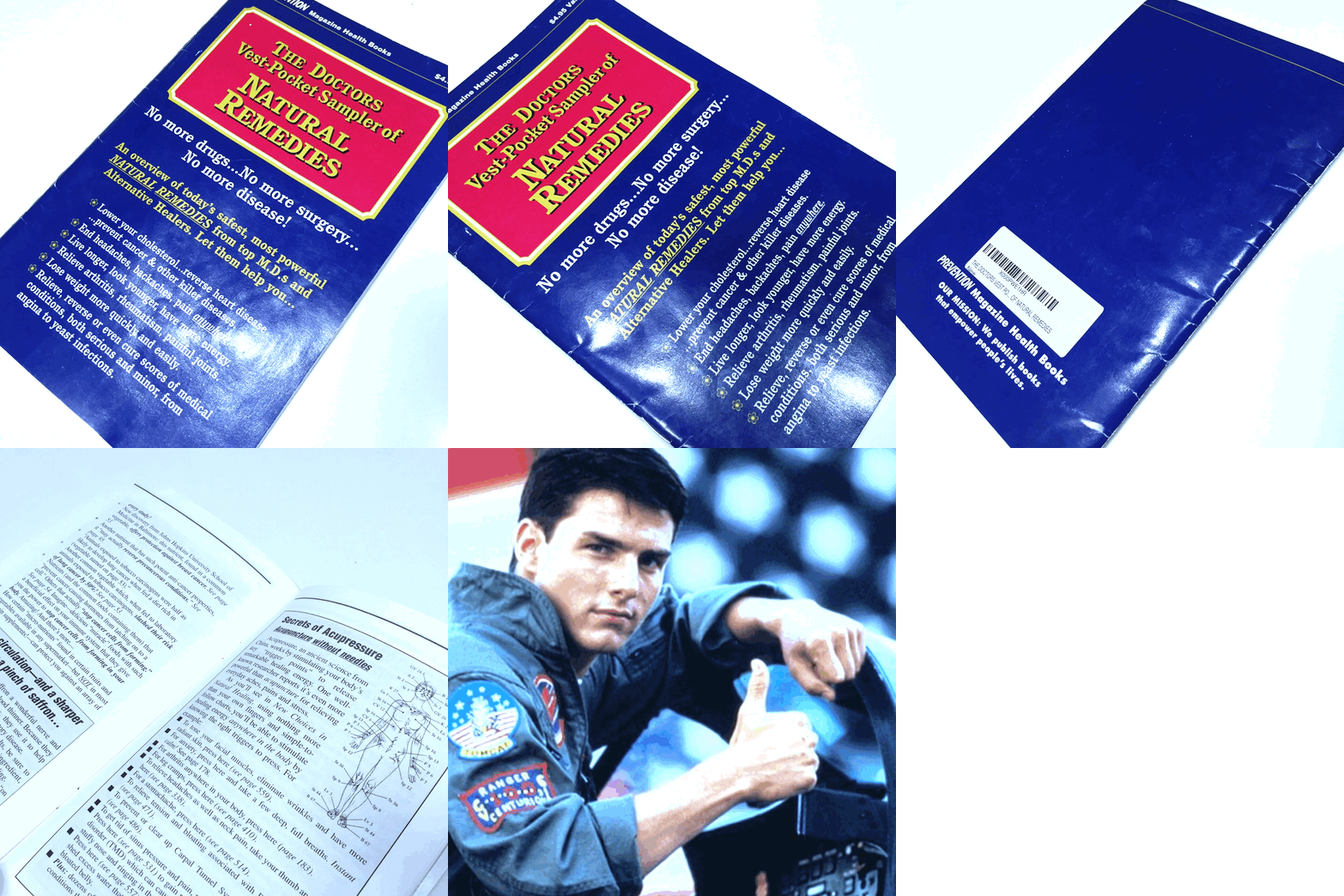


The cover is card stock and paper inside is thick, too. The back is blank, clean, except for the publisher’s mission statement: “We publish books that empower people’s lives.”
The Sampler is also 50 pages long, neatly organized into four enticing chapters:
Chapter 1: Natural Remedies for Whatever Ails You …
Chapter 2: Secret Healing Triggers …
Chapter 3: How to Instantly Get a Second Opinion, or a Third, Fourth, or Tenth!
Chapter 4: For a Lifetime of Greater Health, Try This …
Each chapter is well-formatted and written in plain English that’s scannable and digestible, peppered with bolding and italics that highlight value. Bencivenga gave the Sampler all the characteristics of a real book, which is why Debra-from-Nebraska pulled it from her mailbox, then sat down, put on her glasses, and actually took the time to read it.
“Allow the reader to enter into your ad with the least possible mental shifting of gears from ‘editorial’ to ‘advertisement’,” writes Schwartz. “A single change in format can add 50% to your readership, and your results.” Schwartz calls this concept Copy Camouflage. It refers to taking elements from trusted mediums and using them to lend clout to your ad. This is also known as “borrowed believability.”
Online advertorial articles, or “sponsored” posts, are a good example of this: they look and read like typical articles but have a hidden sales agenda. Bencivenga uses the same tactic, except he camouflaged the Sampler to look and read like a book.

How to Camouflage

Once you know the medium your prospect recognizes, likes, and believes:
a) Borrow the format.
This will help your promotion look familiar to the prospect.
The Sampler looks like a book because it was published before the internet took root (circ. 1995), when physical mediums (e.g., books and newspapers) were among the only recognized, credible sources of written information.
b) Borrow the words and tone.
This will help your copy sound familiar to the prospect.
The Sampler sounds comprehensible, colloquial. It uses simple words -- not medical speak -- to convey clear, concise advice that makes sense to people. And that brings us to the final principle …

3. It’s valuable.

That’s why people trust it.
Bencivenga packed the Sampler with advice that can help people live more comfortable lives:

  • On page 14, he shares a juice recipe that treats asthma.
  • On page 15, he shares a tonic recipe that quells cigarette cravings.
  • On page 16, he shares a cocktail recipe that relieves leg cramps.
In fact, almost every page lends a valuable suggestion, something that makes the reader feel excited about the future, hopeful. Something that makes her say, “Wow, I had no idea ...” Over time, these feelings compound and intensify in the reader, engendering trust.

“Couldn’t it be that if someone took care of you, very good care of you; if this person would do anything for you; if your well-being was his only thought: is it impossible that you might begin to feel something for him?" - Bob Benson, Mad Men

How to Deliver Value

Once you know what your prospect values:
a) Highlight it.
This, again, will ensure that the prospect sees it.
The Sampler is full of bolded, italicized, and underlined words and phrases. It’s full of headlines and subheads, sidebars and images. Remember, people can’t begin to draw value from information if they never even see it.
b) Make it clear and concise.
This will fill the prospect with hope and excitement over her newfound knowledge.
The Sampler uses clear language and short, crisp sentences. Even though it’s a medical book, a native English speaker will comprehend every word. Remember, people will only get value from information they understand.
c) Make it actionable.
This will satisfy the prospect, making her happy.
The Sampler tells readers what to do but also explains how to do it. For example, want to treat asthma? “Blend two ounces of onion juice with two ounces of carrot juice and two ounces of parsley juice, then drink this blend twice each day,” writes Bencivenga. “Of course, use this remedy in conjunction with proper medical treatment.”
Remember, people will get the most value from information they can put to use.

“So, what did working with Gary teach you?” I asked.
“Well,” said Pat, “like many other tests I was involved in, it proved the power and importance of copy.”
I nodded, silently, on the other end.
“When we launched new titles, we always tested two or three different copywriters, “ said Pat. “Sometimes the different approaches were close, within 10 percent. But sometimes, it was a 100 percent difference in response rate. That’s what it was with the Vest-Pocket Sampler. That’s the power of great copy.”


Source

Tuesday, 31 October 2017

How to Write Well: 10 Timeless Rules From Legendary Ad Exec David Ogilvy


Writing is easy. Most people can do it. If you’re reading this, you can write.
But can you write well? Does your writing connect with people? Does it engage readers, compelling them down the page? Does your writing inspire action, selling things or services or ideas?
If so, you have a potent skill at your disposal: you can command attention, a valuable commodity. More importantly, you can influence free will.

Download our free guide here for tips to become a better writer. 


David Ogilvy, the creative force behind Ogilvy & Mather, understood this. He respected the potential of good writing.

The Memo

“The better you write, the higher you will go,” Ogilvy wrote in a memo to his management team. “People who think well, write well.”
The note, drafted in 1982, later appeared in The Unpublished David Ogilvy, a collection of incisive letters and speeches by the man hailed as “The Father of Advertising.”
“Good writing is not a natural gift,” he writes. “You have to learn to write well.”

How to Write Well

He closed out the memo with “10 hints” that anyone could apply to make their writing better.
I’ve transcribed his suggestions below, along with some modern context:

1) "Read the Roman-Raphaelson book on writing. Read it three times."

Full disclosure: Kenneth Roman, Joel Raphaelson, and David Ogilvy were cronies. In fact, Roman served as the agency’s CEO, which explains the front-and-center mention of his book. That said, it’s still a great business-writing resource.
Aside from the knowledge you’ll glean from Writing That Works, reading it over and over and over will acquaint you with the voice, tone, and style of two excellent writers. The more good writing you read, the more good you’ll internalize. The more good you internalize from others, the easier it’ll be to spot and correct the bad in your own writing.

TAKEAWAY: Good writing is the product of prolific reading.

How to read more:
Ryan Holiday, an author and media strategist, offers some advice here: change your mindset.
“Stop thinking of it as some activity that you do,” writes Holiday. “Reading must become as natural as eating and breathing to you. It’s not something you do because you feel like it, but because it’s a reflex, a default.”
Holiday cites three main barriers that keep people from reading:
Time: “Carry a book with you at all times. Every time you get a second, crack it open.”
Money: “Reading is not a luxury … It’s a necessity … Books are an investment.”
Purpose: “The purpose of reading is not just raw knowledge. It’s that it is part of the human experience. It helps you find meaning, understand yourself, and makes your life better.”
If you want to read more, make it a priority.

2) "Write the way you talk. Naturally."

Ogilvy, by all accounts, was down to earth, cool.
“His latest book is called Ogilvy on Advertising. Please welcome, David Ogilvy!” said David Letterman in a 1983 Late Night interview. He reached across the table to shake his guest’s hand. Ogilvy shook back without a word.
“The book is very informative,” said Letterman. “Anyone interested in a career in advertising should certainly do themselves a favor and take a look at that thing.”
Ogilvy broke his silence. “Damn right,” he said.
Ogilvy wrote like he spoke, naturally, which enabled his success as a copywriter.

TAKEAWAY: Good writing is informal.

How to write informally:
Unless you're writing a legal document, feel free to relax your tone. Use:

  • Active voice: “We have noticed that …” vs. “It has been noticed that …”
  • Contractions: “can’t” vs. “can not”
  • Abbreviations: “t.v.” vs. “television”
  • Colloquialisms: “kids” vs. “children”
Informal writing is less cumbersome, easier to read.

3) "Use short words, short sentences and short paragraphs."

Reading is hard, you know. It takes energy and concentration and time, all finite resources.
Dense, long-winded writing that meets the intrinsic needs of the author, rather than the extrinsic needs of the reader, won’t get read. Writing should deliver value, quickly, to the audience. The author’s personal satisfaction is irrelevant.

TAKEAWAY: Good writing gets to the point.

How to write concisely:
Concise writing boils down to:

  • Awareness: your ability to recognize wordiness
  • Discipline: your willingness to cut unnecessary words
These six exercises will help you do both.

4) "Never use jargon words like reconceptualize, demassification, attitudinally, judgmentally. They are hallmarks of a pretentious ass."

It’s true, big words make writers sound snobbish and conceited. What’s worse, they run the risk of confusing the reader, making her feel foolish, detaching her from the message.
As a writer, you have only a small window to capture attention. Don’t narrow it even more by using obscure words.

TAKEAWAY: Good writing is immediately understood.

How to write coherently:
Cut your risk. Use words even a child can understand. For example, instead of:

  • Reconceptualize, write “rethink”
  • Demassification, write “breakup”
  • Attitudinally, write “with attitude”
  • Judgmentally, write “with judgement”
Need help with word choice? Use Hemingway Editor.

5) "Never write more than two pages on any subject."

Take this one with a grain of salt. While “two pages” is subjective, Ogilvy’s point is clear: never write more than is necessary on any subject.
In other words, if you can abridge an explanation without diluting the concept behind it, do it.

TAKEAWAY: Good writing simplifies complicated information.

How to simplify a concept:
The Big Short, an Oscar-winning film about the 2008 housing collapse, was almost never made because the subject matter was too technical for a lay audience. Mortgage bonds; credit default swaps; collateralized debt obligations: all these concepts required explanation …
How did the producers make it work? Cameos and stories.
Anytime a complicated concept was introduced, a celebrity would appear, armed with a quick story. What made these stories so effective and efficient at educating audiences?
Shawn Callahan, founder of Anecdote, cites several key elements

  • Familiarity: The stories were told by famous people, like Selena Gomez, Anthony Bourdain, and Richard Thaler, a renown economist.
  • Plausibility: The stories were credible, thanks to Thaler’s presence.
  • Relatability: The stories took place in recognizable settings, like a casino or a kitchen.
Finally, the stories were metaphorical, drawing parallels between the housing crisis and losing a blackjack hand, for instance.
“If you need to explain something that is complex or highly technical to an audience that might not understand it,” writes Callahan, “then tell them a hypothetical story based on something they do understand, something that’s relatable. And pick someone to deliver the message who is familiar to the audience, someone who is like them and also has credibility.”

6) "Check your quotations."

Take this one literally. As a writer, the information you distribute commands public perception over ideas and events and individuals. It’s a tremendous responsibility.
In the age of self-publishing and Fake News, an author’s integrity is paramount. Check your quotes, your facts. Readers are depending on you, trusting you.

TAKEAWAY: Good writing has integrity.

How to maintain your integrity:
Let your conscience be your guide.

7) "Never send a letter or a memo on the day you write it. Read it aloud the next morning -- and then edit it."

Communication rarely comes out right on the first go, especially when it’s written.
You wouldn’t give a presentation without a dry run, so why send an email or publish an article without an edit? Sure, the writing makes sense to you, the author. But only because you’re so close to it: your perspective is shot.
Distancing yourself from the work is the only way to regain objectivity, ensuring your message makes sense.

TAKEAWAY: Good writing is clear.

How to write clearly:
Richard Lanham, an English professor at the University of California, developed a system called The Paramedic Method. It's designed to help writers clarify their sentences with a simple, two-step process:
STEP ONE: Identify the problems in a sentence.

  • Underline prepositions (e.g., about, to, in, across)
  • Circle forms of the word “be” (e.g., is, am, are, were, was)
  • Box verbs (e.g., run, hide, jump; running, hiding, jumping)
  • Highlight the person or thing performing the action
  • Bracket wind-up explanations
  • Cross out redundancies
STEP TWO: Fix the problems you found.

  • Rewrite or delete unnecessary prepositional phrases
  • Replace forms of “be” with action verbs
  • Put the action in the verb
  • Put the person or thing performing the action into the subject
  • Delete unnecessary wind-up explanations
  • Eliminate redundancies
Lanham’s method streamlines the editing process. For more context and examples, click here.

8) "If it is something important, get a colleague to improve it."

As far as I’m concerned, if your name is on it, it’s important. After all, your writing speaks for you long after you part with it. In that sense, every word counts towards your reputation, your legacy.
With so much on the line, you should have an insurance policy.

TAKEAWAY: Good writing needs an editor.

How to find an editor:
You could ask a coworker to lend a fresh perspective, like Ogilvy suggests. But you have other options, too. It’s not 1982; leverage the internet. Try:

  • Reddit: Post your content in a relevant sub-reddit.
  • Twitter: Tweet your content at a writer you admire.
  • Inbound.org: “When you can’t just tap someone expert on the shoulder, turn to the inbound.org community to help and be helped.”
As long as you're polite, tactful, and appreciative, someone will give you their time. But you have to ask.

9) "Before you send your letter or memo, make sure it is crystal clear what you want the recipient to do."

Business writing, specifically, always needs a goal.
Whether it’s soft (e.g., influencing a general belief) or hard (e.g., driving a specific action), a goal will focus your message, making it more cohesive, not to mention easier to write. Moreover, nobody wants to invest their professional time reading a dead-end message, one that leaves them thinking, What now?

TAKEAWAY: Good (business) writing has purpose.

How to give your writing purpose:
What do you want to accomplish? Do you want to:

  • Inform, driving home the features?
  • Influence, driving home the benefits?
  • Entertain, driving home the brand?
To know for sure, write your call-to-action first. This will give your writing direction, funneling every subhead, paragraph, and sentence towards the same point.

10) "If you want ACTION, don’t write. Go and tell the guy what you want."

In business, nothing is more intimate than a smile and a handshake, a pat on the back. Writing is void of these elements. Even the best writing can’t replicate human interaction, the sensation of being face-to-face.
People are irrational. We like to think we operate logically, but emotions are what ultimately move us. And while reading words can be a powerful experience, nothing replaces eye contact.

TAKEAWAY: Good writing, sometimes, doesn’t work.

How to avoid writing:
Ogilvy said it best: don’t write. Get in front of the person. Get on:

  • Skype
  • FaceTime
  • A plane
And if you’re down the hall from the person, walk to them. They'll appreciate it. And you’ll be in a better position to get what you want.

“Good writing is not a natural gift,” wrote Ogilvy.

“You have to learn to write well.”
Now, you have his advice. The rest is up to you.


Source

Monday, 17 July 2017

How to Be a Copywriting Genius: The Brilliantly Sneaky Trick You Must Learn


Are your readers doing what you want them to do? Are they registering for your free membership site, downloading your ebook, or signing up for your email newsletter?
If not, you need to learn a master craftsman’s copywriting secret.
This technique acts like a remote control to get your readers to take action. Press this “magic button” and you’ll see your results improve dramatically.
The secret, masters-only technique to compelling your readers to act is to …
Ask them.
Annoyed? Think I’m pulling your leg? There’s nothing magical or tricky to getting someone to do something just by asking them, right? That’s completely obvious.
And most copy doesn’t do it.
Which is why most copy gets weak results.

Persuasive writing needs a strong call to action

The advice to “always ask them” has been turned into a heroic-sounding marketing term called the call to action, as if trumpets were sounding and prospects were marching off to war just because you inserted a couple of words at the end of your copy.
The term might sound a little bombastic. But the simple fact is, once you’ve gained your reader’s attention (with a great headline and a strong hook) and presented all the benefits she’ll get by taking the action you want, you still have one more hoop to jump through.

"You need to tell your reader exactly what to do, how to do it, and that you want her to do it right now."

Make it specific

Copywriting master Gary Halbert liked to include seemingly insane levels of detail in his calls to action.
His copy would end with something like, “Call (specific 800 number). You’ll talk with a woman named Robin in a blue sweater who will ask you, ‘Would you like the large size or the jumbo?’ Tell her you want the jumbo. She’ll ask you for your mailing address where you can receive packages, and you’ll give it to her.”
He goes on and on like that for quite some time.
For the beginning copywriter, it feels like a strange, awkward technique that’s going to “look weird.” But for the reader, in the context of taking action that might cost some money, time, or inconvenience, this level of detail creates a solid, comfortable understanding of what to do next and what to expect.

"If you want your reader to take action, use highly specific language with clear, concrete details. Don’t leave any question about what you want to see happen. And don’t be afraid to be a little “too obvious.”

Your readers are not dumb; they’re distracted

As you’re writing, you’ll think you have made yourself stupidly clear. You spent 14 hours on that lengthy article describing your fascinating new product. You followed up with a 12-part series on your blog and an autoresponder sequence of 20 emails.
To you, anyone can see what to do next — your reader should click through to that PayPal button and order your new work of genius.
But the reality isn’t very appealing.
For example, Ron Reader may have found one of your posts (maybe #3 out of that carefully planned series of 12) from a link on Twitter and spent 30 seconds skimming the subheads. He read the first sentence twice because he thought it was funny; then he skipped down and read part of the last paragraph.
Then you got lucky — instead of exiting your post and going back to his Twitter timeline, Ron’s boss came up behind his cube and Ron had to think fast. He brought up a spreadsheet to look like he was working.
An hour later, Ron’s cousin sent him a link to a cute cat video on YouTube, and Ron spent the next 20 minutes surfing videos of dogs drinking beer. Then he wrapped up that really overdue report while eating a bag of Fritos and catching up on email.
Four minutes before he shut down for the day, Ron noticed your post again, so he read your first paragraph and one of the sections that looked kind of interesting.

How to compete for attention … and win

Your readers are not dumb. But they do have a lot of other things competing for their attention.
So no, Ron Reader is not going to know what to do next unless you spell it out with painful clarity — and probably tie a giant red ribbon on it while you’re at it.

"It might be hard to believe, but many hurried and distracted users don’t instantly get that they are supposed to click here. You have to tell them."

Being clear isn’t the same as talking down to your reader

Granddaddy copywriter John Caples wrote about this very point way back in 1932. When you see the word “ad,” substitute “cornerstone content page,” “landing page,” or “online copy.” All persuasive writing is built on the same foundation.

“Don’t make ads simple because you think people are low in intelligence. Some are smart and some are not smart. The point is that people are thinking about other things when they see your ad. Your ad does not get their full attention or intelligence. Your ad gets only a fraction of their intelligence … People won’t study your ad carefully. They can’t be bothered. And so you have to make your ads simple.”
Decide what action you want readers to take. Ask them to take that action. Ask them clearly, succinctly, and unmistakably.
Put at least one unambiguous call to action into every piece of persuasive writing you create. You’ll see results.


Source

Monday, 8 May 2017

The 30 Magic Marketing Words You Should Be Using


Savvy business owners, copywriters, and designers know how language influences emotions and persuades action. Certain words and phrases are time-tested to boost response and conversion rates almost across the board. Of course, different motivating words and phrases work better in different situations, and it’s up to you to figure out which work best for your business. It isn’t all that difficult to figure out, though: If your intuition doesn’t tell you, your customers will. Test the following 30 “magic marketing words” in your next email, social media or blog post, on a direct-mail postcard or website to see which yields the best response.
  1. You – Write as though you’re speaking to the customer and about the customer, not about yourself.
  2. Because – Give customers a reason why they need to take action.
  3. Free – “Because” we all like free things, right?
  4. Value – This implies customers are getting something versus losing something (i.e. money when you say “cost” or “price”).
  5. Guaranteed – Give customers a guarantee to minimize risk perception, so they feel they have everything to gain and nothing to lose.
  6. Amazing – Customers will respond to something that is incredible.
  7. Easy – Make it simple for customers to take the next step in the purchasing process, and let them know how much easier life will be with your product or service.
  8. Discover – This implies there is something new and unknown to the customer, something that has supreme benefits and gives them an edge.
  9. Act now – Motivate an immediate response with a limited-time offer.
  10. Everything included/everything you need – This establishes that your product or service is all your customers will have to buy in order to achieve their goal.
  11. Never – Point out a “negative benefit,” such as “never worry again” or “never overpay again.”
  12. New – Your product or service is the cutting edge in your industry.
  13. Save – The most powerful word to showcase monetary savings, or even time savings.
  14. Proven – Remind customers that your product, service or business is tried-and-true.
  15. Safe and effective – “Proven” to minimize risk perception for health and monetary loss.
  16. Powerful – Let customers know that your business, product or service is robust.
  17. Real results/guaranteed results – Your customers want results, after all.
  18. Secret – Not everyone succeeds, and there are secrets to success. Let customers know you can reveal those secrets.
  19. The – This implies your solution is the “end-all-be-all.” Consider the difference: “3 Solutions for Marketing Success”/”The 3 Solutions for Marketing Success.”
  20. Instant –Instant access or downloads are more appealing than waiting.
  21. How to – Start off with a solution so customers read the rest of your copy.
  22. Elite –Your customers are among the best in the world. Invite newbies to join a highly desirable club.
  23. Premium – Premium helps denote high quality.
  24. Caused by – If your marketing literature builds a case for your product, transitional phrases such as “caused by,” “therefore,” and “thus” can help reinforce the logic of a purchase.
  25. More – Do you offer more than your competitors? Let your customers know, because they want the best deal, after all.
  26. Bargain – Because customers want a great deal, remember?
  27. No obligation – Create a win-win situation for your customers.
  28. 100% money-back guarantee – Again, no risk.
  29. Huge – A large discount or outstanding offer is difficult to resist.
  30. Wealth – If you’re selling products and services related to money, wealth is a desirable word for customers.
They key to success is to combine these words into phrases that trigger buying behavior. For example: “Get real results instantly – 100% money-back guarantee – act now!” Keep your copy short and sweet, play on emotional triggers with these words and phrases, and you’ll increase your conversion and response rates.
Ready to put your copy to action?