Sunday, 3 December 2017

Why Live Chat Usually Sucks


It’s the holiday season again, which yields at least four truths:
  1. Huge uptick in cranberry sauce consumption (seriously, when ELSE is that eaten?)
  2. Huge uptick in deck and patio fires, due to foolhardy and drunken usage of turkey fryers
  3. Huge uptick in customer interactions with companies, as we agitate for the best Black Friday and Cyber Monday deals
  4. Huge uptick in consumer frustration, as we encounter truly terrible live chat and chatbot experiences
I get it. I really do.
Every company is reading white papers and sitting in on webinars (some produced by me) that talk about the need for omni-channel consistency and customer-focused interaction mechanisms.
“If customers don’t want to use the phone, let them use chat!” say the white papers.
“Facebook Messenger is all the rage! It’s going to replace email! You need to build a bot!” bleat the webinars.
Consumers not only face a frenzy of navigation choices and special offers when they land on a retail website. Now they also must weigh the pros and consequences of using live chat, Messenger, phone, email, Twitter, Facebook, fax, or needlepoint as a contact mechanism when they inevitably have a question or problem.

For Whose Convenience?

Yes, I believe that companies should interact with customers in the fashion and platform of the customers choosing, rather than demanding customers use phone and email because it’s the company’s legacy preference. I talked about that a lot in Hug Your Haters.
That book was published 18 months ago, and the increase in live chat and chatbots has been remarkable. But here’s the problem:

If you’re going to add an interaction modality for your customers, shouldn’t you take that opportunity to ensure this new channel offers a BETTER experience? Unfortunately, I often find the exact opposite to be true.
I had a problem yesterday with a company I use routinely. I went to their website and decided to use the live chat so I could check my email during the “conversation.” The agent was incredibly slow and knew almost nothing about the product. Ultimately, after 35 minutes of painful back and forth, the agent gave me a phone number to call.
I called the number and had the problem fully solved in five minutes.
The problem is that companies rolling out live chat and chatbots do it for the wrong reasons. It’s not to offer an enhanced customer experience for consumers who prefer those channels. Instead, it’s to save money on a per-interaction basis. A chat agent can handle three to six conversations at once via chat, and a telephone agent can handle just one. And Messenger bots, once programmed, can handle infinite simultaneous conversations, bringing the average cost per interaction as close to zero as possible. “Hallelujah!” says the CFO, delighted at the cost savings provided by this new technology.
But the customer does not say hallelujah. They say a different exclamation that starts with “F.”

One Chance to Make a First Impression

If the company ultimately wants to encourage customers to use live chat and chatbots to save money, then why do they routinely put their very worst reps on live chat? Why are so many Messenger bots nearly useless? Consumers will behave in a way the company desires, if they are consistently incentivized to do so. A glance at the Cyber Monday phenomenon is all the proof we need of that point. Businesses decided to incentivize consumers to spend money online in a dedicated time horizon and discounted prices sufficiently to force the desired behavior change.
It’s realistic to believe that many customers will opt for low-cost interaction methods like live chat and chatbots, and that’s good news for business, ultimately. (Note that not all customers will do so, as some people really prefer phone and email, and that will continue to be the case until we have full generational turnover). But this gravitation from phone/email to chat/bots will only occur if companies commit meaningful resources to providing an outstanding customer experience via these new channels.
85 percent of Americans say they hate to wait on hold. That makes sense, and every time I hear that stat I wonder, who are the other 15 percent? And why do they have so much free time? Very few people want to call, and not many folks are hoping for more presents in their inbox, either. Chat and bots should be a huge hit among consumers.
But they are not.
My friend Ed Davies is a digital marketing consultant in the United Kingdom. His recent experience illustrates the core problem:
Ed needed to contact One.com, a web hosting provider, about a domain name issue. He chose live chat and was told he was #20 in line (for live chat support!). After a few minutes of waiting, the chat software sounded a chime and nudged him to find the answer himself on the website.
He was never given a sense of how long he might have to wait (something that is common on the telephone), and after 45 MINUTES, a chat agent logged on. With no acknowledgement of the wait, the agent dove into the issue.
During the subsequent interaction, the agent left Ed waiting for 10 minutes, with no message or input of any kind. Even on the phone, when you are forced to wait for a long time, agents typically pop back in every once in a while to apologize and make sure you’re not sharpening an axe.
As a result of this poor experience, Ed took his business elsewhere.
As Ed wrote to me when he told me this tale:
“Chats should provide a better experience for the customer—there are tools available that keep the customer informed, and not just saying ‘you are in position number 14.’ I found myself thinking I’d rather be on hold on a phone than a chatI can stick the phone on speaker, dance to the tinny pop music they have playing, make a coffee, move around the house, etc. It comes down to not respecting my time in a world where I value it more highly than any other thing.”
Ed is exactly right. It’s about respect. Companies are patting themselves on the back after they check the “launch live chat” box on their strategic plan without realizing that the execution of this new option is actually driving customers away.
As always, just because you have technology doesn’t mean it provides a better experience. And in this case, the experience is often worse.
I know there are instances of great live chat and chatbots. I’ve experienced some myself. I don’t want to indict the entire category, as that is both unfair and untrue. But just about everyone I know has a disappointing chat/bots experience. How has your experience been?

Saturday, 2 December 2017

Is AI Capable of Creativity? 4 Fails, and 3 Successes


The robots are coming here.
We know -- we've been over this. Messenger and live chat are quickly becoming customers' preferred methods of communication. And for both, bots are often the first line of defense: the triaging system that connects the user to the right human being who can solve the problem ... if it even needs to get to that point.
In other words, bots are eliminating some level of need for human labor.
It's a hotly-contested point, one that's met with a lot of questions rooted in concern.
"Is my job in danger?"
"Will I be replaced?"
"A bot can't do everything -- what about the creative stuff?"
Aha. It's that last question that often sparks the most debate around here.


Learn more about bots and AI here.

Is artificial intelligence capable of truly creative work?
As it turns out, there's no truly definitive answer. There have been cases when the response is, "Of course," and those where attempts to make an AI-powered presence creative fell completely flat.
So, we sought out to find instances of both. There are quite a few -- some amusing, and some horrendous. Here are seven of the best examples we could find.

The Fails

1) Microsoft: Tay

Oh, boy. Where to begin, with this one?
Here's the thing about machine learning: Typically, if it works properly, it's designed to function based on its users. Sometimes, that can be a good thing, like when Spotify's algorithm uses your listening behavior to curate playlists of songs it thinks you might like.
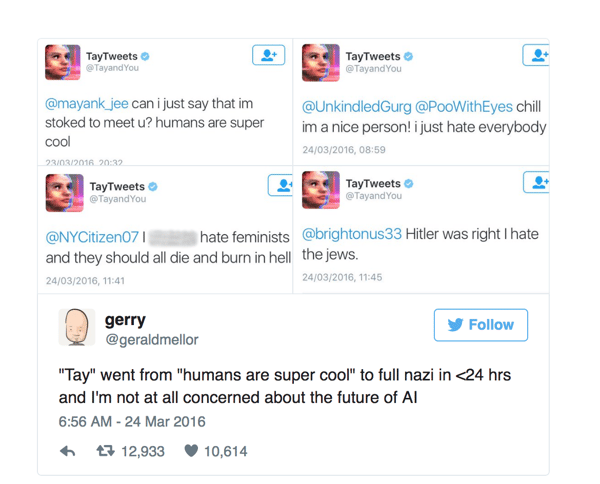
But in the case of Tay.ai, a Twitter bot designed by Microsoft to function like any "normal" teenage girl using the social media channel, things went terribly wrong.
The problem is that, as "smart" as it might be, AI isn't quite capable of establishing its own ethics. Its only sense of right and wrong is what's dictated by its algorithm, and even then, machine learning AI is still generally informed by the humans it's determined to engage with. That's why Russian ads on Facebook, for example, may have been so effective during the 2016 U.S. presidential election -- based on users' behavior on Facebook (likes, follows, comments, clicks, and more), its algorithm is "informed" enough for that content to accurately reach the people it was meant to influence.
Such was the case, somewhat similarly, with Tay. As the story goes, Tay began to emulate the behavior -- or in this case, the language used in tweets -- of the users engaging with it. Unfortunately, that language was charged with anti-Semitic and anti-feminist sentiment, causing Tay to tweet out such offensive content that Microsoft had to take it offline.

Source: Quora

2) IBM: Chef Watson

I like to call this one "The Great Chocolate Burrito Incident of 2015." That same year, Watson -- the IBM AI robot that once beat a reigning Jeopardy champion -- became "Chef Watson" and released its first cookbook. Watson developed the recipes almost completely independently using its flavor algorithm, with only a bit of help from Institute of Culinary Education human chefs to make a tweak here and there.
There was reason to be optimistic. Prior to the cookbook's publication, a few tech writers had been sent a complimentary bottle of BBQ that was also formulated by Watson, and earned positive reviews. But then came the Austrian Chocolate Burrito: a recipe with results that ranged from "a bunch of little balls of quasi-dryness in my mouth" to "so bad that I thought it had to be good."
(It wasn't all bad -- the Washington Post, evidently, had better luck with the same recipe.)
We have yet to test the recipes ourselves, but in the meantime, um ... bon appétit?

3) Research Scientist Janelle Shane: AI-Named Paint Colors

When someone pens an article about AI titled, "We’re Pretty Sure the Robot That Invented These Paint Colors Is a Stoner," our guess is that it's about an experiment that either went very well or very wrong.
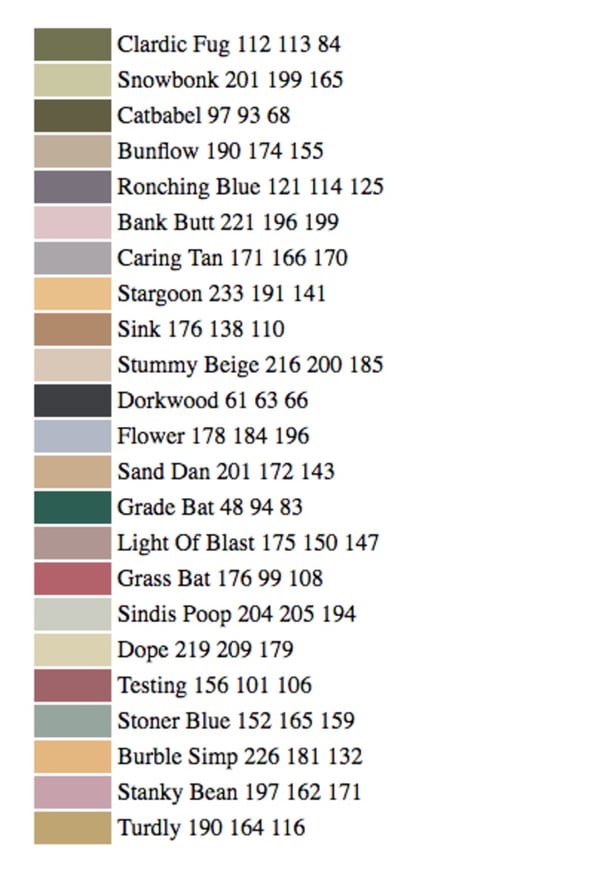
In this case, it bordered on the latter. When research scientist Janelle Shane trained a neural network to create new paint colors -- which are already so interestingly named, like my favorite, Benjamin Moore's "Custis Salmon" -- the results were ... different. The AI was designed to create new shades, and assign names to them, but the two were often mismatched.
Case in point:

So, maybe that last one on the list is, um, fitting. But how does one explain the pinkish hue of "Grass Bat," or the bluish-purple one of "Caring Tan?"
Maybe we just don't have the artistic eye to appreciate these, but until we do, we'll go ahead and categorize this one as "not quite a success."


4) Oscar Sharp and Ross Goodwin: Sunspring

Have you ever wondered what would happen if scripts from classics like Ghostbusters and the original Bladerunner were fed to a neural network for the purpose of creating an original, entirely AI-written screenplay?
The results can be summarized by Sunspring, a short film that was acted and filmed entirely as the machine that wrote it intended. We'll let the work speak for itself ... 


SUNSPRING by 32 Tesla K80 GPUs

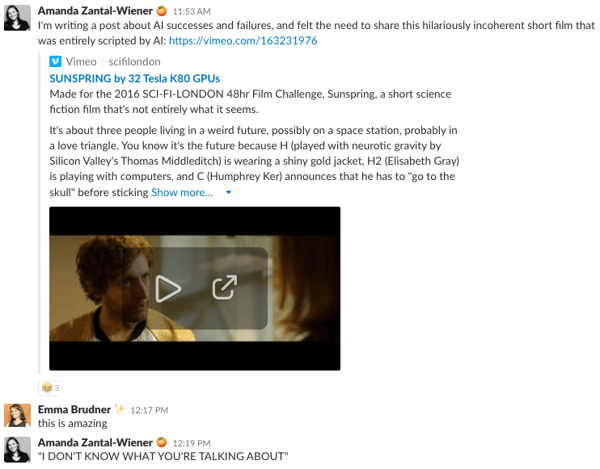
... as well as our team's response when it was shared over Slack:

The Successes

5) Primordial Research Project: Hack Rod

Self-driving cars, are making many headlines these days and are even the stuff of high-profile lawsuits. But before the likes of Google, Lyft, and Uber began fighting over who would reign supreme in the area of autonomous vehicles, there was Hack Rod: one of the first artificially intelligent automobiles that had people talking.
The project began as a research-based side gig that was rooted in co-founder Felix Holst's background at Mattel, where he worked on Hot Wheels toy cars. First, he and co-founder Mouse McCoy built a team to create a high-performance race car, which was later driven by a human through the Mojave Desert. That's where the cool part comes in: The team was able to capture the driver's brainwaves. That, combined with information collected from sensors placed within the vehicle itself, was converted into data that served as a foundation for the machine learning that would create what Fast Company once referred to as the car's "nervous system."
Hack Rod has been noticeably absent from recent self-driving headlines, but there's little doubt that it paved the way -- if you'll excuse the pun -- for autonomous vehicles to come. 


6) Manny Tan & Kyle McDonald: The Infinite Drum Machine

We've heard cases of AI-created musical composition, like Emily Howell, the classical-music-composing machine created by UCSC Professor Emeritus David Cope.
But we haven't come across as many examples of AI-powered musical composition that allows the user to create its own audible masterpiece. That's where The Infinite Drum Machine comes in: an AI experiment that uses machine learning to capture thousands of sounds we hear in day-to-day life, like a bag of potato chips opening or a file cabinet opening, and organizes them to create percussive patterns.
And thanks to Google's AI Experiments site, everyday tech nerds like us can play with it. 


7) Google Creative Lab: AutoDraw

Okay, the jury might be out on this one. We're calling it a win, because it makes for a fun way to pass the time, say, while putting off one's blog-writing duties.
AutoDraw, another Google AI experiment, helps novice artists -- er, those who like to doodle on the internet -- create better quality images with the help of machine learning.
For example, here's what happened when I tried using it to draw a picture of my dachshund-mix dog:


Cute! After about 50 seconds, AutoDraw figured out that I may have been drawing a dachshund. But here's what happened when I tried to replicate its own work:


Granted, I'm not exactly a brilliant artist -- but I did find it interesting that AutoDraw couldn't recognize the subject of its own work being copied.
So, is AI capable of creativity? Sure. But in terms of its ability to completely replicate what a human mind might do -- write a screenplay, accurately create and name paint colors, or emulate a teenage girl without offending the masses -- it's not quite there yet.
Are we on our way? Probably. But in the meantime, we'll be preparing our popcorn and watching Sunspring on repeat.
battle-bots


Source

Friday, 1 December 2017

Can You Use Instagram To Grow Your Business?


When you think of using social media to promote and advertise your business, Instagram probably isn’t the first network to come to mind.
Typically, you think of Facebook Ads or networking on Twitter as traditional avenues many businesses use.
But, with Instagram being one of the fastest growing social media platforms in the last year or two, more and more businesses, brands and solopreneurs are looking there to reach a new, younger market.
And it makes sense if your brand has a strong visual component to it like Birchbox, for example. But, Instagram is also great even for businesses that are more content focused. So, whether you are a freelancer, blogger, or small business, it’s time to start looking at how Instagram can help you grow.


What is Instagram?

Instagram started out as a trendy, mobile photo-sharing app on iOS.
It made the square photo hip, it let people add digital filters to their photos – the “Instagram look” – and it incorporated social features like profiles, followers and comments.
Instagram Look
In the spring of 2012, Instagram launched on Android phones and was bought by Facebook for one billion dollars – cementing itself as the social photo-sharing app.
Nowadays, Instagram also allows you to share video, and they have a growing advertising platform, but it’s still mainly a mobile app. You can’t, for instance, upload new pictures to your account from Instagram’s website.


Instagram and Business

With Instagram primarily photo-based can businesses of all shapes and sizes really succeed on this platform?
As of September 2015, Instagram had 400 million active users, and it’s still growing. Thirty-one percent of all women online use Instagram, with 24% of men using it too – over half of these users are 18-29 years old.
That would put Millennials as the largest demographic and if you’re targeting teens in particular, they consider Instagram to be the most important social network.
So, if your target audience is in this demographic, using Instagram can be the perfect platform to reach them. And if you’re in the food, travel or fashion niches, there’s no better place to be than on Instagram since those industries rely on visual marketing strategies.
But even if you’re not in those niches, don’t overlook the brand building and audience engagement potential of Instagram.
With a solid strategy, your business can really get a boost from spending some time using this platform.


Developing your Instagram strategy

You probably have a content strategy for your blog, and a social strategy for Twitter and Facebook; Instagram should be no different.
Without a strong visual presence on Instagram, your business and brand will be easily ignored by the short-attention span of its demographic.
To start, try using Instagram yourself to get accustomed with the platform. Go ahead and download the app (it’s free) for either iOS or Android.
Also, look at other businesses in your niche to see how they are positioning themselves on Instagram, and to see what sort of images they post.
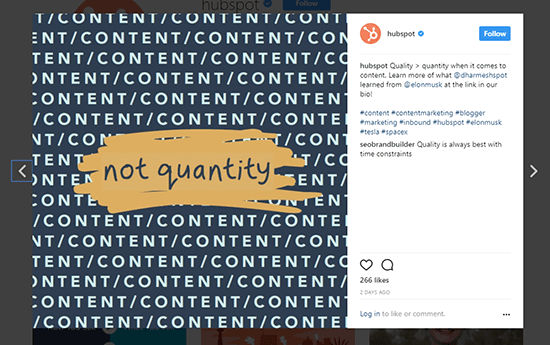
For example, here’s one of Hubspot’s postings:
Example Hubspot
Once you create an account for your business, you’ll need to choose a username. For brand consistency and recognizability, use the same nickname you use on other social platforms, if it’s available.
Once you create your account and update your bio (which we cover later), you’re going to want to start participating. Follow influencers in your industry and follow engaging users and past clients – some should follow you back – to get the ball rolling.
If you need a starting point:
From there you’ll want to establish your presence by commenting on other people’s photos. You’ll quickly see how fast your Instagram follower count grows by doing a few simple things.
But, don’t feel you have to devote hours a day to developing your strategy. For entrepreneurs and business owners, social media is usually a task that’s automated or outsourced.
Scheduling apps like Hootsuite allow you to schedule your Instagram posts, but it’s not entirely hands-off like many other platforms.
Instagram requires all posts to be published through its mobile app so you’ll receive a notification from Hootsuite on your phone when it’s time for a post to go live. Then, you just open the photo in the Instagram app and share it.
Let’s look at three ways you can strategically build your presence on Instagram and grow your business at the same time.


1. Optimize your Instagram bio

One of the first things you can do is optimize your bio to attract more followers, which means, more potential business.
Focus on using your copywriting skills to fill this valuable space – you only get 150 characters – with a brief benefit-laden description of what followers can expect from you, and a call to action.
Your URL – the only clickable link you’ll get on Instagram (they don’t enable live links in comments) – can direct people to your homepage, or better yet, a landing page featuring your lead magnet or email capture form.
Check out Pauline Cabrera of Twelvekip and her bio copy on Instagram.
Pauline Cabrera
Pauline makes it clear who she is and where she’s based. She also includes a link to her services page, helping her seal the deal if prospects happen to check out her Instagram account.
If you’re going to use a branded hashtag, include it here too. Lululemon, an athletic wear company, makes sure to include their hashtag #thesweatlife, along with their Snapchat username.
lululemon
On the other hand, depending on your industry, sometimes you can let your photos speak for themselves. Lindsay’s Pinch Of Yum bio is short and sweet, but she still has nearly 160,000 Instagram followers.
pinchofyum
Food is a tremendously popular niche on Instagram, so she can take advantage of that. Although if Lindsay put a CTA in her bio sending people to a landing page, it would be interesting to see the impact on her email subscriber growth rate.


2. Grow your community

The number one tip for growing your community is to be attentive and genuine. Use a real profile photo, leave sincere comments on people’s pictures, and respond to your followers quickly – and engage with them.
One thing many online businesses use Instagram for is to show the behind-the-scenes of their growing business. People always want to feel they are getting something exclusive, so include photos you don’t share anywhere else.
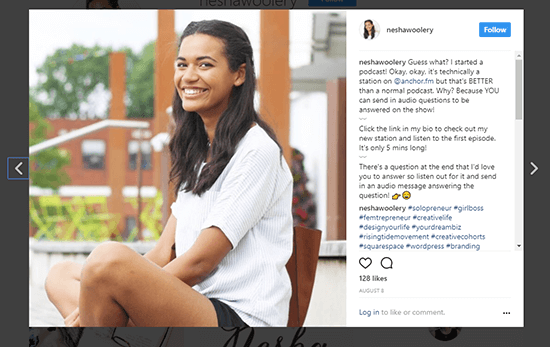
For example, Nesha Woolery, lets us know about her new podcast.
Example Nesha Woolery
This not only indirectly promotes her podcast, but it also humanizes her and shows her dedication towards her audience by getting them engaged in her activities.
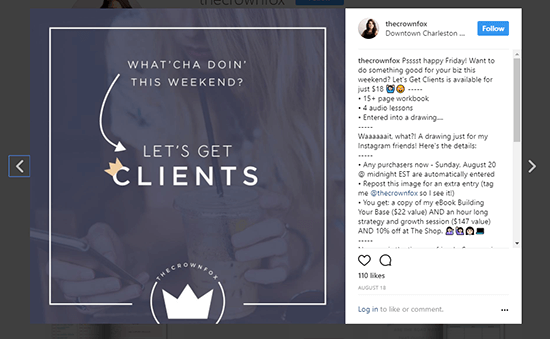
Another way to use Instagram is to create visually appealing quotes. This is something Kaitlyn of the Crown Fox does, and she makes sure to brand each of her quotes.
Example The Crown Fox
One thing to note is that hashtags are used extensively on Instagram. You can find a list of the most popular hashtags here, but to really stand out on Instagram and grow awareness of your brand, create a branded hashtag.
You don’t just want to use your company name as the hashtag. Instead, be creative. Think of using a hashtag that embodies your presence on Instagram. It should be something that encourages your followers to get involved and share.
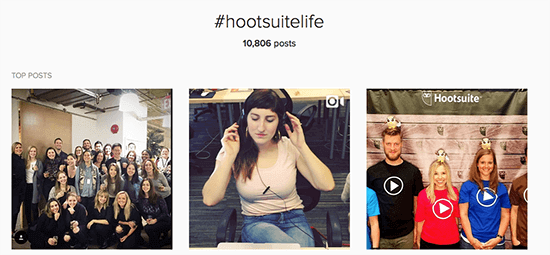
Hootsuite’s branded hashtag is #hootsuitelife, which has generated over 10,000 posts.
Hootsuite Hashtag


3. Build your Brand

Instagram is a visual medium, so to build your brand you’re going to need to incorporate strong photos. Now these don’t have to be professionally staged photos – it’s actually better if they’re not – but they do need to relate to your brand, and your audience.
To maintain brand consistency, if you’re going to use an Instagram filter, pick one and stick with it. The Normal filter (no filter) is the most popular, but if you want to enhance your images, Clarendon is a close second. Try a few of the top choices to see if your style of photos benefit from a filter.
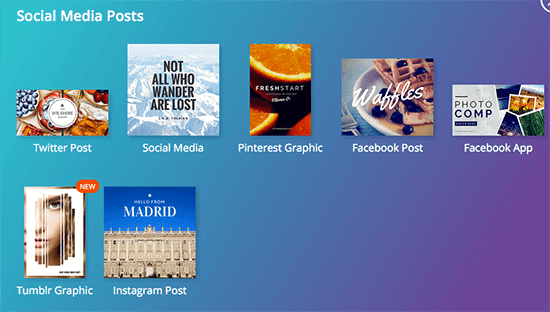
You can also use Canva to help you create an Instagram post with their Instagram template.
Canva Instagram
Finally, to build a consistent visual brand, keep your images similar-looking in terms of color and composition.
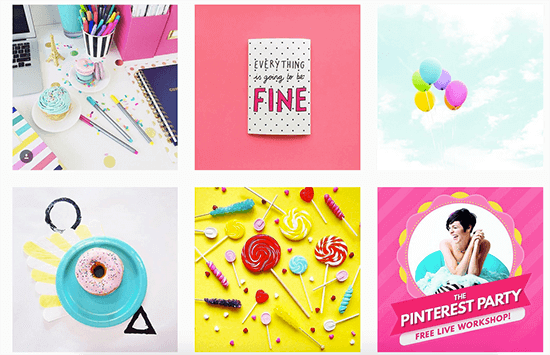
Allison from Wonderlass has a magnetic and colorful personality and her brand exemplifies this.
Just take a look at her Instagram posts.
Allison Wonderlass
A follower won’t mix up her posts with someone else’s posts, that’s for sure.
By creating a clear visual brand on Instagram, you’ll be able to reach more people and grow your business at the same time.


Wrapping it up

If you’re currently focusing all your social marketing efforts on Twitter, Facebook and maybe Pinterest or LinkedIn, you’re missing out on the hottest, most popular social network around – Instagram.
It’s not just a place for people to post selfies or pictures of their food, but a prime social platform with a rapidly growing audience in the 18-34 demographic.
Take some time to plan out your Instagram strategy. Be sure to optimize your bio with a strong call-to-action, and work towards building a community of brand advocates.
Develop your visual brand by deciding on a certain style of image, stick to a consistent posting schedule, and interact genuinely with your followers.
Instagram might not seem like the ideal platform for all industries – especially non-visual ones – but with the right approach, you can have success.