Showing posts with label Goals. Show all posts

Monday, 14 May 2018

5 Questions If You Launching a New Business


Successful entrepreneurs share some common traits. You have definitely heard about many of these. Passion, motivation, self-belief, flexibility, hard work and networking, right?
But there’s one trait which overrides all – ‘’asking the right questions.’’
If you are planning to launch a new business, you have multiple challenges that stare you in the face. At any given point of time, you’re asking yourself whether you should do something or you shouldn’t do something. In fact, there are millions of questions that you face. But only a few of them actually matter, ones that you should really ask yourself to get started right and lead your business in the right direction. You need to know what those questions are.
Given below is a list of five questions that are essential to your success as an entrepreneur.

1. Is my market segment profitable enough?

Before you start to operate your business, you should find out whether that market offers opportunities for making sufficient revenue. On the surface, the market you pick may look like a promising one. But the truth emerges when you dig deeper and explore. Nowadays, most market segments are highly competitive because they have been so saturated.
Do adequate research and make sure that the market you choose will allow you to build a profitable business.

2. What are my target audience demographics?

Your business can’t win them all. To achieve success, you must reach a specific group of people who have a specific need. The challenge for you, as an entrepreneur, is to identify that specific audience.
It requires you to know as much about your target audience as possible. Once you have collected that information, you’ll find yourself in a better position to reach out to them and make a real impact. Start your research by looking at the key demographics of the geographical location that’s on your radar. Study groups of people in terms of their age, gender, income range, marital status, occupation and education among others.

3. What are the needs of my potential customers?

Now, move on to the next vital piece of information: customer needs. Why would people purchase your product or service?
The answer lies in understanding what your customer needs are. If you are going to start a business in health and fitness, you need to find out what your customers care about. Are your customers looking for home-based exercise? Do they have time to attend a gym? Conduct thorough research and connect with friends and colleagues who are conscious about their health and aspire to lead a happy and disease-free life, for insights.
That way, you’ll be able to craft a product which fits in with the actual needs of your customers and marketing will be easier too.

4. Who are my key competitors?

To beat competitors, you need to know and understand competitors. When you start a new business, one of the first things you should ask yourself is what your key five or ten competitors look like.
Find out who your top competitors are so that you can learn from them and improve your own offer. When you keep a close watch, you’ll always be aware of the changes they make to their marketing and advertising, which in turn reveals new processes and strategies. Use different tools for researching content strategies, display ad strategies, ranking strategies etc. It will help you size up the competition really well.

5. What are my business goals?

Be crystal clear about what you want to achieve from your business – both for the short and long term. Not just business goals, you should also take your personal and financial goals into consideration. Knowing your expectations from day one will help you make the right decisions.


Sunday, 28 January 2018

13 of the Best Brands to Follow for Instagram Marketing Inspiration


Instagram has become a critical part of social media marketing, after having acquired a large segment of social media users and an equally impressive amount of brand engagement.
In fact, as of September 2017,
-Instagram had acquired 800 million users, each of whom had followed at least one brand.
-Further, it was discovered that 75% of Instagram users who viewed brand ad posts were influenced to take action.

These encouraging trends, among others, have convinced social media managers from everywhere to include Instagram in their social media marketing. And some social media managers are excelling on the platform.
With a reliable social media management tool, like DrumUp, and the best visual marketing ideas, you can use Instagram to meet important business goals. This post describes how other brands are using Instagram, so you can use them as inspiration to create your Instagram marketing plan.
Here are 13 of the best brands on Instagram, along with descriptions of how they’re using the social media platform for marketing.

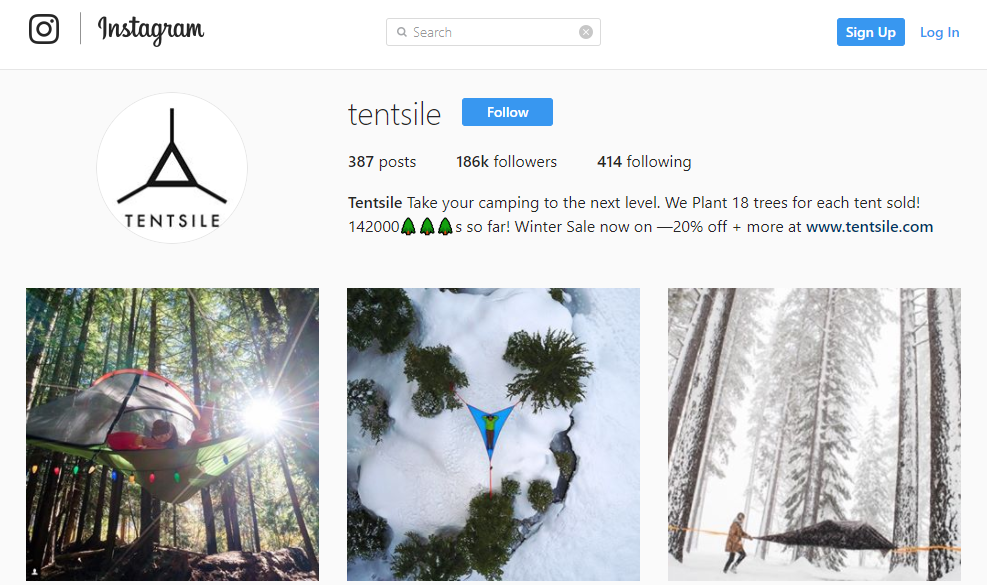
1. Tentsile

1
Tentsile’s Instagram identity is simple, elegant and impressionable. The brand shares beautiful images of their products within the setting of equally scintillating getaway destinations. This, with the brand’s Instagram bio in which it promises to grow 18 trees for every tent sold, make for a page worth following.
Create an Instagram identity that spotlights your main product, creates endless visual possibilities and communicates irresistible experiences.

2. Shake Shack

2
The restaurant industry plays the perfect fit for what Instagram has to offer as a social media marketing platform. Shake Shack proves this point, by using its Instagram account to share tantalising pictures of the burgers and shakes it serves. Shake Shack also gets creative and works humor into its posts from time to time, which is great for getting fans to smile.
Share beautiful, strongly positive pictures of your products regularly, so your fans begin to associate positive emotions with your brand.

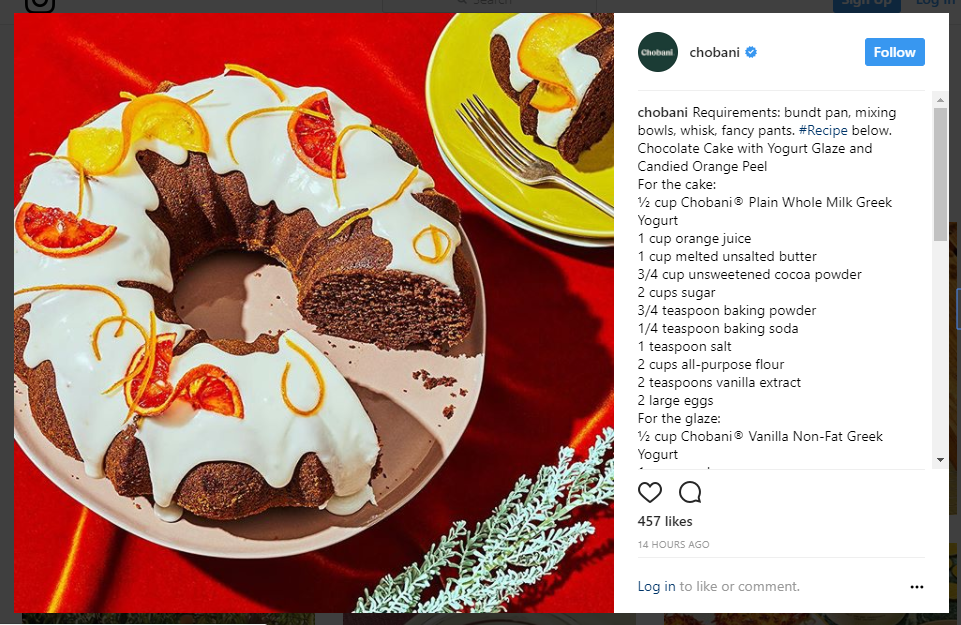
3. Chobani

3
While the food manufacturing industry is very close to the restaurant industry, it can seem like a tougher sell on Instagram, especially when your company is focused on one product. But that shouldn’t limit your marketing possibilities. Chobani, for instance, sells Yoghurt, but the company has turned its Instagram account into a place for family dinners and warm, yummy recipes.
Try and find a visually representable use-case for your product that you can display on Instagram posts. Also focus your Instagram storyline on something that’s important to fans.

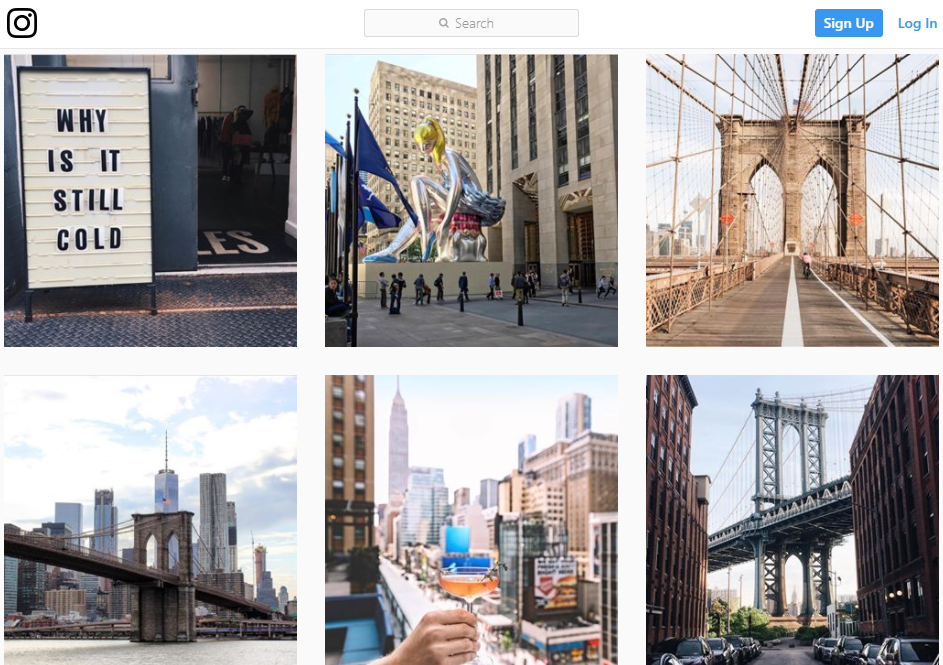
4. No Your City

4
A visual storytelling blog, No Your City has a lot they can do on Instagram. Since the entire blog is based on visuals, the brand has a never-emptying source of visual posts for Instagram. Since the posts are essentially recommendations of beautiful spots to visit or cultural events to take part of in cities, the resulting Instagram posts are naturally engaging.
Try and identify experiences related to your products that you can document and encourage your fans to try.

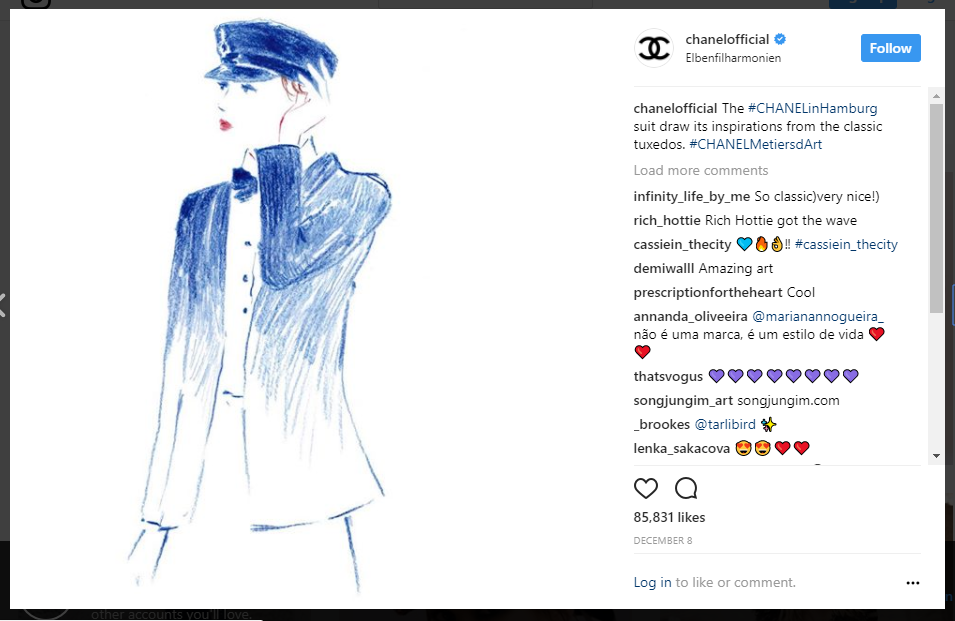
5. Chanel

5
Chanel’s most obvious approach to Instagram marketing would be to post pictures of photoshoots, runway shows and designers. But the brand has extended this list to include so much more. Chanel also shares sketches of new designs, pictures of celebrities wearing the brand’s clothes and lifestyle and experience based ads (videos and GIFs).
Get creative with visuals. You don’t have to limit yourself to product photographs; you can create GIFs and videos to entertain your audience.

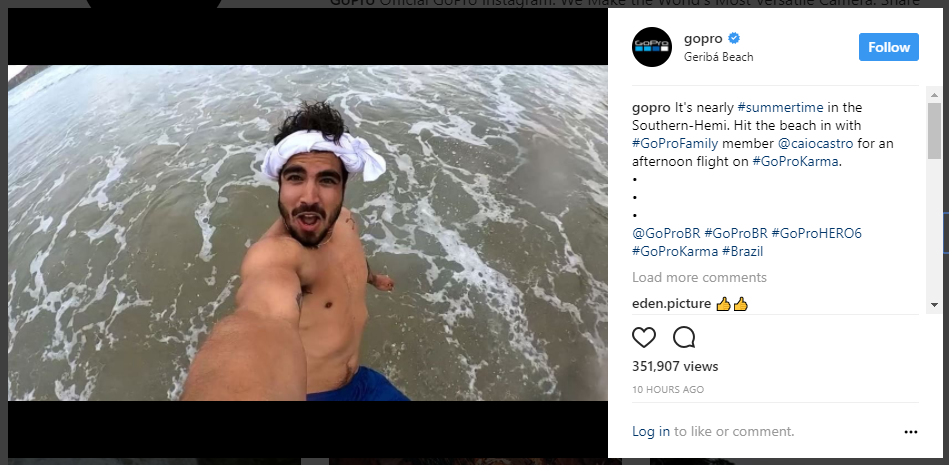
6. GoPro

 7

GoPro’s well known for its social media marketing. Built to help people “capture + share their worlds”, the brand has a pretty straight-forward approach on social media. They collect and share their users’ experiences on Instagram. In general, UGC is a strategy that works well on social media, and GoPo uses wide spaced subject matters, so every viewer feels included.
If there’s a way for you to collect UGC created by or including your product, you can save the costs involved in both creating and marketing content.

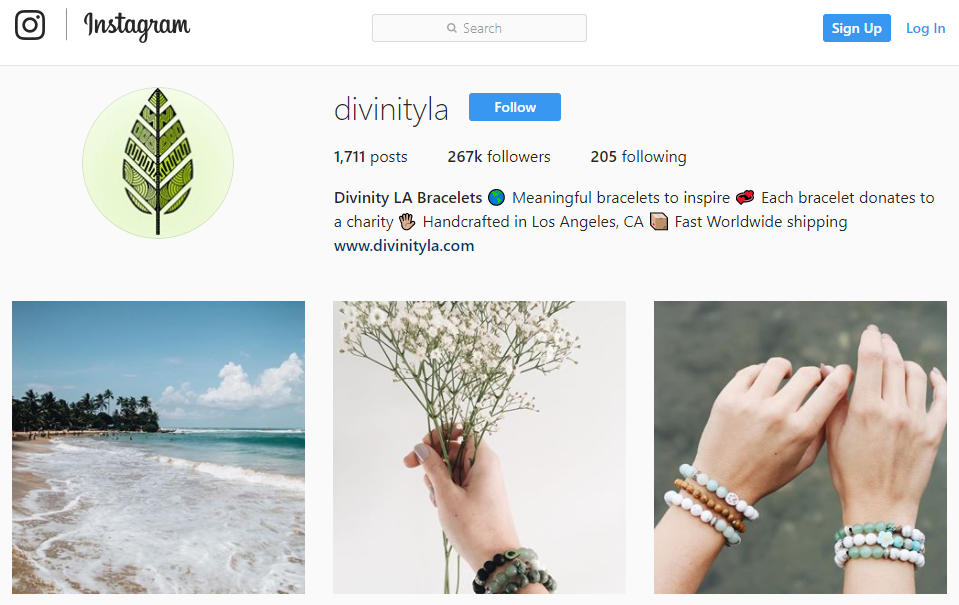
7. Divinity LA Bracelets

6
Divinity LA Bracelets beautifully demonstrates how context can transform your marketing. This brand’s main product is bracelets, and how they showcase bracelets in photographs is amazing. The subject of their posts is never the bracelet itself. It’s the story in the frame, and the bracelet is just one object that’s a part of the frame.
Your products don’t have to be at the centre of every story, as long as they make an appearance in the frame.

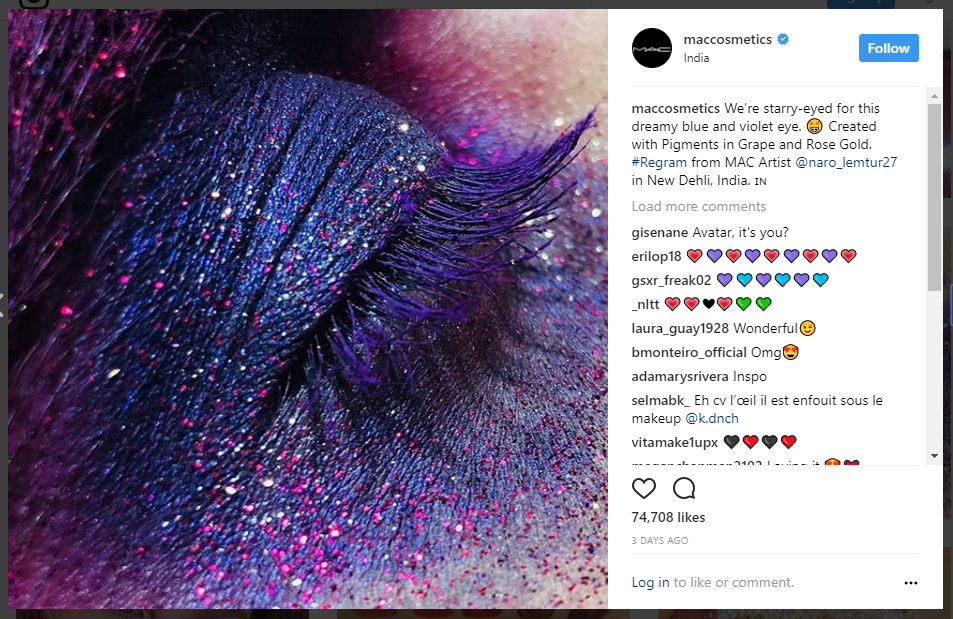
8. MAC Cosmetics

8
Cosmetics brands can simply post pictures of people using their cosmetics, but MAC Cosmetics takes it one step further. The brand posts beautiful close-ups of makeup ideas regularly, emphasizing the endless possibilities that customers have when using the brand. Further, the brand also posts tutorials on how to create the “Look of the day” and buy the guides and cosmetics necessary.
Instagram provides the best platform for selling products, by demonstrating their use and effect. Use this advantage.

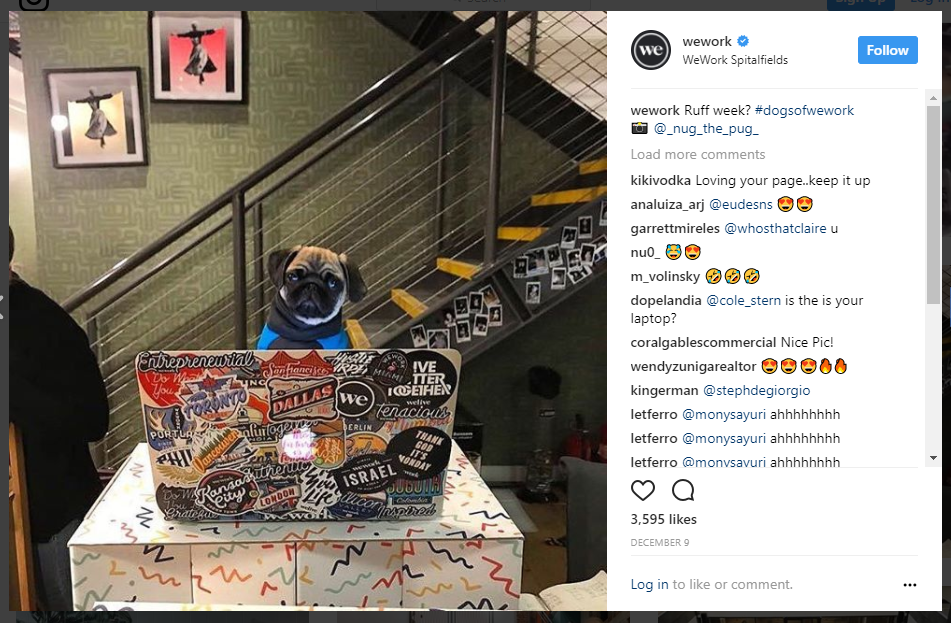
9. We Work

9
We Work is a workspace that shares beautiful work experiences on Instagram. Although all of their works are focused on work, they bring humor, inspiration and positivity to the table. Overall, We Work has projected the image that theirs is a fun place to work, which is likely to attract the startup crowd that wants a place where they can experience that culture.
Talk about the experiences that your target audience cares about. Create posts that resonate with them.

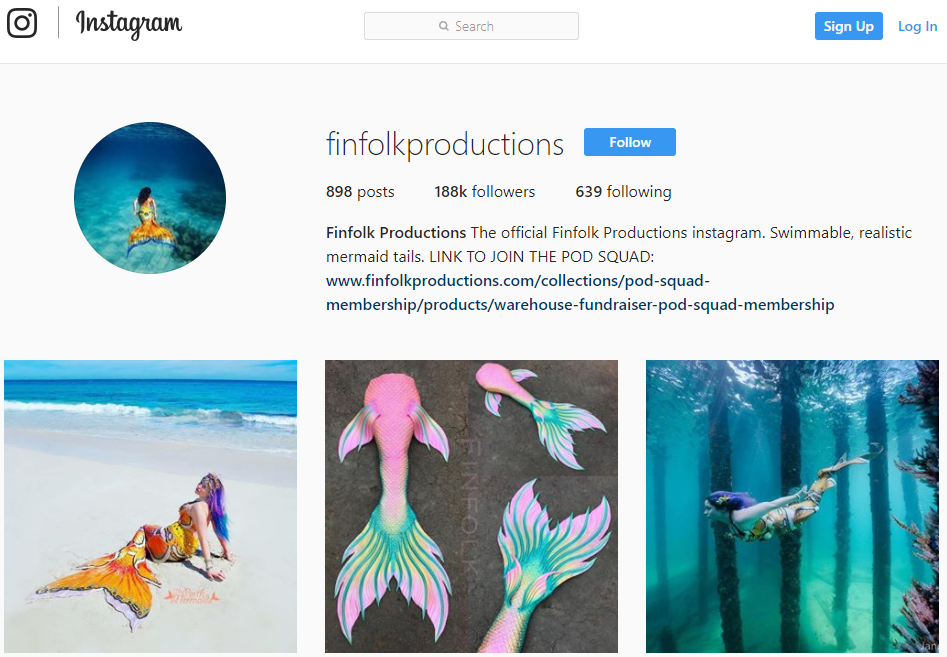
10. Finfolk Productions

10
Colors are a critical part of Instagram marketing. You can make an impression on your audience just by choosing the right colors, and using them consistently across your Instagram posts. Finfolk Productions blue hues are beautiful and prominent in all of their fantasy-focused social media posts.
Choose colors that are representative of your brand and its identity. Focus on what goes best with your products and don’t be afraid to experiment with shades.

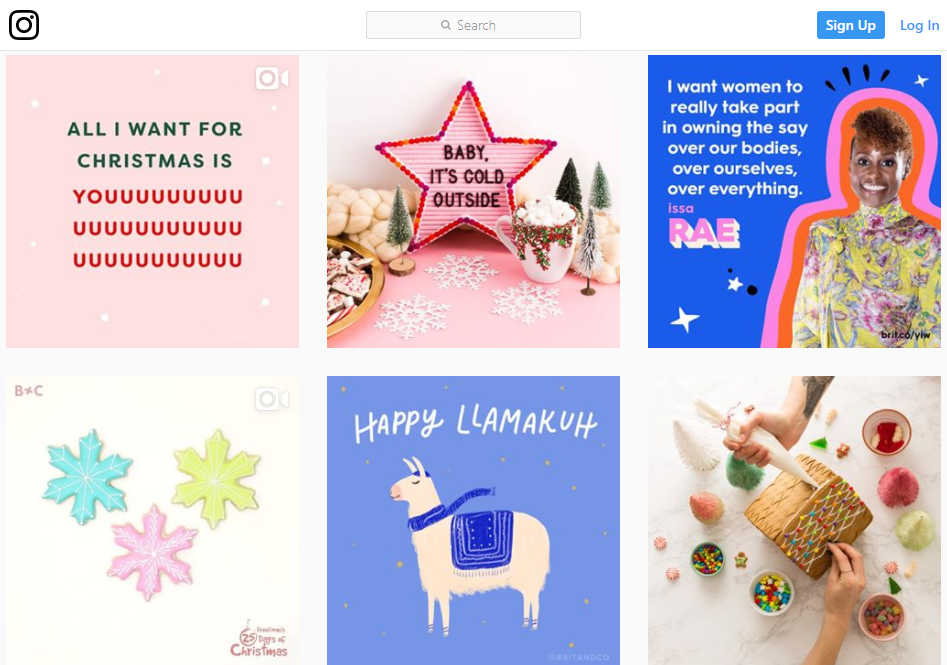
11. Brit + Co

11
Focused on sharing creative ideas for DIY projects, Brit + Co’s Instagram account is visually appealing, informative and highly shareable. The brand shares both video and photograph based DIYs on a regular basis, making themselves indispensable to their target audience, women with a creative spirit.
Visuals can also be used to convey important information, and any brand can use them to establish themselves as subject matter experts. You can even turn blog posts into Instagram posts focusing on the highlights.

12. National Geographic

12
National Geographic is famous for its breathtaking photographs. The brand posts several of these on their Instagram page, featuring their photographers and videographers and reaching new audiences through them. The brand also states facts about the stunning moments posted on their page to help their fans learn about nature.
Simple, high-quality photographs can help you increase engagement when paired with the right text.

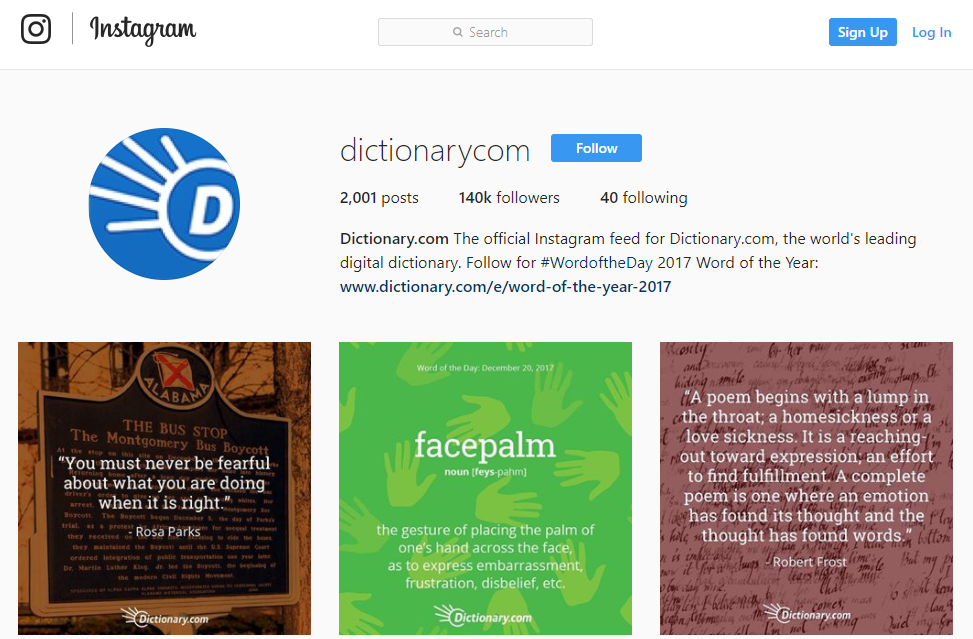
13. Dictionary.com

13
If you thought that simple text on stock images couldn’t attract a large fan following, Dictionary.com would prove you wrong. All of this brand’s posts are simple, visually appealing backgrounds with humorous or informative text on them. The brand not only teaches their fans new words, but also wows them from time to time by sharing the meanings of words that they never thought were “official” dictionary words.
Envision a concept that is enough to wow audiences, so you can get away with just creating simple text based visuals.

Tuesday, 16 January 2018

5 Smart Strategies to be Consistent


 Creating a life and business you love can only be achieved through taking the right and consistent action.
Being consistent is saying what you mean and doing what you say ON A DAILY BASIS: our decisions, conversations, actions, the way we show up in business and in life.
Being consistent is even more important when we face challenges. It’s in these moments that you really have to dig deep and do what you said you would. Life becomes so much easier when you are consistent with yourself, your brand and your business.
Here are 5 strategies I use to be consistent:
1. Know who you are
If you want to be consistent, know what you stand for. Write down your core values and pin them to your wall – or at least at the forefront of your mind! Use them to make decisions or when you feel stuck.  When we are stressed or fearful it’s easy to lose sight of who we really are. Don’t. 2.
2. Consistency is a daily task
It’s easier to change a little every day, than a lot overnight.
It’s like diets: we all know diets don’t work. So instead of going on some crazy diet, do the simple things; consistently. Eat less, exercise more. Eat more greens, less crap.
Never underestimate the power of small consistent actions.
3. Build new habits
A few weeks ago I wrote about “My Morning Ritual”.  Habits are what makes us. I wake up at the same time every day and depending on my schedule, I will either write, meditate or exercise. Then I wake up Jett; prepare breakfast and take Jett to school. I don’t need to think about it; it’s consistency.
When you’re taking up something new or want to succeed in a new venture, make it a habit. If you want to write a book: write a couple of pages every day at the same time. In just three months you could see your first book finished!
4. Consistency is a mindset
80% of success is the mindset and 20% is in the mechanics. When you’re facing a challenge it’s easy to be detracted from your reasons why, your values and goals. However, this is exactly when you MUST keep doing what you know you should be doing!
Get your head into gear and the rest will follow.
5. Always be yourself
You know I’m a fierce advocate of being authentic and true to yourself. I can’t stress enough how important it is to stop worrying about what other people think about you, and just be MORE YOU! 
If you are true to yourself you will appeal to your tribe, not to everyone. If you try to please everyone you will actually end up pleasing no one, least of all yourself. 
If you follow me on Facebook you will know that I not only share the good moments, but also my challenges and dreams.  I even shared my “plan your man” board!
Some people won’t like it when you do this, but that’s OK. I’d rather have a smaller tribe of people who really resonate with me; foibles and all, than an army of people thinking I’m ‘OK’.
Be consistent and you will achieve your goals so much quicker. 
“Be yourself, everyone else is taken”


I’d love to know what being yourself means to you …

Thursday, 4 January 2018

Must Haves for a Social Media Strategy That Gets Results


THE significance of social media is blatantly obvious when you get the facts. According to the Pew Research Center, nearly two-thirds of American adults (65%) use social networking sites.  The average person has five social media accounts and spends around 1 hour and 40 minutes browsing these networks every day. Clearly, social media has a profound impact on people’s lives.


The use of social media has long been recognized by businesses looking to reach new customers.  In order to utilize these platforms to do so, businesses must establish a strategy, which of course, has to align with their overall business plan and company goals.
While every business has different plans and goals, experts agree there are certain characteristics every social media strategy must have in order to be successful and yield great results.

Clearly Defined Goals

The number one requirement for a strategy to be successful?  Clearly defined goals.
Don’t start with a certain social media strategy just to have one.  Instead, think about your business and how you can benefit from social media.
Keep in mind that not all social networks are perfect for each business, nor are you required to be active on all of them.  Choose the ones that are suitable for the type of promotion you want to work on.  For example, if you’re a photographer looking to get hired, using Instagram is surely a part of your strategy.  As an image based platform, it will allow you to display your work and thus demonstrate your skill to potential customers.  On the other hand, if you own a restaurant, Facebook is a platform you just cannot overlook.  This will allow customers to check in, leave a review and share their experience with followers.  In fact, you could even encourage people to do so, by giving out free food or drinks in return for checking in!
Selecting the best social media platform for your business can really help maximize your online exposure.  This is just one way to help clearly define your desired results.  Here are some other specific goals to consider when setting up your social media strategy:
  • Increasing sales
  • Generating more traffic from social media
  • Obtaining leads
  • Expanding the mailing list
  • Improving the influence of your brand
As you can see, obtaining more followers isn’t one of the goals we want to highlight.  There is no actual benefit for your company in this case, except for bragging rights about the number of followers you have.  Realistically, your reach is only important if it helps achieve a tangible, quantifiable goal for your company.  Social Media strategies with clearly defined goals are the ones that help you grow your business.

Valuable Content

If you have spent any time on the topic of social media, you must have come across the statement “Content is the king”.  Most marketing experts stand by this statement for a reason.  Due to the rapid expansion of social media, we have reached a point that there is an excessive amount of information online.  And not everything you find is useful.  In fact, a large percentage of it is junk.  This is why quality content has surfaced as a tool to find and filter out all of those scammers and shady marketers who have flooded the internet.  Content marketing is the answer to those scammers who seek to profit with no effort.
You should know that scamming your way through online marketing is not possible nowadays.  If you want a social media strategy that gets results, you need to invest both your time and your budget into this strategy.  This really comes down to providing quality content.  Sharing useful status updates, posting original images, and recording instructional videos are some of the tactics that will help you.
Content that is high-quality, content that engages, content that gets shared, is ultimately the content that gets conversions.

Consistency

We have all stumbled upon obstacles with social media marketing.  Posting day after day and getting no response can get really frustrating, but you mustn’t give up.  If you are completely serious and really want social media marketing to work, you need to be consistent, even when times get tough.
Establish a schedule for posting and be sure to respond in a timely manner.  Next, think about your approach, because consistency matters here as well.  You can’t go all formal one day, and the next choose to post some lousy jokes, throwing in a few swear words along the way.  This approach is certainly not something a serious marketer would advise, as it won’t generate any results in the long run.  You need to find your own voice, determine the language and a post structure that appeals to your target group and stick with it to be really successful in social media marketing.

Solutions that Work… for YOU

Finally, we get to the analysis of how your company has been performing on social media.  This is an important aspect of the strategy, as you’ll learn a lot about your target group, about your approach, and eventually about your business.  Even though a lot of so-called experts might share tips such as: post every day, post a lot of images, post one promotional update out of five quality ones – in reality, there is no concrete evidence that this will work for you.
You should know that a successful social media marketing strategy is a completely customized solution, based on the type of business, on the product and services it provides, on the target group, etc. This means, that only you, as the one who analyzes the performance of your social media marketing, is qualified to say “this works, and this doesn’t”.
Ask yourself: is your strategy getting you closer to where you want to be?  Is it helping you take your business to the next step?  Is it allowing you to reach your goals?  Once you reach this conclusion, you’ll be able to refine your strategy and maximize the results you obtain through social media marketing.
Take a minute and think about your own strategy.  Does it include these must-haves?  Or maybe it involves others that you see as vital to your success?  If so, fill us in!  We’d love to hear your personal social media strategy must-haves.

Sunday, 31 December 2017

7 Questions to Ask Before Working With a Micro-Influencer


The way we ask for recommendations has evolved.
Whereas once upon a time we may have asked a neighbor to recommend a product or service, 47% of millennials now turn to social media for recommendations and reviews before deciding on a purchase.
But these consumers aren’t always going to the social media accounts of brands. Much of the time, they're visiting the profiles of a special breed of social media personalities: influencers.
Consider this: Close to 40% of Twitter users alone have made a purchase as a result of influencer marketing -- and that's excluding the influence, if you will, of personalities on other channels, like Instagram.

Click here to learn how to grow your network and become an influencer in your industry.


 And when we think of influencers, for many of us, A-list personalities and celebrities come to mind. Take Kylie Jenner, for example, who helped catapult the brand Fashion Nova into a favorite online retail brand.


Sure, celebrities might significantly help boost your sales and achieve your marketing goals. But let’s face it: most of us can't afford their price tags. After all, it’s reported that Kylie Jenner gets $400,000 for a single promotional Instagram post.
The good news is that marketers and startup business owners now have another option that will allow them to tap into the power of influencer marketing without putting their ROI in jeopardy.
This option comes in the form of a unique group of social media users collectively known as micro-influencers.


Why Use Micro-Influencers?

At first, opting to use micro-influencers for your marketing campaign may sound counterintuitive. Would it be more beneficial to tap an influencer with millions of followers, as opposed to getting a micro-influencer with just a few thousand followers?
Not necessarily.
That’s because when it comes to influencer marketing, the level of engagement is more crucial. It is one of the key metrics that will help you gauge the effectiveness of your influencer marketing campaign.
In a study done by Markerly, a converse relationship was discovered between the number of followers an influencer has, and the level of engagement each post gets. In other words, as the number of followers increases, the engagement rate decreases.

Macintosh HD:Users:adeleyuboco:Downloads:Screen-Shot-2016-04-11-at-3.44.27-PM.png
Macintosh HD:Users:adeleyuboco:Downloads:Screen-Shot-2016-04-11-at-3.44.59-PM.png
Source: Markerly

In its own study, Expercity found that micro-influencers not only generate 22.2X more conversion than the average social media user, but that 74% of them are rather direct in encouraging their followers to buy or try a product or service they're endorsing. That communicates credibility and transparency, which can help to build a loyal following.
Cost is another reason why many brands are now turning to micro-influencers. According to a study done by Bloglovin’, 97% of micro-influencers charge $500 and below for a sponsored post on Instagram.

Macintosh HD:Users:adeleyuboco:Downloads:1*SoYJLiz3vcTbEIGL8GTnLg.png
Source: Influence
Additionally, 87% micro-influencers charge $500 and below for a sponsored blog post.

Macintosh HD:Users:adeleyuboco:Downloads:1*Wmgc1Mj6lG-zPqEU_2Gb3w.png
Source: Influence


Finding the Right Micro-Influencer for Your Business

With so many micro-influencers out there, it’s no surprise that 73% of marketers point to finding the right one as one of their biggest challenges.

Macintosh HD:Users:adeleyuboco:Downloads:Screen_Shot_2016-02-22_at_16.01.41.png
Source: Econsultancy
Of course, you can choose to hire an influencer marketing agency to help you find the right micro-influencers for your campaign. But if you want to be more hands-on in finding the right micro-influencer, here are seven questions you’ll need to answer very carefully.

1. What are your goals?

The first thing to consider when finding the right micro-influencer is to look at what you're aiming to achieve. Do you want to generate more leads for your business? If so, look for micro-influencers that frequently host contests or giveaways on their social media accounts -- especially if they involve encouraging their followers to sign up in exchange for free trials, products or access to an exclusive event.

2. Who are the micro-influencer's followers?

When reviewing the followers of the micro-influencer you want to reach, look at to how well they align with your brand's buyer personas. Some of the things to consider are:

  • Where are the majority of the micro-influencers' followers based (geographically)?
  • Are they mostly male or female?
  • Which type of posts resonates with them the most?


3. Is the micro-influencer already a fan?

Working with a micro-influencer that’s already using your product or service has several benefits. For starters, he or she might already be posting about your company and products -- so a partnership is more natural and appears more genuine to followers.
Also, micro-influencers who are fans of your products and brand are more likely negotiate lower fees. Some may even be willing to collaborate with you in exchange for some free products or services.
One way to find these micro-influencers is to perform a general search for blog posts mentioning your brand. Since Google ranks sites based on content quality, there's a good chance that the first two or three results belong to a micro-influencer in your niche.
Another is by using a tool like Gatsby.ai (which has an integration with HubSpot) to your website. Gatsby helps you search through your customer database for micro-influencers that have bought your products, and help you quickly retrieve their information so that you can reach out to them.


4. How engaged is the micro-influencer's audience?

As I mentioned earlier, a micro-influencer’s engagement rate is one of the key metrics that will help you determine the success (or lack of it) of your influencer marketing campaign.
Review the social media accounts of the micro-influencer to see how many likes, comments, and shares each post gets. Although likes are good, I often recommend that my clients focus more on the number of comments and shares a post receives. That's because it requires more effort for a follower to leave a comment on or share a post than it is to click on the like button. Often, followers will only leave comments when they find the post compelling enough for them do so.

5. What kind of content does the micro-influencer produce?

Micro-influencers create their posts based on their own brand and image they want to convey to their followers and compare this against the image you want your audience to associate with your brand. There must be alignment between your perceived brand image the micro-influencer's, in order to ensure that the posts he or she creates for you don't look like a mismatch. Followers tend not to appreciate that -- after all, they follow this micro-influencer for relevant content.

6. Are they working with your competitors?

If you're seriously considering using influencer marketing, there's a chance that your competitors are also doing the same. Take some time to review the posts of the micro-influencers you want to work with, and see if they've worked with any of your direct or indirect competitors.
If so, how did the audience respond to the post? Was there anything mentioned by the micro-influencer about your competitors' products that you can leverage?

7. How many platforms do they use?

Although 80% of micro-influencers point to Instagram as their preferred platform for creating and publishing content, many of them are equally active on their own blogs and in other social media channels. Some even have access to traditional media like TV and magazines. The more platforms a micro-influencer can use to promote your content, the better for you.
Free Guide Influencer in Industry


Source